What ISPM-15 actually requires
ISPM-15 is the international standard governing wood packaging material in cross-border trade. Solid wood packaging — pallets, crates, dunnage — must be heat treated or fumigated and marked with a compliant stamp showing the country code, a facility code and the treatment code.
Corrugated containers are not covered: paper is a processed material and falls outside the standard. The pallet underneath, however, is squarely inside it, and the pallet is what gets your shipment held.
The failure mode is almost always legibility
Inspectors are not usually finding untreated pallets. They are finding treated pallets whose stamps have been worn, painted over, covered by a label, or placed on a board that was later replaced in a repair.
This is why a repaired export pallet needs careful handling: if the stringer carrying the stamp is replaced, the pallet is no longer compliant even though the wood that remains was treated.
Moisture, the quieter problem
An ocean container is a condensation chamber. Warm humid air sealed in at origin condenses on the walls as the ship moves through temperature zones and rains back down on the load — the trade calls it container rain, and it ruins corrugated.
Two defences matter. First, load dry: damp pallets are a significant contributor to the humidity inside the box. Second, use desiccant appropriate to the voyage length, hung rather than laid on the load.
A pre-seal checklist
Five minutes before the doors close is worth a week of correspondence afterwards.
- Every pallet stamp visible and legible — photograph them.
- No repaired boards covering or replacing a stamped member.
- Pallet moisture content checked on a sample.
- Desiccant hung, quantity matched to voyage days and load volume.
- Corrugated dry to the touch and not stored against a dock door overnight.
- Photographs of the loaded container before the doors close, with the seal number visible.
Why corrugated is often the right export container
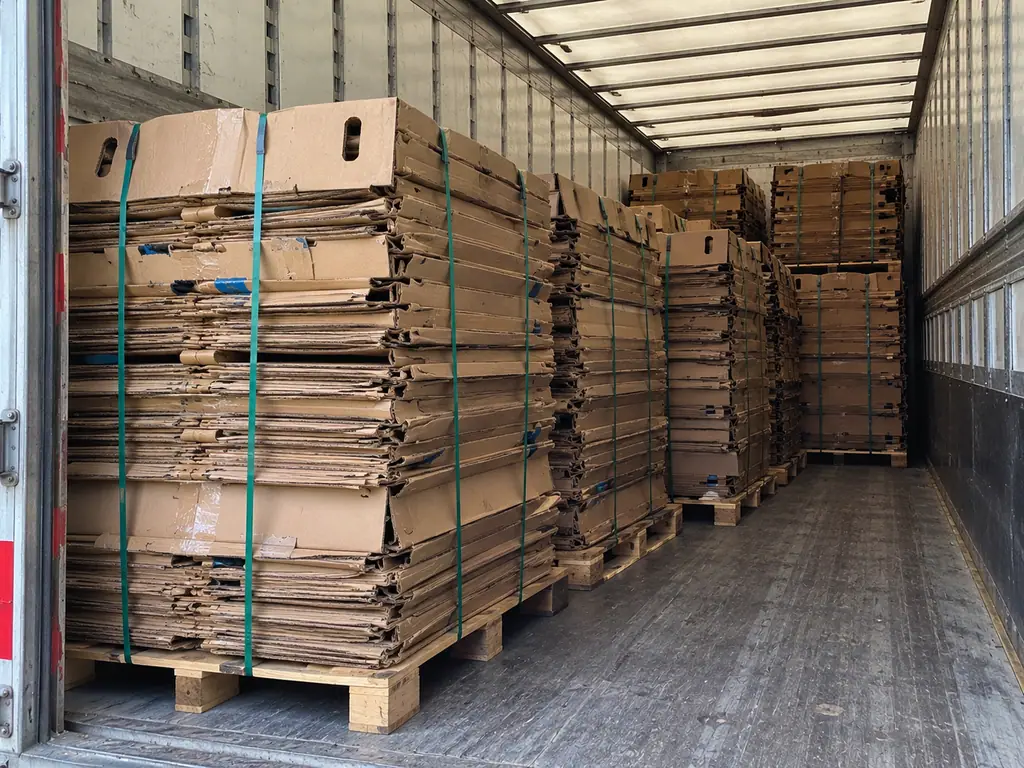
Because it falls outside ISPM-15, a corrugated bulk container removes an entire compliance surface compared with a wooden crate. For many exporters, switching from crates to triple or five-wall corrugated on a treated pallet is both cheaper and simpler at the border.
The trade-off is moisture sensitivity, which is managed rather than eliminated — hence the checklist.
A typical export setup
ISPM-15 heat-treated pallets with legible stamps from certified facilities, moisture checked on export stock, paired with new or Grade A used containers depending on whether your buyer has a cosmetic standard.
Photographs of the stamps, kept with the load documentation, make it much easier to answer a port query quickly.