Logistics · November 21, 2023 · 6 min read

What a 53-Foot Trailer Really Holds

Empty bulk containers are awkward freight: all cube, no weight. Here is how to think about loading them.

At a glance
Quote request
Free, no obligation
Fulfilled by
Partner suppliers
Requests from
Across the US
Pricing
By written quote
Request a quote

Put this to work on your load

Free and no obligation. The form notes which page you were reading, and a partner supplier in our network follows up.

US or Canada numbers only

US ZIP code or Canadian postal code

✳ required. Every field is checked before sending so genuine requests never sit behind spam. Your details are shared with partner suppliers in our network to prepare this quote. See the privacy policy.
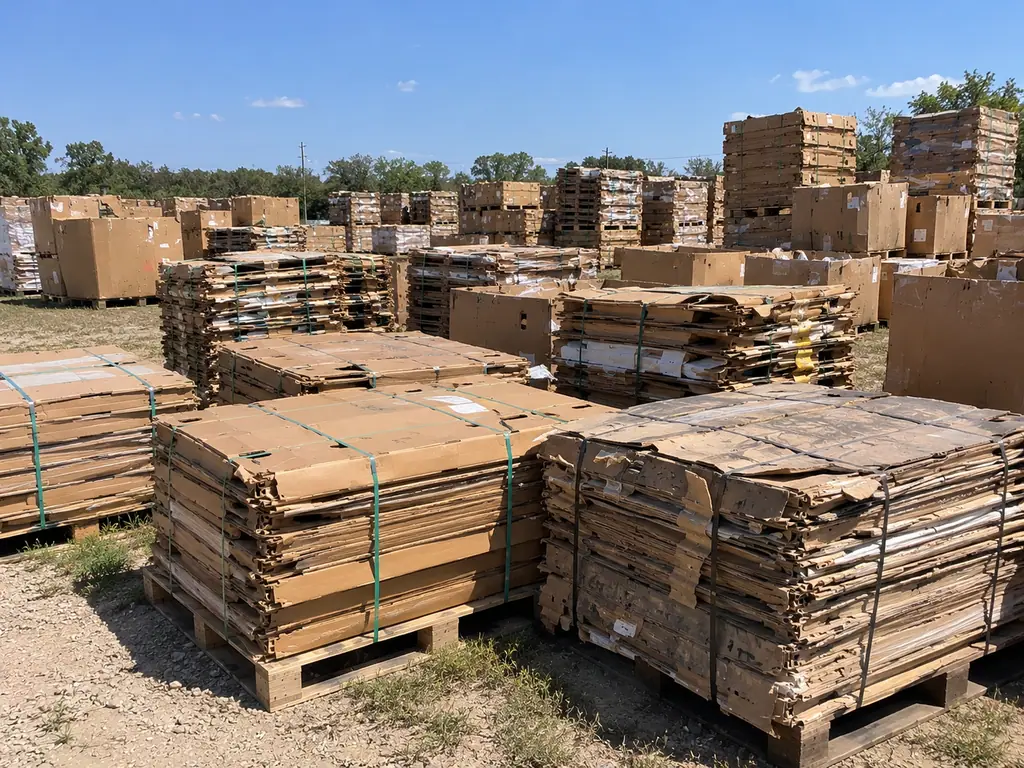
Outdoor storage area with banded pallets of flattened gaylord boxes under a blue skyStorage
Flattened containers on pallets outdoors. Corrugated has little wet strength, so cover it quickly.

The cube problem

A 53-foot dry van gives you a few thousand cubic feet of usable space and a legal payload far beyond what empty containers weigh. Knocked-down gaylords will fill the space long before they approach the weight limit.

This means every freight decision in this business is a volume decision. Rate per mile matters far less than how many units you can physically get through the door.

Rough planning numbers

These are rough planning figures, not a manufacturer's chart. Real loads vary with banding, bundle discipline and how patient the loader is feeling. Ask your supplier for the count on your actual load.

  • Knocked down, triple wall, 48×40 × 36": 400 – 600 units.
  • Knocked down, double wall: 600 – 850 units.
  • Assembled and nested, 36": 180 – 240 units.
  • Assembled, not nested: about 120 units, and never do this if you can avoid it.
  • Banded bundles of 25 on pallets: 24 – 26 pallets, floor loaded.

Why knocked down wins

A knocked-down container takes a fraction of the trailer space of an assembled one. On a long haul, that difference is the gap between a sensible freight cost per unit and a number that makes the whole purchase pointless.

The catch is that knocking down must be done along the original score lines. A container folded across a vertical corner is no longer a container; it is fiber. This is one of the most valuable instructions you can give your receiving team.

The backhaul arithmetic

Because the load is light, carriers price these runs on opportunity cost rather than on fuel. An empty return leg is the real expense, which is why matching a delivery with a collection in the same corridor can matter so much.

When a backhaul match exists, it should show up in the freight line. When none exists, the quote should not price as though one did.

Planning advice that actually helps

Order in trailer-sized increments where storage allows. Half a trailer often costs nearly what a full one does, so the second half is effectively discounted.

Give the dock window early and make it wide. Detention charges can turn a good freight quote into a bad one, and a wide window on a quiet weekday is worth real money compared to a tight one on a Friday.

And if a nearby facility has the same need, say so — consolidating two partial loads into one trailer is one of the easiest savings in the business.

Takeaway: You are buying cube, not weight — plan freight around how many units fit, not what they weigh.
Newer postGaylords in Cold Storage: Condensation, Not Cold, Is the EnemyOlder postHumidity, Gulf Warehouses and the Strength You Quietly Lose
Reference

The tables this post refers to

Construction reference for the figures discussed above.

Construction, thickness and typical working capacity
ConstructionThicknessTypical max weightStackingTypical use
Single wall C5/32" (4.0 mm)65 lbNot for bulkLids, layer pads, dividers
Double wall BC9/32" (7.1 mm)900 – 1,200 lb1 high loadedGeneral bulk under 1,200 lb
Double wall CC5/16" (7.9 mm)1,000 – 1,300 lb1 high loadedSlightly better cushioning than BC
Triple wall BCC7/16" (11.1 mm)2,200 – 2,500 lb2 high loadedThe bulk workhorse
Triple wall ACC1/2" (12.7 mm)2,400 – 2,700 lb2 high loadedDense product with cushioning need
Five wall AAC5/8" (15.9 mm)3,000 lb+3 high, matched palletsCastings, stampings, export
FAQ

Common questions on this subject

Short answers to common questions. If yours is not covered, ask it on the form and a partner supplier in our network can answer it with your quote.

All 33 answers
How much do used gaylords cost?
Pricing is set by the partner supplier who quotes your request. Grade, wall count, height, quantity and freight all move the number, and freight is usually the biggest variable, so ask for it as a separate line.
What areas do you serve?
Gaylord Boxes takes requests from across the United States. Availability depends on partner suppliers near your dock, and freight distance affects the price.
Can you match a competitor's price?
Pricing is set by the partner supplier who quotes your request. When comparing quotes, check that both are graded per unit, both include freight, and both are quoting the same wall count: those three differences explain most gaps.
What size trailer do I need to receive a truckload?
Usually a 53-foot dry van. If your dock cannot take one, say so on the form: smaller deliveries are often possible, though the freight cost per unit rises.
Is fuel included in the freight price?
Ask the supplier to show freight, including any fuel surcharge, as its own line on the quote so you can compare like with like.
Next step

Apply it to your actual containers

One free, no-obligation request. A partner supplier in our network follows up with grade, flute, height and freight.