Boxes that refuse to die quietly.
Request quotes to buy, sell, recycle or move used gaylord boxes: the big corrugated containers that carry bulk freight through American warehouses. Gaylord Boxes matches your request with partner suppliers in our network.
- 01Quote request
- Free, no obligation
- 02Fulfilled by
- Partner suppliers
- 03Order size
- Bundle or truckload
- 04Pricing
- By written quote
A used box is not a compromise. It is the engineering optimum.
Corrugated board loses a share of its compression strength on its first cycle. After that, loss per trip is smaller, so a properly graded used triple-wall gaylord often performs close to how it did on its previous trip.
That is why a graded used container is often the sensible buy: it usually costs less than new and does the same job. Reusing a box also avoids making a new one for that trip. The trick is being honest about where that stops applying.
When a used box is the wrong answer, such as phytosanitary export or a printed compliance panel, you can request a quote for a new one instead.
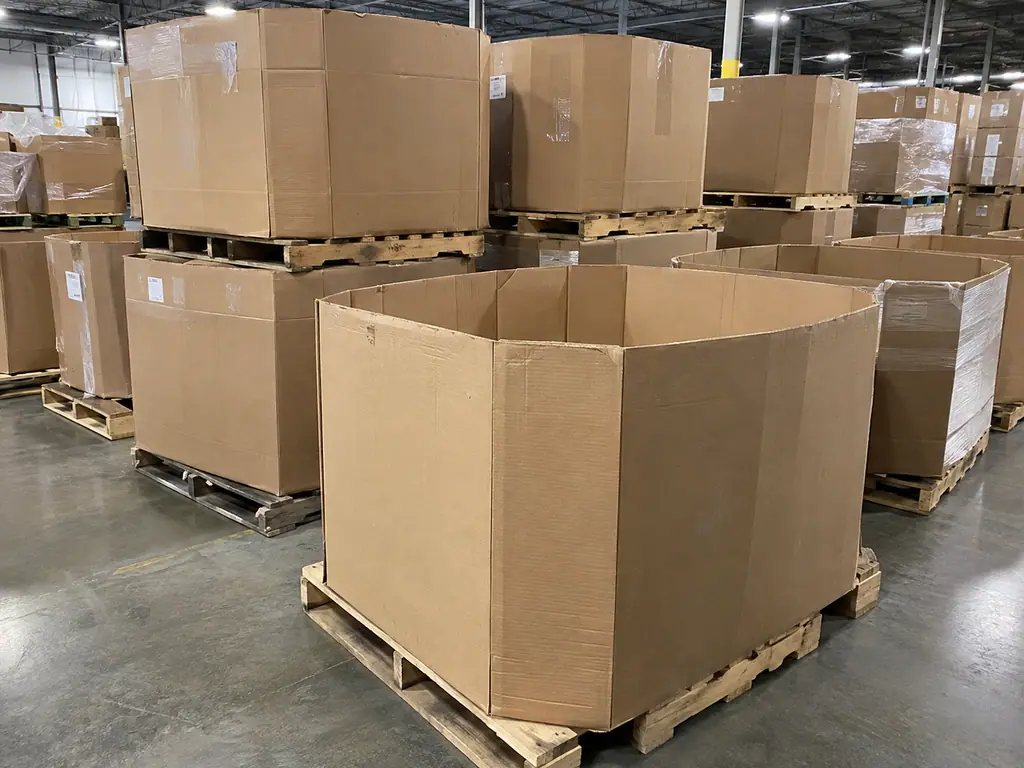 Triple wall
“Moisture and odor first. Corners second. Cosmetics last, and never instead.”
Whichever end of the box's life you are at
Buy, sell, recycle, or arrange pickup and delivery. Each request goes to partner suppliers in our network.
Buy Used Gaylords
Request graded used gaylords by the bundle or the truckload. A partner supplier in our network quotes your load.
Sell Your Gaylords
Turn a dock corner full of empties into an offer from a partner supplier who buys used containers.
Recycling & Baling
Recycling pickup for corrugated that is past reuse, arranged through partner suppliers.
Pickup & Delivery
Delivery of containers and pickup of empties, arranged through partner suppliers and their carriers.
Five families, one fiber stream
Each product page carries a short spec summary: flute combination, wall count, stacking guidance, reuse and fiber. Specify the detail on the quote.
Used Gaylord Boxes
Graded, inspected bulk containers that have already done one job and are ready for several more, supplied through partner suppliers in our network.
Double & triple wallBC / BCCWhen the spec cannot flexNew Gaylord Boxes
New bulk boxes made to your footprint, flute and print through partner suppliers, for the loads where a used box will not do.
Double, triple, five wallBC, CC, BCC, AACEight sides, no dead cornersBulk Bins & Octabins
Octagonal and round fiber bins for free-flowing product such as resin pellets, grain, powders and nuts, supplied through partner suppliers.
Double & triple wallBC / CCThe thing underneath everythingPallets
Recycled GMA, heat-treated export, plastic and presswood pallets, matched to the box riding on top and supplied through partner suppliers.
Stringer or block constructionn/a — timber & polymerThe small parts that decide everythingAccessories
Lids, pallet caps, liners, corner boards, slip sheets and strapping: the parts that keep a bulk load square, supplied through partner suppliers.
Single to triple wallB, C, BC (board parts)Recover, grade, redeploy, recycle
Four stages of a gaylord's working life. Scroll the rail.
Recover
Empties are collected from docks before anyone bales them: produce houses, print shops, mills, 3PLs.
Grade
Good suppliers inspect each unit against a four-grade standard. Moisture and odor first, cosmetics last.
Redeploy
Graded units are sold by the bundle or the truckload and matched to the right pallet.
Recycle
Units past reuse are baled as OCC and go back into the fiber stream as new board.
The dimension most buyers get wrong is height
Footprint comes from your pallet. Height comes from your racking, your reach and your settled product — and choosing it badly costs a rack level or doubles your box count.
| Footprint | Height | Walls | Flute | Capacity | Commonly used for |
|---|---|---|---|---|---|
| 48 × 40 | 36" | Double | BC | 1,200 lb | General bulk, scrap, textiles |
| 48 × 40 | 36" | Triple | BCC | 2,200 lb | Metals, dense scrap, produce |
| 48 × 40 | 40" | Triple | BCC | 2,400 lb | Harvest bins, bakery |
| 48 × 40 | 44" | Triple | BCC | 2,500 lb | Light bulky goods, foam, film |
| 48 × 40 | 28" | Double | BC | 900 lb | Low-clearance racking, retail backroom |
What a full container weighs, and what each grade means
Two tables that settle most specification questions before a quote is even requested.
| Product | Bulk density | Loaded weight | Construction | Notes |
|---|---|---|---|---|
| Mixed apparel, unbaled | 6 – 9 lb/ft³ | 200 – 300 lb | Double wall | Volume-limited. Buy tall, not strong. |
| Loose foam / film | 2 – 5 lb/ft³ | 70 – 170 lb | Double wall | 44 inch bodies pay for themselves here. |
| Cardboard offcuts | 7 – 12 lb/ft³ | 230 – 400 lb | Double wall | Keep dry or the weight is water. |
| Plastic regrind flake | 20 – 30 lb/ft³ | 660 – 1,000 lb | Double / triple | Static — specify antistatic liner. |
| Resin pellets (PE, PP) | 32 – 38 lb/ft³ | 1,050 – 1,250 lb | Triple wall | Octabin preferred above 1,200 lb. |
| PET flake | 22 – 28 lb/ft³ | 730 – 930 lb | Double wall | Abrasive — 5 mil liner minimum. |
| Apples / citrus | 30 – 35 lb/ft³ | 1,000 – 1,150 lb | Triple wall | Field heat and condensation; 40 inch is the produce default. |
| Potatoes / root crops | 38 – 45 lb/ft³ | 1,250 – 1,500 lb | Triple wall | Bottom-layer bruising — use a layer pad. |
| Frozen fruit / vegetable | 35 – 42 lb/ft³ | 1,150 – 1,400 lb | Triple wall | Manage the freezer-to-dock transition before stacking. |
| Grain / seed | 42 – 50 lb/ft³ | 1,400 – 1,650 lb | Triple wall | Octabin or bin — hoop stress matters. |
| Mineral powder | 55 – 75 lb/ft³ | 1,800 – 2,480 lb | Triple / five wall | At the top of what fiber should carry. Check the pallet. |
| Glass cullet | 80 – 95 lb/ft³ | 2,650 lb+ | Five wall | Fill to weight, not to height. Never fill to the top. |
| Metal stampings | 90 – 140 lb/ft³ | Fill by weight | Five wall + V-board | Sharp edges: burst strength and corner protection both matter. |
| Electronic returns, mixed | 10 – 16 lb/ft³ | 330 – 530 lb | Double wall | Mixed-height pools work best here. |
| Books / paper records | 35 – 45 lb/ft³ | 1,150 – 1,500 lb | Triple wall | Dense and deceptive — people routinely overfill. |
| Nuts / dried goods | 28 – 34 lb/ft³ | 930 – 1,120 lb | Triple wall | Gusseted liner, plus eight inches of height. |
| Attribute | Grade A | Grade B | Grade C | Grade D |
|---|---|---|---|---|
| Vertical corners | Square, no repair | Sound, light scuffing | Repaired or trimmed | Failed |
| Bottom flaps | Full strength | Sound, minor wear | One replacement allowed | Dead scores |
| Interior | Clean, no film | Light dust | Visible use | Residue or staining |
| No conflicting marks | Old labels present | Multiple marks | Irrelevant | |
| Squareness | Within 1/8" | Within 3/8" | Visible rack | Out of square |
| Moisture / odour | None | None | None | Disqualifying at any grade |
| Typical use | Food-adjacent, customer-facing | General bulk, reusable pools | Internal staging, scrap | Pads, dividers, OCC |
The twelve-point inspection, in order
What a careful supplier checks on every used unit, and what you can check at receiving. The cheapest rejection happens first, which is why odor and moisture come before anything cosmetic.
Odor
Thirty seconds in open air, nose at the opening.
Any persistent smell — instant rejection.Moisture
Hand and meter at the bottom score line where it hides.
Staining above the bottom score, or any delamination.Vertical corners
Thumb pressure at knee, waist and shoulder height.
Hollow give, shear, or crush longer than four inches.Bottom flaps
Fold test on each flap; the score must hold.
Two or more dead scores sends the unit to cutting.Squareness
Diagonal measurement across the open top.
Over 3/8 inch of rack drops the grade.Interior cleanliness
Visual plus a wipe for residue and dust film.
Grease strike-through, product residue, staining.Pest evidence
Corners, flutes and under the bottom flaps.
Frass, gnaw marks or webbing — rejected outright.Wall thickness
Caliper at two points on a cut edge.
Mislabelled construction should be re-specified before it is quoted.Print & labels
Check for conflicting brands and old spec marks.
Covered, or graded down if legibility matters.Top edge
Fray, crush and compression over the perimeter.
Over a quarter of the perimeter → trim candidate.Previous repair
Tape, V-board inserts, replaced flaps from another life.
Should be declared on the quote, not presented as original.Origin lane
Where the unit came from and what was in it.
Industrial origins never enter the food-adjacent lane.| Period | Supply | Demand | What to do |
|---|---|---|---|
| January – March | High — post-peak returns flood the market | Low | Best buying window of the year. Buy the annual pool if you have storage. |
| April – June | Tightening | Rising with early produce | Plan summer needs now, while supply is still reasonable. |
| July – September | Scarce, especially tall triple wall | Peak | Reserve inventory in June. Sell empties now — they are worth the most. |
| October – November | Moderate | High through retail peak | Confirm freight capacity early; carriers reprice light freight. |
| December | Flood in the last ten days | Falling | Opportunistic buying if you can take a load on short notice. |
Eight ways bulk packaging fails
Damage is evidence. Where it appears tells you whether the problem is the container, the pallet, the aisle or the weather.
| Failure | What it looks like | Cause | Prevention |
|---|---|---|---|
| Strap cut | Crushed line across a vertical corner, half an inch wide. | Polyester strap tensioned over an unprotected edge. | A V-board corner protector under every strap. |
| Forklift shear | Scuff outside, hollow feel inside over a six-inch band. | Lateral contact delaminating liner from medium. | Floor guides at pinch points; operator training. |
| Overhang crush | Failure at the bottom score, two corners only. | Container footprint larger than the pallet deck. | Buy pallet and container on the same quote. |
| Humidity creep | Bulging walls, leaning stack after weeks of storage. | Compression loss above 70% RH compounding under load. | Reduce stack height; one construction up; shorter dwell. |
| Condensation cycling | Soft outer liner after a freezer-to-dock move. | Surface below dew point for twenty minutes. | No stacking for 24 hours after a temperature transition. |
| Liner bridge | Uneven settle, container out of square after filling. | Flat liner bridging the corners under free-flowing product. | Gusseted liner sized to the footprint. |
| Dead score | Bottom flap will not hold its fold. | Repeated knock-down and re-erection, or wrong fold line. | Collapse along original scores only; train receiving. |
| Tine puncture | Paired holes about four inches above the base. | Tines entering at the wrong height on a stacked position. | Position signage and double-stack rules. |
| Construction | Thickness | Typical max weight | Stacking | Typical use |
|---|---|---|---|---|
| Single wall C | 5/32" (4.0 mm) | 65 lb | Not for bulk | Lids, layer pads, dividers |
| Double wall BC | 9/32" (7.1 mm) | 900 – 1,200 lb | 1 high loaded | General bulk under 1,200 lb |
| Double wall CC | 5/16" (7.9 mm) | 1,000 – 1,300 lb | 1 high loaded | Slightly better cushioning than BC |
| Triple wall BCC | 7/16" (11.1 mm) | 2,200 – 2,500 lb | 2 high loaded | The bulk workhorse |
| Triple wall ACC | 1/2" (12.7 mm) | 2,400 – 2,700 lb | 2 high loaded | Dense product with cushioning need |
| Five wall AAC | 5/8" (15.9 mm) | 3,000 lb+ | 3 high, matched pallets | Castings, stampings, export |
| Height | Cube | Fits | Best for | Watch for |
|---|---|---|---|---|
| 28" | 25.9 ft³ | Low-clearance racking, pick faces | Dense product, ergonomic sorting | Doubles your container count on light goods |
| 36" | 33.3 ft³ | Most standard racking | The default — best price and availability | Check reach height if hand-loaded |
| 40" | 37.0 ft³ | Cooler racks, harvest lines | Produce, bakery, mixed DC | Top-edge wear climbs with reach |
| 44" | 40.7 ft³ | Tall bays, textile sorting | Light bulky goods — foam, film, apparel | Hand-loading above 44" is uncomfortable |
| 48" | 44.4 ft³ | Dedicated tall programs | Very light, very bulky loads | Triple wall only; never stack loaded |
| Measure | Imperial | Metric | Notes |
|---|---|---|---|
| Standard footprint | 48 × 40 in | 1,219 × 1,016 mm | The GMA pallet that standardised US distribution. |
| Triple wall thickness | 7/16 in | 11.1 mm | Takes about 7/8 in off interior width across both walls. |
| Typical capacity | 2,200 lb | 998 kg | Triple wall BCC, evenly distributed, matched pallet. |
| Container cube at 36" | 33.3 ft³ | 0.943 m³ | Outside dimensions, before board thickness. |
| OCC bale | 1,000 – 1,400 lb | 454 – 635 kg | Typical bale from a horizontal baler. |
| Trailer capacity, knocked down | 400 – 600 units | — | 53-foot dry van; cube limited, never weight limited. |
| Moisture ceiling for OCC | 12% | 12% | Above this you are selling water at a penalty. |
Four industries, four different definitions of “strong enough”
Food & Beverage
Containers for food plants, where origin, odor and moisture matter more than anywhere else.
Open →Textiles & Apparel
High-volume, low-density sorting where height and reuse count matter more than crush rating.
Open →E-commerce & 3PL
Returns processing, bulk consolidation and reverse logistics on a predictable replenishment cycle.
Open →Manufacturing & Industrial
Dense parts, sharp edges and work-in-process staging that punish ordinary packaging.
Open →Guides, written down
Grading standards, sizing logic, stacking strength, liner selection, dock-level selling advice. No gated PDFs.
What Is a Gaylord Box, Really?
The container named after a Michigan paper company that became the standard bulk box of American warehouses.
Buying Guide · 6 minHow Used Gaylords Are Graded
A, B, C and D are not vibes. Here is what a careful grader looks at, in what order, and what gets rejected outright.
Sizing · 8 minGaylord Box Sizes Explained
Why 48×40 dominates, when 40×40 is smarter, and how to choose a height that fits your racking rather than your habit.
Twelve common, expensive mistakes
None of these are exotic. All of them are expensive, and most cost nothing to fix.
| Mistake | What it costs | The fix |
|---|---|---|
| One container specification for every load | Paying for strength and cube most loads never use | Weigh ten loaded containers and split the spec by weight band. |
| Buying new where used performs identically | A higher unit price for the same job | Trial a small batch of graded used units against your worst load. |
| Paying to dispose of sellable empties | Disposal fees on material that could be sold | Collapse along the scores, store indoors, and ask for an offer. |
| Mismatched pallet footprint | Damage claims plus a lost rack level | Buy pallet and container on the same quote. |
| Skipping corner protection on strapped loads | Premature failure of otherwise sound units | V-board under every strap that crosses an edge. |
| Specifying height from habit | Wasted cube and a higher unit price | Measure settled product height and clear rack height. |
| Liner cut flush to the container | Contamination and rework | Interior height plus eight inches, twelve if twist-tied. |
| Flattening containers across the corner | A resellable container becomes recycling | One laminated card at the unload station. |
| Storing empties outdoors over winter | The entire value of the stack | Indoors, off the floor, or more frequent collection. |
| Accepting per-lot grading | Unpredictable receiving and disputes | Ask whether grading is per unit, and what the reject rate is. |
| Comparing unit prices instead of cost per trip | Misdirects every other decision | Divide total annual packaging cost by trips delivered. |
| Buying the annual pool at the seasonal peak | Paying peak prices for stock you could have bought earlier | Shift the buy into the post-peak window where storage allows. |
Related reading
How Used Gaylords Are Graded
A, B, C and D are not vibes. Here is what a careful grader looks at, in what order, and what gets rejected outright.
Read →Gaylord Box Sizes Explained
Why 48×40 dominates, when 40×40 is smarter, and how to choose a height that fits your racking rather than your habit.
Read →Choosing Liners for Bulk Boxes
Gauge, gusset, grade and antistatic: the four decisions behind a small part that prevents big failures.
Read →What Is a Gaylord Box, Really?
The container named after a Michigan paper company that became the standard bulk box of American warehouses.
Read →Asked constantly
Your request goes to a partner supplier in our network, who replies in writing.
What exactly is a gaylord box?
Are used gaylord boxes strong enough?
How much do used gaylords cost?
What is the minimum order?
Can I sell my used boxes?
Can used containers be used for food?
What areas do you serve?
How fast can I get containers?
Can boxes be cut to a custom height?
What happens to boxes that fail grading?
Send a load description. Get a real answer.
One form and a free, no-obligation quote request. A partner supplier in our network follows up in writing.