Five families. One fiber stream.
Every family here has a short spec summary: flute combination, wall count, stacking guidance, reuse and fiber. Quotes come from partner suppliers in our network.
- 01Quote request
- Free, no obligation
- 02Fulfilled by
- Partner suppliers
- 03Requests from
- Across the US
- 04Pricing
- By written quote
Pick the family, then specify the detail on the quote
Nobody should have to guess a flute combination off a web page. Choose the family that matches your load and ask for the exact construction on the quote.
Used Gaylord Boxes
Graded, inspected bulk containers that have already done one job and are ready for several more, supplied through partner suppliers in our network.
Double & triple wallBC / BCCWhen the spec cannot flexNew Gaylord Boxes
New bulk boxes made to your footprint, flute and print through partner suppliers, for the loads where a used box will not do.
Double, triple, five wallBC, CC, BCC, AACEight sides, no dead cornersBulk Bins & Octabins
Octagonal and round fiber bins for free-flowing product such as resin pellets, grain, powders and nuts, supplied through partner suppliers.
Double & triple wallBC / CCThe thing underneath everythingPallets
Recycled GMA, heat-treated export, plastic and presswood pallets, matched to the box riding on top and supplied through partner suppliers.
Stringer or block constructionn/a — timber & polymerThe small parts that decide everythingAccessories
Lids, pallet caps, liners, corner boards, slip sheets and strapping: the parts that keep a bulk load square, supplied through partner suppliers.
Single to triple wallB, C, BC (board parts)The basics of each family
Borrowed from the idea of a material passport: the details a future user needs to keep the thing in service instead of throwing it away.
- Flute
- BC / BCC
- Walls
- Double & triple wall
- Stacking
- Typically 2 high loaded (triple wall)
- Reuse
- Several more trips, depending on grade
- Fiber
- Recovered fiber (already in use)
- Flute
- BC, CC, BCC, AAC
- Walls
- Double, triple, five wall
- Stacking
- Depends on specification
- Reuse
- Reusable when handled well
- Fiber
- Varies by mill; ask for it on the spec
- Flute
- BC / CC
- Walls
- Double & triple wall
- Stacking
- Depends on construction and fill
- Reuse
- Several trips with matched frames
- Fiber
- Recovered fiber (used stock)
- Flute
- n/a — timber & polymer
- Walls
- Stringer or block construction
- Stacking
- Rack, floor and drive-in rated options
- Reuse
- Many trips when graded and repaired
- Fiber
- Recovered timber (recycled grades)
Construction limits and specification tables
General guidance on construction, height, pallets, liners and grades. Pricing comes by quote for your specific load.
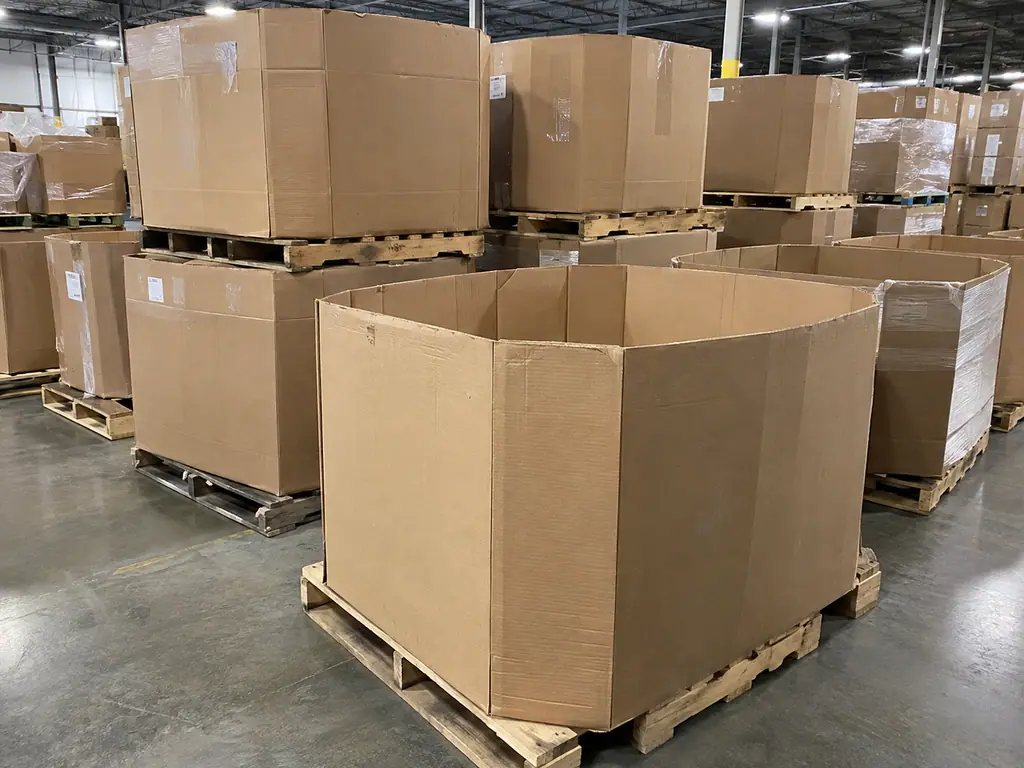 Triple wall
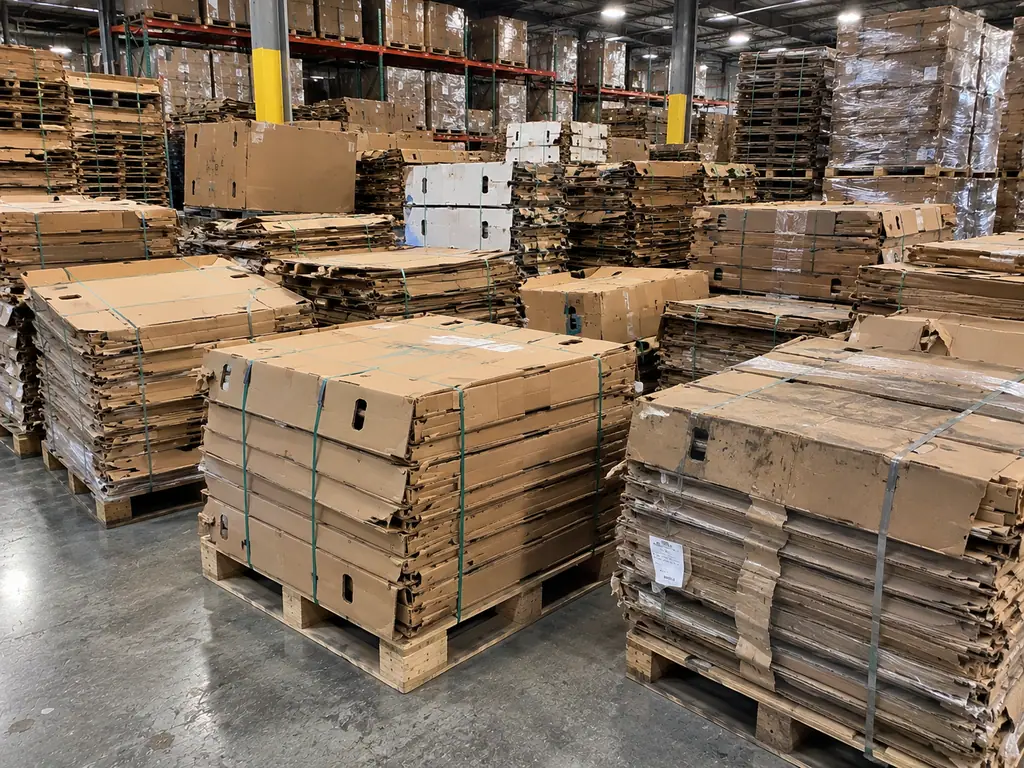 Bundles
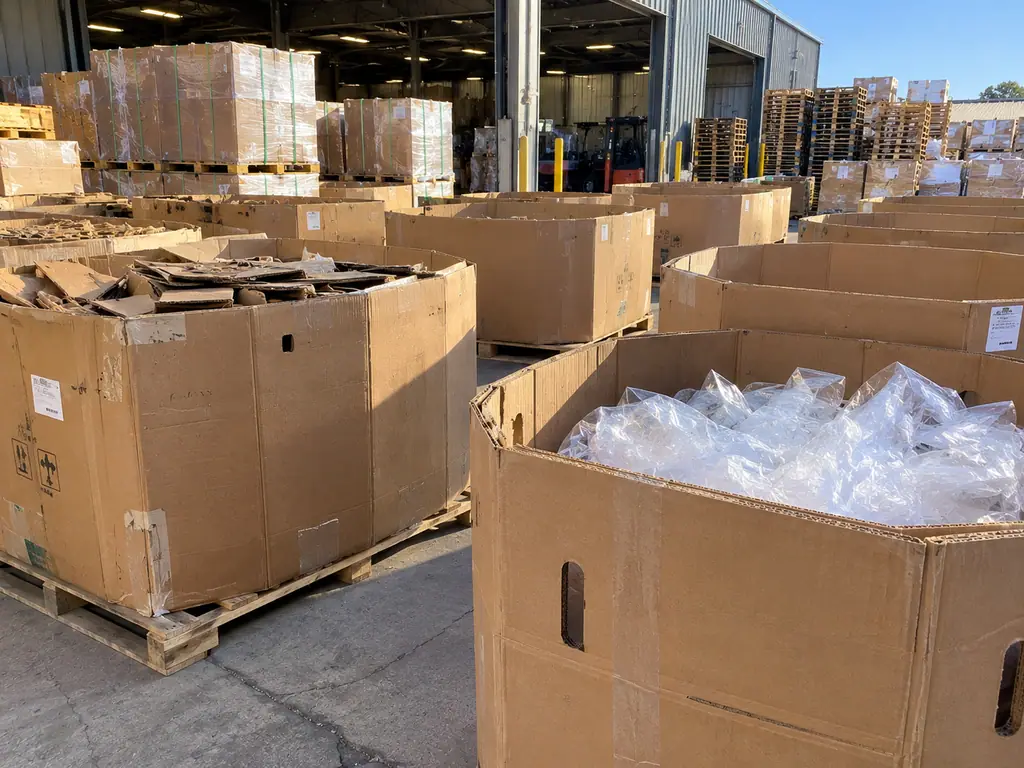 On the dock
| Construction | Thickness | Typical max weight | Stacking | Typical use |
|---|---|---|---|---|
| Single wall C | 5/32" (4.0 mm) | 65 lb | Not for bulk | Lids, layer pads, dividers |
| Double wall BC | 9/32" (7.1 mm) | 900 – 1,200 lb | 1 high loaded | General bulk under 1,200 lb |
| Double wall CC | 5/16" (7.9 mm) | 1,000 – 1,300 lb | 1 high loaded | Slightly better cushioning than BC |
| Triple wall BCC | 7/16" (11.1 mm) | 2,200 – 2,500 lb | 2 high loaded | The bulk workhorse |
| Triple wall ACC | 1/2" (12.7 mm) | 2,400 – 2,700 lb | 2 high loaded | Dense product with cushioning need |
| Five wall AAC | 5/8" (15.9 mm) | 3,000 lb+ | 3 high, matched pallets | Castings, stampings, export |
| Height | Cube | Fits | Best for | Watch for |
|---|---|---|---|---|
| 28" | 25.9 ft³ | Low-clearance racking, pick faces | Dense product, ergonomic sorting | Doubles your container count on light goods |
| 36" | 33.3 ft³ | Most standard racking | The default — best price and availability | Check reach height if hand-loaded |
| 40" | 37.0 ft³ | Cooler racks, harvest lines | Produce, bakery, mixed DC | Top-edge wear climbs with reach |
| 44" | 40.7 ft³ | Tall bays, textile sorting | Light bulky goods — foam, film, apparel | Hand-loading above 44" is uncomfortable |
| 48" | 44.4 ft³ | Dedicated tall programs | Very light, very bulky loads | Triple wall only; never stack loaded |
| Type | Size | Capacity | Notes |
|---|---|---|---|
| Recycled GMA #1 | 48 × 40 | 2,800 lb rack / 4,600 lb floor | No plugs, no companion stringers. Use under stacked loads. |
| Recycled GMA #2 | 48 × 40 | 2,500 lb rack / 4,000 lb floor | Up to three repaired boards. Floor-level staging. |
| Remanufactured | 48 × 40 and custom | 2,200 lb rack | Built from salvaged components. Heavier, variable deck gap. |
| ISPM-15 export | 48 × 40, 48 × 48 | 2,800 lb rack | Heat-treated, stamped, moisture checked below 19%. |
| Nestable plastic | 48 × 40 | 2,200 lb rack | Washdown and food environments; nests for return freight. |
| Presswood | 48 × 40, 45 × 45 | 1,500 lb floor | Light, nestable, effectively one-way. |
| Gauge | Style | Product | Notes |
|---|---|---|---|
| 2 mil | Flat | Dry, light, non-abrasive goods | Bagged or boxed contents inside the container. |
| 3 mil | Flat or gusseted | Light powders, dry components | Usually the lowest gauge suited to free-flowing product. |
| 4 mil | Gusseted | Pellets, produce, general purpose | The default specification for most applications. |
| 5 – 6 mil | Gusseted | Heavy, sharp-edged or dragged product | Specify when discharge involves dragging the liner. |
| 4 mil antistatic | Gusseted | Resin pellets and polymer powders | Performance falls in very dry air; rotate stock. |
| Foil barrier | Gusseted, sealable | Hygroscopic powders, long storage | Seal above the fill line, never against the board. |
| Attribute | Grade A | Grade B | Grade C | Grade D |
|---|---|---|---|---|
| Vertical corners | Square, no repair | Sound, light scuffing | Repaired or trimmed | Failed |
| Bottom flaps | Full strength | Sound, minor wear | One replacement allowed | Dead scores |
| Interior | Clean, no film | Light dust | Visible use | Residue or staining |
| No conflicting marks | Old labels present | Multiple marks | Irrelevant | |
| Squareness | Within 1/8" | Within 3/8" | Visible rack | Out of square |
| Moisture / odour | None | None | None | Disqualifying at any grade |
| Typical use | Food-adjacent, customer-facing | General bulk, reusable pools | Internal staging, scrap | Pads, dividers, OCC |
| Style | Code | Description | Bottom | Used for |
|---|---|---|---|---|
| Full-flap bulk box | FEFCO 0201 scaled | Four-panel body with top and bottom flaps meeting at the centre. | Full overlap | The strongest common bottom. Heavy and dense loads. |
| Partial-overlap bulk box | FEFCO 0203 scaled | Flaps overlap partially rather than fully. | Partial overlap | Lighter loads; slightly less material, meaningfully less bottom strength. |
| Open-bottom sleeve on tray | FEFCO 0300 series | Body sleeve sitting on a separate die-cut tray or pallet-top sheet. | Separate tray | Reusable pools — the body can be replaced without the tray. |
| Octagonal body (octabin) | Custom scored | Eight-sided body, usually with top and bottom frames. | Frame or tray | Free-flowing solids: resin, grain, powders, nuts. |
| Telescoping lid | FEFCO 0301 cap | Cap sliding over the outside of the body. | n/a | Protects contents and enables stacking. Order matched to body footprint. |
| Pallet cap | Die-cut cover | Flat cap sitting over a loaded pallet or container. | n/a | Dust and light protection where a full lid is unnecessary. |
| Bulk bin with discharge chute | Custom die-cut | Body with a die-cut chute panel for gravity discharge. | Flat or frame | Powder and pellet handling lines. |
| Layer pad / tier sheet | Flat blank | Flat board between product layers. | n/a | Load stability and crush distribution inside the container. |
| Slotted divider set | FEFCO 0900 series | Interlocking slotted boards forming cells. | n/a | Parts separation — from two to twenty-four cells. |
| Trim-to-height body | Cut from stock | A taller stock body knife-cut down to a true score line. | Original | When the height you need is not the height the market has. |
| Product | Bulk density | Loaded weight | Construction | Notes |
|---|---|---|---|---|
| Mixed apparel, unbaled | 6 – 9 lb/ft³ | 200 – 300 lb | Double wall | Volume-limited. Buy tall, not strong. |
| Loose foam / film | 2 – 5 lb/ft³ | 70 – 170 lb | Double wall | 44 inch bodies pay for themselves here. |
| Cardboard offcuts | 7 – 12 lb/ft³ | 230 – 400 lb | Double wall | Keep dry or the weight is water. |
| Plastic regrind flake | 20 – 30 lb/ft³ | 660 – 1,000 lb | Double / triple | Static — specify antistatic liner. |
| Resin pellets (PE, PP) | 32 – 38 lb/ft³ | 1,050 – 1,250 lb | Triple wall | Octabin preferred above 1,200 lb. |
| PET flake | 22 – 28 lb/ft³ | 730 – 930 lb | Double wall | Abrasive — 5 mil liner minimum. |
| Apples / citrus | 30 – 35 lb/ft³ | 1,000 – 1,150 lb | Triple wall | Field heat and condensation; 40 inch is the produce default. |
| Potatoes / root crops | 38 – 45 lb/ft³ | 1,250 – 1,500 lb | Triple wall | Bottom-layer bruising — use a layer pad. |
| Frozen fruit / vegetable | 35 – 42 lb/ft³ | 1,150 – 1,400 lb | Triple wall | Manage the freezer-to-dock transition before stacking. |
| Grain / seed | 42 – 50 lb/ft³ | 1,400 – 1,650 lb | Triple wall | Octabin or bin — hoop stress matters. |
| Mineral powder | 55 – 75 lb/ft³ | 1,800 – 2,480 lb | Triple / five wall | At the top of what fiber should carry. Check the pallet. |
| Glass cullet | 80 – 95 lb/ft³ | 2,650 lb+ | Five wall | Fill to weight, not to height. Never fill to the top. |
| Metal stampings | 90 – 140 lb/ft³ | Fill by weight | Five wall + V-board | Sharp edges: burst strength and corner protection both matter. |
| Electronic returns, mixed | 10 – 16 lb/ft³ | 330 – 530 lb | Double wall | Mixed-height pools work best here. |
| Books / paper records | 35 – 45 lb/ft³ | 1,150 – 1,500 lb | Triple wall | Dense and deceptive — people routinely overfill. |
| Nuts / dried goods | 28 – 34 lb/ft³ | 930 – 1,120 lb | Triple wall | Gusseted liner, plus eight inches of height. |
| Measure | Imperial | Metric | Notes |
|---|---|---|---|
| Standard footprint | 48 × 40 in | 1,219 × 1,016 mm | The GMA pallet that standardised US distribution. |
| Triple wall thickness | 7/16 in | 11.1 mm | Takes about 7/8 in off interior width across both walls. |
| Typical capacity | 2,200 lb | 998 kg | Triple wall BCC, evenly distributed, matched pallet. |
| Container cube at 36" | 33.3 ft³ | 0.943 m³ | Outside dimensions, before board thickness. |
| OCC bale | 1,000 – 1,400 lb | 454 – 635 kg | Typical bale from a horizontal baler. |
| Trailer capacity, knocked down | 400 – 600 units | — | 53-foot dry van; cube limited, never weight limited. |
| Moisture ceiling for OCC | 12% | 12% | Above this you are selling water at a penalty. |
The twelve-point inspection, in order
What a careful supplier checks on every used unit, and what you can check at receiving. The cheapest rejection happens first, which is why odor and moisture come before anything cosmetic.
Odor
Thirty seconds in open air, nose at the opening.
Any persistent smell — instant rejection.Moisture
Hand and meter at the bottom score line where it hides.
Staining above the bottom score, or any delamination.Vertical corners
Thumb pressure at knee, waist and shoulder height.
Hollow give, shear, or crush longer than four inches.Bottom flaps
Fold test on each flap; the score must hold.
Two or more dead scores sends the unit to cutting.Squareness
Diagonal measurement across the open top.
Over 3/8 inch of rack drops the grade.Interior cleanliness
Visual plus a wipe for residue and dust film.
Grease strike-through, product residue, staining.Pest evidence
Corners, flutes and under the bottom flaps.
Frass, gnaw marks or webbing — rejected outright.Wall thickness
Caliper at two points on a cut edge.
Mislabelled construction should be re-specified before it is quoted.Print & labels
Check for conflicting brands and old spec marks.
Covered, or graded down if legibility matters.Top edge
Fray, crush and compression over the perimeter.
Over a quarter of the perimeter → trim candidate.Previous repair
Tape, V-board inserts, replaced flaps from another life.
Should be declared on the quote, not presented as original.Origin lane
Where the unit came from and what was in it.
Industrial origins never enter the food-adjacent lane.Eight ways bulk packaging fails
Damage is evidence. Where it appears tells you whether the problem is the container, the pallet, the aisle or the weather.
| Failure | What it looks like | Cause | Prevention |
|---|---|---|---|
| Strap cut | Crushed line across a vertical corner, half an inch wide. | Polyester strap tensioned over an unprotected edge. | A V-board corner protector under every strap. |
| Forklift shear | Scuff outside, hollow feel inside over a six-inch band. | Lateral contact delaminating liner from medium. | Floor guides at pinch points; operator training. |
| Overhang crush | Failure at the bottom score, two corners only. | Container footprint larger than the pallet deck. | Buy pallet and container on the same quote. |
| Humidity creep | Bulging walls, leaning stack after weeks of storage. | Compression loss above 70% RH compounding under load. | Reduce stack height; one construction up; shorter dwell. |
| Condensation cycling | Soft outer liner after a freezer-to-dock move. | Surface below dew point for twenty minutes. | No stacking for 24 hours after a temperature transition. |
| Liner bridge | Uneven settle, container out of square after filling. | Flat liner bridging the corners under free-flowing product. | Gusseted liner sized to the footprint. |
| Dead score | Bottom flap will not hold its fold. | Repeated knock-down and re-erection, or wrong fold line. | Collapse along original scores only; train receiving. |
| Tine puncture | Paired holes about four inches above the base. | Tines entering at the wrong height on a stacked position. | Position signage and double-stack rules. |
Common questions on this subject
Short answers to common questions. If yours is not covered, ask it on the form and a partner supplier in our network can answer it with your quote.
All 33 answersWhat exactly is a gaylord box?
Can you match a competitor's price?
How does selling empties work?
Are used gaylord boxes strong enough?
How much do used gaylords cost?
Can I sell my used boxes?
Can used containers be used for food?
What areas do you serve?
Specification notes worth reading
Grade A Triple Wall, 48 × 40
A commonly requested item, examined properly: what Grade A means on a triple-wall body, how it is inspected, and when it is worth the premium over Grade B.
Deep diveGaylord Liners: Gauge, Gusset, Grade
A small part behind many bulk packaging failures. Four decisions, in the order they matter.
Related reading
Choosing Liners for Bulk Boxes
Gauge, gusset, grade and antistatic: the four decisions behind a small part that prevents big failures.
Read →How Used Gaylords Are Graded
A, B, C and D are not vibes. Here is what a careful grader looks at, in what order, and what gets rejected outright.
Read →Gaylord Box Sizes Explained
Why 48×40 dominates, when 40×40 is smarter, and how to choose a height that fits your racking rather than your habit.
Read →What Is a Gaylord Box, Really?
The container named after a Michigan paper company that became the standard bulk box of American warehouses.
Read →Not sure which family fits?
Describe the product, the weight and the number of trips you need. A partner supplier in our network follows up with a specification and pricing.