Something on your dock is failing. Start here.
Twelve common symptoms. Each one gets the likely cause, the action for this afternoon, and the change that stops it coming back.
- 01Quote request
- Free, no obligation
- 02Fulfilled by
- Partner suppliers
- 03Requests from
- Across the US
- 04Pricing
- By written quote
Symptom, cause, action, prevention
General guidance only. If your symptom is not here, describe it on the form when you request replacement stock.
| Symptom | Likely cause | Do now | Prevention |
|---|---|---|---|
| Stacks leaning after a few weeks | Humidity creep plus sustained load. | De-stack to one high and move the oldest units first. | Measure RH; derate; shorten dwell time. |
| Bottom units bulging at the base | Overfilled, or overhang removing corner support. | Check pallet footprint under the failing units. | Match pallet to container; fill to weight, not height. |
| Containers out of square after filling | Flat liner bridging the corners. | Switch to gusseted liner on the next fill. | Specify gusseted for anything that pours. |
| Liner splitting at a bottom corner | Gauge too light for the product. | Step up one gauge and inspect the discharge path. | 4 mil general purpose; 5 – 6 mil heavy or abrasive. |
| Product clumping during discharge | Static charge on polymer. | Switch to antistatic liner; check grounding at the station. | Antistatic as standard for pneumatically conveyed resin. |
| Soft walls after moving from the freezer | Condensation during the temperature transition. | Do not stack for 24 hours; let units equalise. | Stage through a tempered anteroom; one construction up. |
| Crushed line along a vertical edge | Strapping over an unprotected corner. | Add V-board before the next banding cycle. | Corner protection on every strapped load. |
| Paired holes near the base | Forklift tines entering at the wrong height. | Review the double-stack position and signage. | Operator training; floor and rack position markings. |
| Received load lighter in count than the BOL | Bundle count or banding error. | Count bundles with the driver present; note the exception before signing. | Open one bundle per pallet at receiving. |
| Strong smell inside a received container | Origin contamination not caught at grading. | Reject, photograph and raise it with the supplier promptly. | Buy from a supplier that screens odour first, not last. |
| Units will not re-erect square | Flat stack stored too high, scores compressed. | Use the units for low-stack staging rather than shipping. | Cap flat stacks at 60 inches; rotate oldest first. |
| Bales rejected or downgraded at the mill | Film, wax or moisture contamination. | Pull liners before baling; check bale moisture. | Separate wax board entirely; keep bales dry and ticketed. |
Eight ways bulk packaging fails
Damage is evidence. Where it appears tells you whether the problem is the container, the pallet, the aisle or the weather.
| Failure | What it looks like | Cause | Prevention |
|---|---|---|---|
| Strap cut | Crushed line across a vertical corner, half an inch wide. | Polyester strap tensioned over an unprotected edge. | A V-board corner protector under every strap. |
| Forklift shear | Scuff outside, hollow feel inside over a six-inch band. | Lateral contact delaminating liner from medium. | Floor guides at pinch points; operator training. |
| Overhang crush | Failure at the bottom score, two corners only. | Container footprint larger than the pallet deck. | Buy pallet and container on the same quote. |
| Humidity creep | Bulging walls, leaning stack after weeks of storage. | Compression loss above 70% RH compounding under load. | Reduce stack height; one construction up; shorter dwell. |
| Condensation cycling | Soft outer liner after a freezer-to-dock move. | Surface below dew point for twenty minutes. | No stacking for 24 hours after a temperature transition. |
| Liner bridge | Uneven settle, container out of square after filling. | Flat liner bridging the corners under free-flowing product. | Gusseted liner sized to the footprint. |
| Dead score | Bottom flap will not hold its fold. | Repeated knock-down and re-erection, or wrong fold line. | Collapse along original scores only; train receiving. |
| Tine puncture | Paired holes about four inches above the base. | Tines entering at the wrong height on a stacked position. | Position signage and double-stack rules. |
Two tables that explain most failures
Many collapsing stacks come down to one of these two: the derating was not applied, or the stack height was taken from a catalogue.
| Relative humidity | Duration under load | Strength factor | What to do |
|---|---|---|---|
| Below 50% | Under 30 days | 1.00 | Published stacking limits apply as stated. |
| Below 50% | Over 30 days | 0.25 – 0.30 | Divide laboratory compression by about four. |
| 50 – 70% | Under 30 days | 0.85 | Reduce stack height by one unit on marginal loads. |
| 50 – 70% | Over 30 days | 0.22 | Two high loaded becomes one high for double wall. |
| 70 – 85% | Under 30 days | 0.65 – 0.75 | Specify one construction up, or stop stacking. |
| 70 – 85% | Over 30 days | 0.15 – 0.18 | Do not stack loaded containers. Shorten dwell time. |
| Above 85% | Any | 0.10 – 0.14 | Fiber is the wrong container unless dwell is measured in hours. |
| Construction | First week | After 30 days | After 90 days | Notes |
|---|---|---|---|---|
| Double wall BC | 2 high | 1 high | 1 high, inspect weekly | Never stack a partly filled unit. |
| Triple wall BCC | 3 high | 2 high | 2 high, inspect weekly | Two high loaded is a common working figure that already allows for storage. |
| Five wall AAC | 4 high | 3 high | 2 – 3 high | Matched pallets only; check deck boards each move. |
| Empty, nested | 8 high | 6 high | 6 high | Above that the bottom scores compress and will not re-erect square. |
| Knocked down, flat | To 60 inches | To 60 inches | To 48 inches | Scores aligned, off the floor, indoors. |
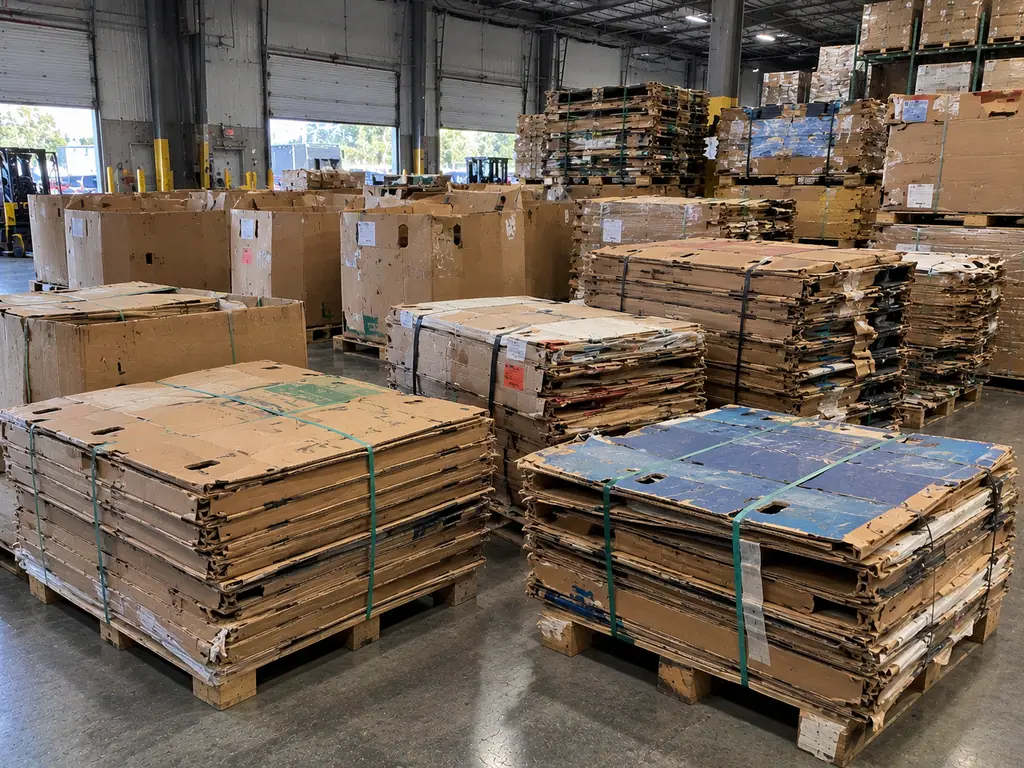 Used stock
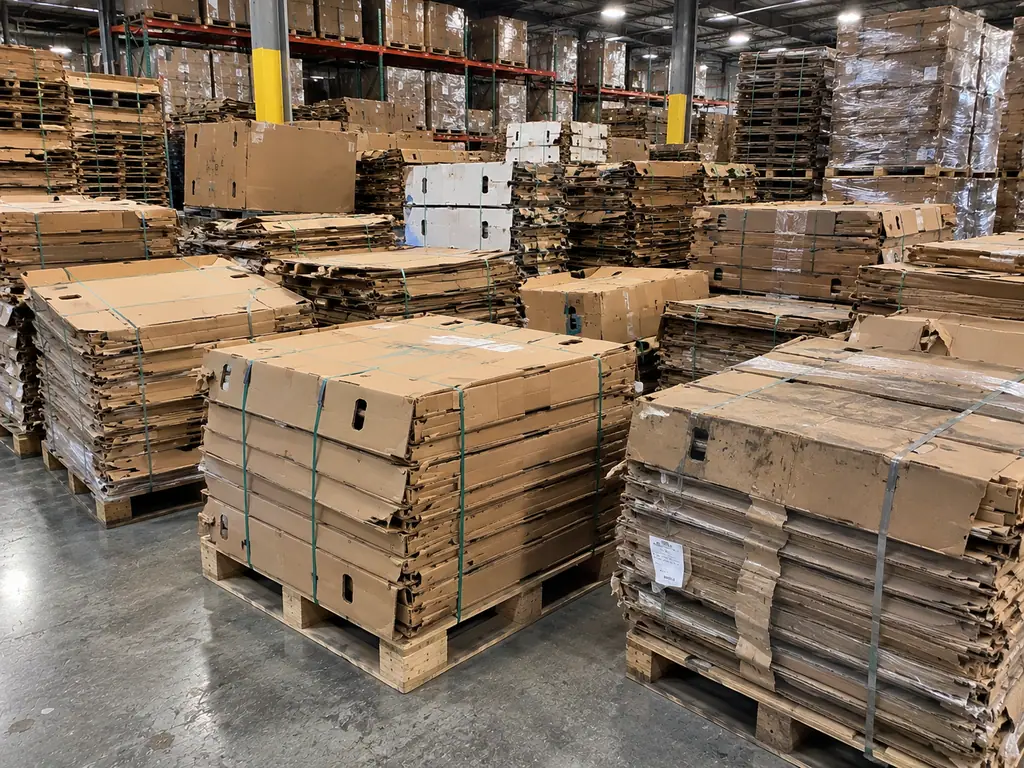 Bundles
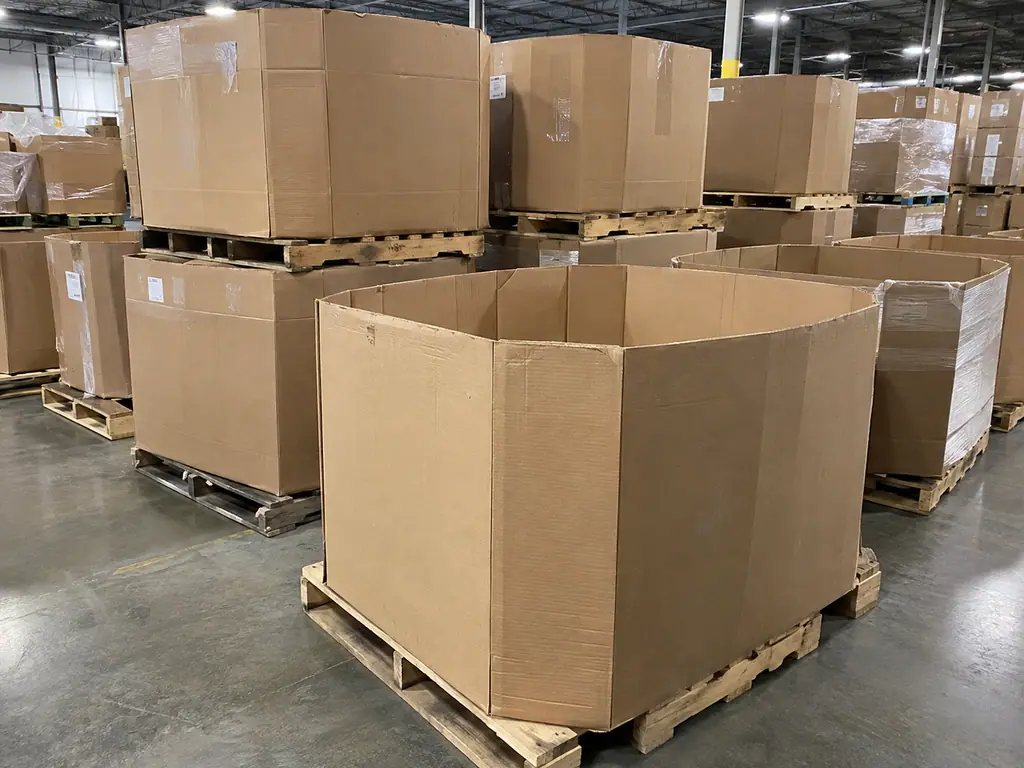 Triple wall
“Two high loaded for triple wall. One high for double. Never on corners you have not looked at.”
A striking share of the problems on this page are not packaging problems at all. They are aisle widths, pallet grades, operator habits and warehouse humidity, all of which show up as damage on a box because the box is the softest thing in the system.
That is why a good diagnosis starts with sorting a month of damaged containers by where the damage sits. The position of a scar tells you more than its severity, and the fix is often free.
Common questions on this subject
Short answers to common questions. If yours is not covered, ask it on the form and a partner supplier in our network can answer it with your quote.
All 33 answersWhat happens if a load arrives damaged?
Can used containers be used for food?
Can I get pallets and liners too?
Are used containers safe for food handling?
Do corrugated containers need a safety data sheet?
Related reading
ECT, Burst and Stacking Strength
A plain-language guide to the three numbers printed in the box maker's certificate — and which one to actually use.
Read →Choosing Liners for Bulk Boxes
Gauge, gusset, grade and antistatic: the four decisions behind a small part that prevents big failures.
Read →Humidity, Gulf Warehouses and the Strength You Quietly Lose
Corrugated loses a meaningful share of its compression strength in high humidity. Most plants have never measured theirs.
Read →Why Gaylord Corners Fail Before Anything Else
Four vertical edges carry most of the stack load. Here is what commonly breaks them, and how to prevent it.
Read →Need a stronger container?
Describe the load and the failure. A partner supplier in our network can quote a construction to suit it.