Market note

How the OCC Market Actually Prices Your Fiber

Old Corrugated Containers is a traded commodity with a published index, a seasonal rhythm and a contamination penalty. Here is how it decides what your bales are worth.

At a glance
Quote request
Free, no obligation
Fulfilled by
Partner suppliers
Requests from
Across the US
Pricing
By written quote
Request a quote

Quote how the occ market actually prices your fiber

Fill this in once. A partner supplier in our network follows up with grade, construction, quantity and freight.

US or Canada numbers only

US ZIP code or Canadian postal code

✳ required. Every field is checked before sending so genuine requests never sit behind spam. Your details are shared with partner suppliers in our network to prepare this quote. See the privacy policy.

There is a published price

Recovered paper grades trade on published regional indices, revised monthly. OCC — grade 11 in the standard specifications — is the most liquid of them, which means your bales have a reference price whether or not your hauler mentions it.

Ask any recycler what index they price against and what their discount to index is. A hauler who cannot answer is pricing against your ignorance rather than the market.

Seasonality is real

Generation surges after the retail peak and falls in late summer, while mill demand runs on its own cycle. The practical consequence is that it is worth asking how a fixed annual price compares with an index-linked one.

Contamination is the whole game

Four things move your bales down a grade, and three of them are avoidable on the dock.

  • Wax-coated board — a separate, much cheaper grade. Keep it out entirely.
  • Plastic film and liners left inside containers, a very common cause of downgrades.
  • Moisture above roughly 12% — you are selling water at a penalty.
  • Foreign material: banding, pallets, product residue, the occasional forklift tine.

Baled beats loose, almost always

A trailer of loose corrugated carries a fraction of the tonnage of a baled trailer, so freight per ton is brutal. If you generate a steady volume of corrugated, a baler may pay for itself; ask a recycler to run the numbers for your site.
Reference

Numbers that apply to this page

Construction limits and typical working capacity, as general guidance.

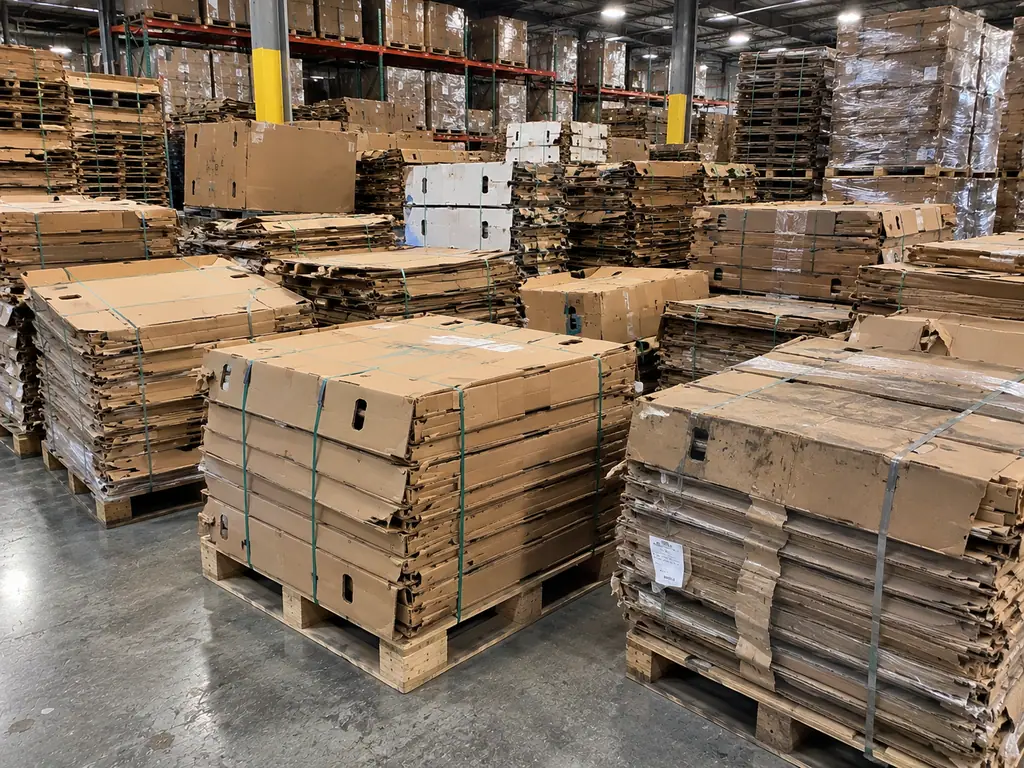
Warehouse aisles filled with banded pallets of knocked-down corrugated bulk boxesBundles
Banded bundles of knocked-down containers sorted by footprint and height.
Construction, thickness and typical working capacity
ConstructionThicknessTypical max weightStackingTypical use
Single wall C5/32" (4.0 mm)65 lbNot for bulkLids, layer pads, dividers
Double wall BC9/32" (7.1 mm)900 – 1,200 lb1 high loadedGeneral bulk under 1,200 lb
Double wall CC5/16" (7.9 mm)1,000 – 1,300 lb1 high loadedSlightly better cushioning than BC
Triple wall BCC7/16" (11.1 mm)2,200 – 2,500 lb2 high loadedThe bulk workhorse
Triple wall ACC1/2" (12.7 mm)2,400 – 2,700 lb2 high loadedDense product with cushioning need
Five wall AAC5/8" (15.9 mm)3,000 lb+3 high, matched palletsCastings, stampings, export
FAQ

Common questions on this subject

Short answers to common questions. If yours is not covered, ask it on the form and a partner supplier in our network can answer it with your quote.

All 33 answers
How much do used gaylords cost?
Pricing is set by the partner supplier who quotes your request. Grade, wall count, height, quantity and freight all move the number, and freight is usually the biggest variable, so ask for it as a separate line.
How fast can I get containers?
Lead times are set by the partner supplier who quotes your request and depend on stock and distance. Put your deadline on the form so the supplier can tell you whether they can meet it.
What happens to boxes that fail grading?
Boxes that cannot be reused are usually baled and recycled as Old Corrugated Containers (OCC), which is one of the most widely recycled packaging materials.
How do I know which size I need?
Measure clear height under your lowest rack beam, the reach height of whoever loads by hand, and your product's settled height at target weight. Choose roughly two inches under the limiting constraint. The size charts and load-capacity guide walk through it.
How do I contact Gaylord Boxes?
Through the quote form. It goes to a partner supplier in our network, who follows up about your request.
Next step

Need this specified for your load?

Send the weight, the product, the footprint and the number of trips. A partner supplier in our network follows up with a specification and pricing.