Four industries, four definitions of strong enough
A textile sorter needs height and reuse count. A metal stamper needs five-wall corners. A food plant needs documented origin. The same container family serves all three — specified completely differently.
- 01Quote request
- Free, no obligation
- 02Fulfilled by
- Partner suppliers
- 03Requests from
- Across the US
- 04Pricing
- By written quote
Choose yours
Each page lists what that industry usually needs, and which products answer it.
Containers for food plants, where origin, odor and moisture matter more than anywhere else.
High-volume, low-density sorting where height and reuse count matter more than crush rating.
Returns processing, bulk consolidation and reverse logistics on a predictable replenishment cycle.
Dense parts, sharp edges and work-in-process staging that punish ordinary packaging.
“One specification for every load — then paying for the cube you never fill.”
Many plants use a single box specification across loads that differ wildly in weight and density. It is understandable, since one SKU is simpler to buy, but it often means paying for strength and cube most loads never use.
Mixed-height programs look like a complication and often behave like a saving. The size guide walks through how to split a specification by load.
The same four decisions, whatever you make
Construction, height and liner. Every industry page uses these tables with different emphasis.
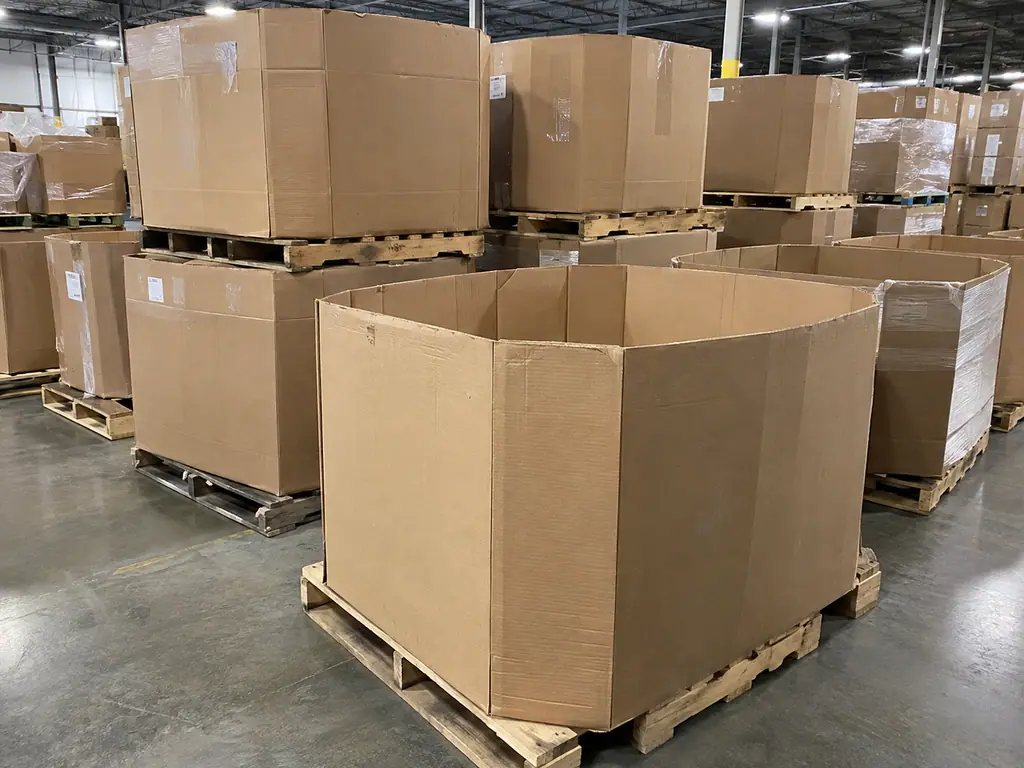 Triple wall
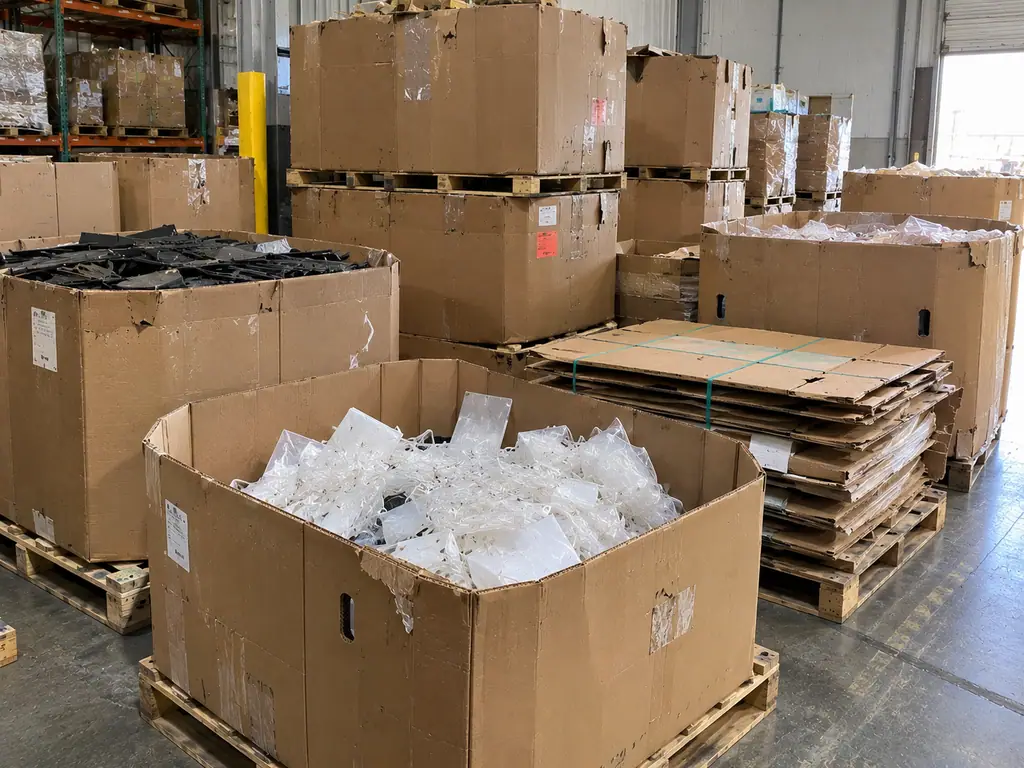 In service
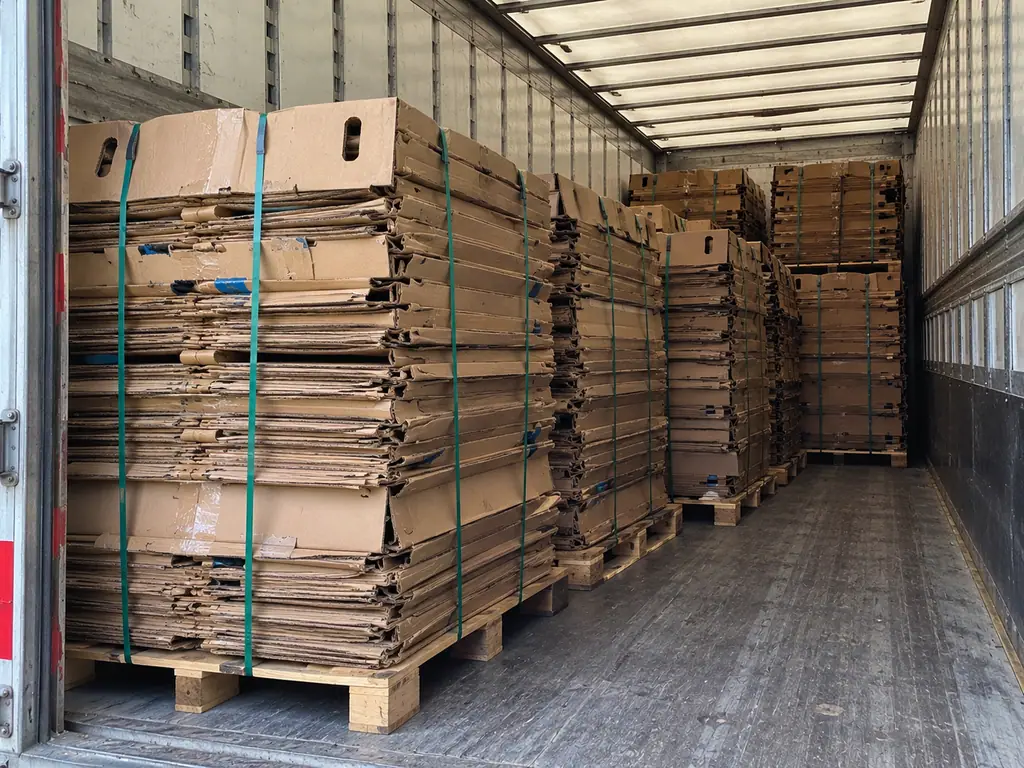 Freight
| Construction | Thickness | Typical max weight | Stacking | Typical use |
|---|---|---|---|---|
| Single wall C | 5/32" (4.0 mm) | 65 lb | Not for bulk | Lids, layer pads, dividers |
| Double wall BC | 9/32" (7.1 mm) | 900 – 1,200 lb | 1 high loaded | General bulk under 1,200 lb |
| Double wall CC | 5/16" (7.9 mm) | 1,000 – 1,300 lb | 1 high loaded | Slightly better cushioning than BC |
| Triple wall BCC | 7/16" (11.1 mm) | 2,200 – 2,500 lb | 2 high loaded | The bulk workhorse |
| Triple wall ACC | 1/2" (12.7 mm) | 2,400 – 2,700 lb | 2 high loaded | Dense product with cushioning need |
| Five wall AAC | 5/8" (15.9 mm) | 3,000 lb+ | 3 high, matched pallets | Castings, stampings, export |
| Height | Cube | Fits | Best for | Watch for |
|---|---|---|---|---|
| 28" | 25.9 ft³ | Low-clearance racking, pick faces | Dense product, ergonomic sorting | Doubles your container count on light goods |
| 36" | 33.3 ft³ | Most standard racking | The default — best price and availability | Check reach height if hand-loaded |
| 40" | 37.0 ft³ | Cooler racks, harvest lines | Produce, bakery, mixed DC | Top-edge wear climbs with reach |
| 44" | 40.7 ft³ | Tall bays, textile sorting | Light bulky goods — foam, film, apparel | Hand-loading above 44" is uncomfortable |
| 48" | 44.4 ft³ | Dedicated tall programs | Very light, very bulky loads | Triple wall only; never stack loaded |
| Gauge | Style | Product | Notes |
|---|---|---|---|
| 2 mil | Flat | Dry, light, non-abrasive goods | Bagged or boxed contents inside the container. |
| 3 mil | Flat or gusseted | Light powders, dry components | Usually the lowest gauge suited to free-flowing product. |
| 4 mil | Gusseted | Pellets, produce, general purpose | The default specification for most applications. |
| 5 – 6 mil | Gusseted | Heavy, sharp-edged or dragged product | Specify when discharge involves dragging the liner. |
| 4 mil antistatic | Gusseted | Resin pellets and polymer powders | Performance falls in very dry air; rotate stock. |
| Foil barrier | Gusseted, sealable | Hygroscopic powders, long storage | Seal above the fill line, never against the board. |
Eight ways bulk packaging fails
Damage is evidence. Where it appears tells you whether the problem is the container, the pallet, the aisle or the weather.
| Failure | What it looks like | Cause | Prevention |
|---|---|---|---|
| Strap cut | Crushed line across a vertical corner, half an inch wide. | Polyester strap tensioned over an unprotected edge. | A V-board corner protector under every strap. |
| Forklift shear | Scuff outside, hollow feel inside over a six-inch band. | Lateral contact delaminating liner from medium. | Floor guides at pinch points; operator training. |
| Overhang crush | Failure at the bottom score, two corners only. | Container footprint larger than the pallet deck. | Buy pallet and container on the same quote. |
| Humidity creep | Bulging walls, leaning stack after weeks of storage. | Compression loss above 70% RH compounding under load. | Reduce stack height; one construction up; shorter dwell. |
| Condensation cycling | Soft outer liner after a freezer-to-dock move. | Surface below dew point for twenty minutes. | No stacking for 24 hours after a temperature transition. |
| Liner bridge | Uneven settle, container out of square after filling. | Flat liner bridging the corners under free-flowing product. | Gusseted liner sized to the footprint. |
| Dead score | Bottom flap will not hold its fold. | Repeated knock-down and re-erection, or wrong fold line. | Collapse along original scores only; train receiving. |
| Tine puncture | Paired holes about four inches above the base. | Tines entering at the wrong height on a stacked position. | Position signage and double-stack rules. |
Common questions on this subject
Short answers to common questions. If yours is not covered, ask it on the form and a partner supplier in our network can answer it with your quote.
All 33 answersCan used containers be used for food?
What happens if a load arrives damaged?
Are used containers safe for food handling?
Related reading
Returns Processing: A Mixed-Height Strategy for 3PLs
Returns arrive unpredictably and must be consolidated fast. One container height cannot serve all three stages.
Read →Textile Sorting at Volume: Why 44 Inches Wins
Soft goods are a volume business, not a weight business — which inverts almost every normal packaging assumption.
Read →What Is a Gaylord Box, Really?
The container named after a Michigan paper company that became the standard bulk box of American warehouses.
Read →How Used Gaylords Are Graded
A, B, C and D are not vibes. Here is what a careful grader looks at, in what order, and what gets rejected outright.
Read →Tell us what the load does, not just what it weighs
Density, handling, dock height, climate, number of trips. Those five things specify a container properly, and a partner supplier can quote against them.