What does a gaylord of that weigh?
The question behind almost every mis-specification. Sixteen common products, their bulk density, what a standard container holds when filled, and the construction that survives it.
- 01Quote request
- Free, no obligation
- 02Fulfilled by
- Partner suppliers
- 03Requests from
- Across the US
- 04Pricing
- By written quote
Sixteen products, weighed
Approximate figures for a 48 × 40 × 36 inch container filled to about 90% of interior height on a matched pallet. Your settled density will differ, so weigh one.
| Product | Bulk density | Loaded weight | Construction | Notes |
|---|---|---|---|---|
| Mixed apparel, unbaled | 6 – 9 lb/ft³ | 200 – 300 lb | Double wall | Volume-limited. Buy tall, not strong. |
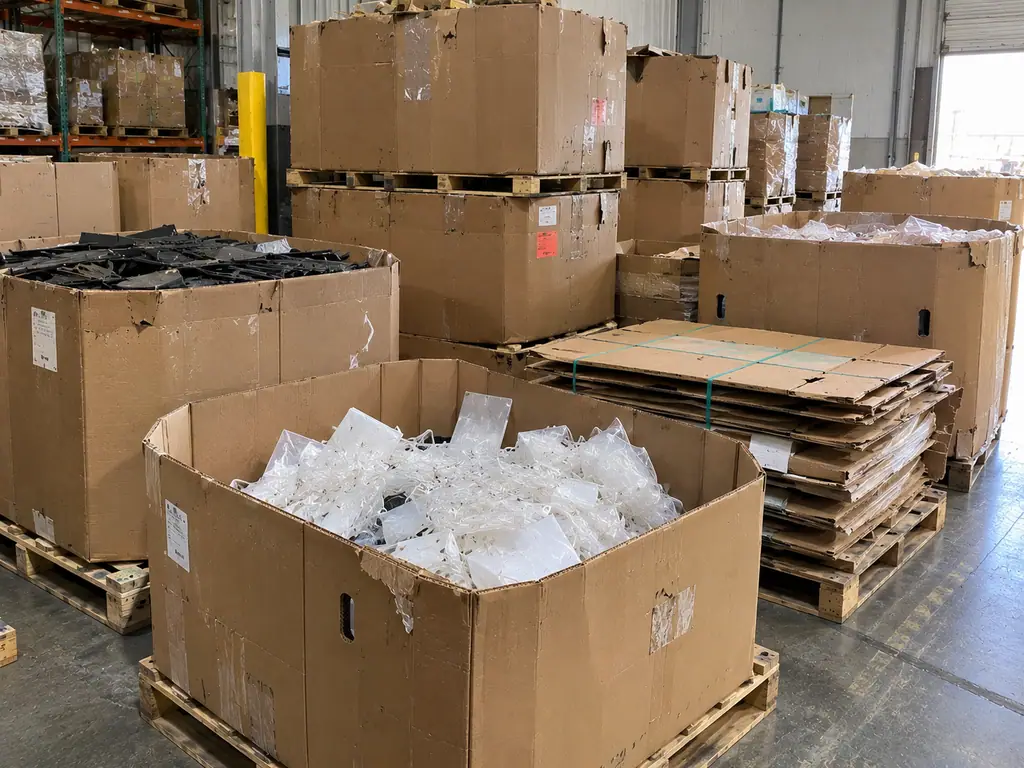
| Loose foam / film | 2 – 5 lb/ft³ | 70 – 170 lb | Double wall | 44 inch bodies pay for themselves here. |
| Cardboard offcuts | 7 – 12 lb/ft³ | 230 – 400 lb | Double wall | Keep dry or the weight is water. |
| Plastic regrind flake | 20 – 30 lb/ft³ | 660 – 1,000 lb | Double / triple | Static — specify antistatic liner. |
| Resin pellets (PE, PP) | 32 – 38 lb/ft³ | 1,050 – 1,250 lb | Triple wall | Octabin preferred above 1,200 lb. |
| PET flake | 22 – 28 lb/ft³ | 730 – 930 lb | Double wall | Abrasive — 5 mil liner minimum. |
| Apples / citrus | 30 – 35 lb/ft³ | 1,000 – 1,150 lb | Triple wall | Field heat and condensation; 40 inch is the produce default. |
| Potatoes / root crops | 38 – 45 lb/ft³ | 1,250 – 1,500 lb | Triple wall | Bottom-layer bruising — use a layer pad. |
| Frozen fruit / vegetable | 35 – 42 lb/ft³ | 1,150 – 1,400 lb | Triple wall | Manage the freezer-to-dock transition before stacking. |
| Grain / seed | 42 – 50 lb/ft³ | 1,400 – 1,650 lb | Triple wall | Octabin or bin — hoop stress matters. |
| Mineral powder | 55 – 75 lb/ft³ | 1,800 – 2,480 lb | Triple / five wall | At the top of what fiber should carry. Check the pallet. |
| Glass cullet | 80 – 95 lb/ft³ | 2,650 lb+ | Five wall | Fill to weight, not to height. Never fill to the top. |
| Metal stampings | 90 – 140 lb/ft³ | Fill by weight | Five wall + V-board | Sharp edges: burst strength and corner protection both matter. |
| Electronic returns, mixed | 10 – 16 lb/ft³ | 330 – 530 lb | Double wall | Mixed-height pools work best here. |
| Books / paper records | 35 – 45 lb/ft³ | 1,150 – 1,500 lb | Triple wall | Dense and deceptive — people routinely overfill. |
| Nuts / dried goods | 28 – 34 lb/ft³ | 930 – 1,120 lb | Triple wall | Gusseted liner, plus eight inches of height. |
Three steps from a product name to a specification
1. Find the density band
Products under about 15 lb/ft³ are volume-limited: you will run out of height before you run out of strength, so buy tall and buy double wall. Between 15 and 45 lb/ft³ is triple-wall territory. Above that, you are filling to weight rather than to height, and the pallet underneath starts to matter more than the container.
2. Check the weight against the construction
As a general guide, double wall is commonly used up to about 1,200 lb, triple wall around 2,200 – 2,500 lb, and five wall above that. Confirm the rating of the containers you are quoted. If your product lands within about 15% of a boundary, specify up — the derating tables below will eat that margin before the container is thirty days old.
3. Apply the derating before you stack
Humidity and dwell time can remove a large share of laboratory compression strength. The tables here show common rules of thumb for how much.
 In service
“People fill a container to the top and then weigh it. Fill to the weight instead.”
Construction, height, humidity, stacking
| Construction | Thickness | Typical max weight | Stacking | Typical use |
|---|---|---|---|---|
| Single wall C | 5/32" (4.0 mm) | 65 lb | Not for bulk | Lids, layer pads, dividers |
| Double wall BC | 9/32" (7.1 mm) | 900 – 1,200 lb | 1 high loaded | General bulk under 1,200 lb |
| Double wall CC | 5/16" (7.9 mm) | 1,000 – 1,300 lb | 1 high loaded | Slightly better cushioning than BC |
| Triple wall BCC | 7/16" (11.1 mm) | 2,200 – 2,500 lb | 2 high loaded | The bulk workhorse |
| Triple wall ACC | 1/2" (12.7 mm) | 2,400 – 2,700 lb | 2 high loaded | Dense product with cushioning need |
| Five wall AAC | 5/8" (15.9 mm) | 3,000 lb+ | 3 high, matched pallets | Castings, stampings, export |
| Height | Cube | Fits | Best for | Watch for |
|---|---|---|---|---|
| 28" | 25.9 ft³ | Low-clearance racking, pick faces | Dense product, ergonomic sorting | Doubles your container count on light goods |
| 36" | 33.3 ft³ | Most standard racking | The default — best price and availability | Check reach height if hand-loaded |
| 40" | 37.0 ft³ | Cooler racks, harvest lines | Produce, bakery, mixed DC | Top-edge wear climbs with reach |
| 44" | 40.7 ft³ | Tall bays, textile sorting | Light bulky goods — foam, film, apparel | Hand-loading above 44" is uncomfortable |
| 48" | 44.4 ft³ | Dedicated tall programs | Very light, very bulky loads | Triple wall only; never stack loaded |
| Relative humidity | Duration under load | Strength factor | What to do |
|---|---|---|---|
| Below 50% | Under 30 days | 1.00 | Published stacking limits apply as stated. |
| Below 50% | Over 30 days | 0.25 – 0.30 | Divide laboratory compression by about four. |
| 50 – 70% | Under 30 days | 0.85 | Reduce stack height by one unit on marginal loads. |
| 50 – 70% | Over 30 days | 0.22 | Two high loaded becomes one high for double wall. |
| 70 – 85% | Under 30 days | 0.65 – 0.75 | Specify one construction up, or stop stacking. |
| 70 – 85% | Over 30 days | 0.15 – 0.18 | Do not stack loaded containers. Shorten dwell time. |
| Above 85% | Any | 0.10 – 0.14 | Fiber is the wrong container unless dwell is measured in hours. |
| Construction | First week | After 30 days | After 90 days | Notes |
|---|---|---|---|---|
| Double wall BC | 2 high | 1 high | 1 high, inspect weekly | Never stack a partly filled unit. |
| Triple wall BCC | 3 high | 2 high | 2 high, inspect weekly | Two high loaded is a common working figure that already allows for storage. |
| Five wall AAC | 4 high | 3 high | 2 – 3 high | Matched pallets only; check deck boards each move. |
| Empty, nested | 8 high | 6 high | 6 high | Above that the bottom scores compress and will not re-erect square. |
| Knocked down, flat | To 60 inches | To 60 inches | To 48 inches | Scores aligned, off the floor, indoors. |
| Measure | Imperial | Metric | Notes |
|---|---|---|---|
| Standard footprint | 48 × 40 in | 1,219 × 1,016 mm | The GMA pallet that standardised US distribution. |
| Triple wall thickness | 7/16 in | 11.1 mm | Takes about 7/8 in off interior width across both walls. |
| Typical capacity | 2,200 lb | 998 kg | Triple wall BCC, evenly distributed, matched pallet. |
| Container cube at 36" | 33.3 ft³ | 0.943 m³ | Outside dimensions, before board thickness. |
| OCC bale | 1,000 – 1,400 lb | 454 – 635 kg | Typical bale from a horizontal baler. |
| Trailer capacity, knocked down | 400 – 600 units | — | 53-foot dry van; cube limited, never weight limited. |
| Moisture ceiling for OCC | 12% | 12% | Above this you are selling water at a penalty. |
Common questions on this subject
Short answers to common questions. If yours is not covered, ask it on the form and a partner supplier in our network can answer it with your quote.
All 33 answersHow do I know which size I need?
What exactly is a gaylord box?
Are used gaylord boxes strong enough?
How much do used gaylords cost?
What is the minimum order?
Can I sell my used boxes?
Related reading
ECT, Burst and Stacking Strength
A plain-language guide to the three numbers printed in the box maker's certificate — and which one to actually use.
Read →How Used Gaylords Are Graded
A, B, C and D are not vibes. Here is what a careful grader looks at, in what order, and what gets rejected outright.
Read →Humidity, Gulf Warehouses and the Strength You Quietly Lose
Corrugated loses a meaningful share of its compression strength in high humidity. Most plants have never measured theirs.
Read →What Is a Gaylord Box, Really?
The container named after a Michigan paper company that became the standard bulk box of American warehouses.
Read →Weigh one container, send the number
That single figure specifies the construction more reliably than any catalogue table, including this one.