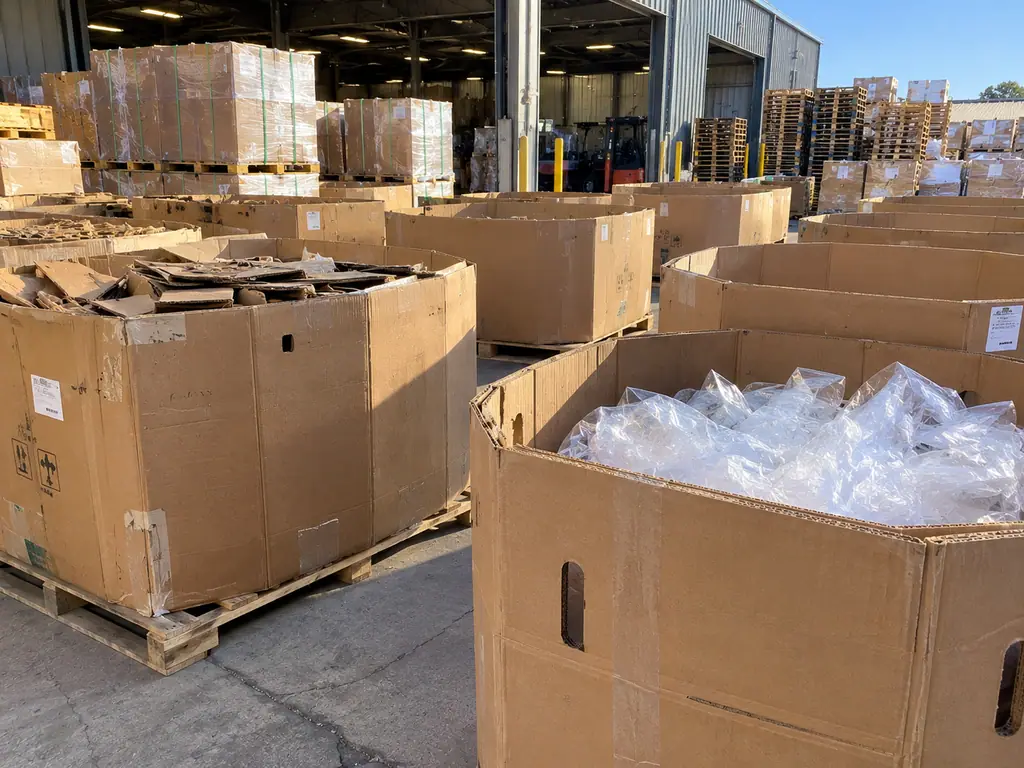
Damage as evidence
Look at enough damaged containers and patterns become unmistakable. The position of the damage is a far better diagnostic than its severity.
If you run a dock, the same exercise works in miniature: set aside a month of damaged units, sort them by where the damage is, and the root cause usually announces itself.
Low corner strikes, one side only
Damage concentrated on the lower third of the vertical corners, consistently on the same side, is almost always an aisle-width problem combined with a turning habit. Operators cut the corner on the same side every time because of how the racking is laid out.
The container is telling you about your aisle, not about your packaging. Widening is rarely practical; adding a guide line on the floor at the pinch point is, and it usually works.
Tine punctures through the lower panel
Clean punctures about four inches above the base, usually in pairs, mean tines entering at the wrong height — typically an operator approaching a double-stacked position and hitting the upper unit.
This is training and signage, not packaging. No practical corrugated specification resists a forklift tine.
Top edge collapse all around
Uniform fray and crush around the entire top perimeter is hand-loading damage. Crews lean on the lip, drag product over it, and over a few dozen cycles the edge dies.
This one is relatively good news: a container worn at the top edge can sometimes be trimmed to a true score, removing exactly the worn part. It also hints that your container may be taller than it should be — crews lean on the lip when they are reaching.
Diagonal crease across one panel
A single diagonal crease running corner to corner across a panel is a lifting failure: the container was moved while partly loaded, or lifted by the lip, or dragged. The crease is the panel buckling under shear.
It usually appears in facilities where containers are moved by hand or with a pallet jack over uneven floor transitions.
Turning the diagnosis into a change
Four observations, four different responses — and only one of them is about buying a different box.
- Low corner strikes → floor guides, aisle layout, V-board protection on the affected side.
- Tine punctures → operator training and position signage.
- Top edge collapse → shorter containers, or quarterly reconditioning as a planned cost.
- Diagonal creases → stop moving partly loaded units; fix floor transitions.
The cost of not looking
A plant replacing containers because of damage it has never categorised is spending money on an unexamined problem. Sorting a month of damage takes a supervisor an hour.
This exercise is often the most useful part of any packaging review — not because the analysis is clever, but because nobody had ever laid the damaged units out and looked at them together.