When the spec cannot flex

New Gaylord Boxes

New bulk boxes made to your footprint, flute and print through partner suppliers, for the loads where a used box will not do.

Export loadsRetail complianceBranded bulkKnown-history programs
At a glance
Quote request
Free, no obligation
Fulfilled by
Partner suppliers
Requests from
Across the US
Pricing
By written quote
Request a quote

Quote new gaylord boxes

Quantity, footprint, height, weight inside and how many trips you need. That is enough for a partner supplier to quote.

US or Canada numbers only

US ZIP code or Canadian postal code

✳ required. Every field is checked before sending so genuine requests never sit behind spam. Your details are shared with partner suppliers in our network to prepare this quote. See the privacy policy.

Sometimes the application wins the argument: export loads under phytosanitary review, a retailer that mandates a printed compliance panel, or a process where container history must be known. For those, new construction is the safer choice.

New gaylords can be specified by wall count, flute combination, bottom style (full flap, partial overlap, die-cut tray), lid style and print. Recycled content varies by mill and grade, so ask the supplier to state it on the specification sheet if it matters to you.

If a used box would do the same job, the quote request is a good place to ask. You can request both and compare.

What to ask for

  • Ask for recycled content to be stated on the spec sheet
  • Ask for a FEFCO-referenced drawing before tooling
  • Ask which test standard the board rating refers to
  • Request used and new quotes side by side
Pricing: Quoted per run by a partner supplier. Footprint, flute, print and volume all move the number.
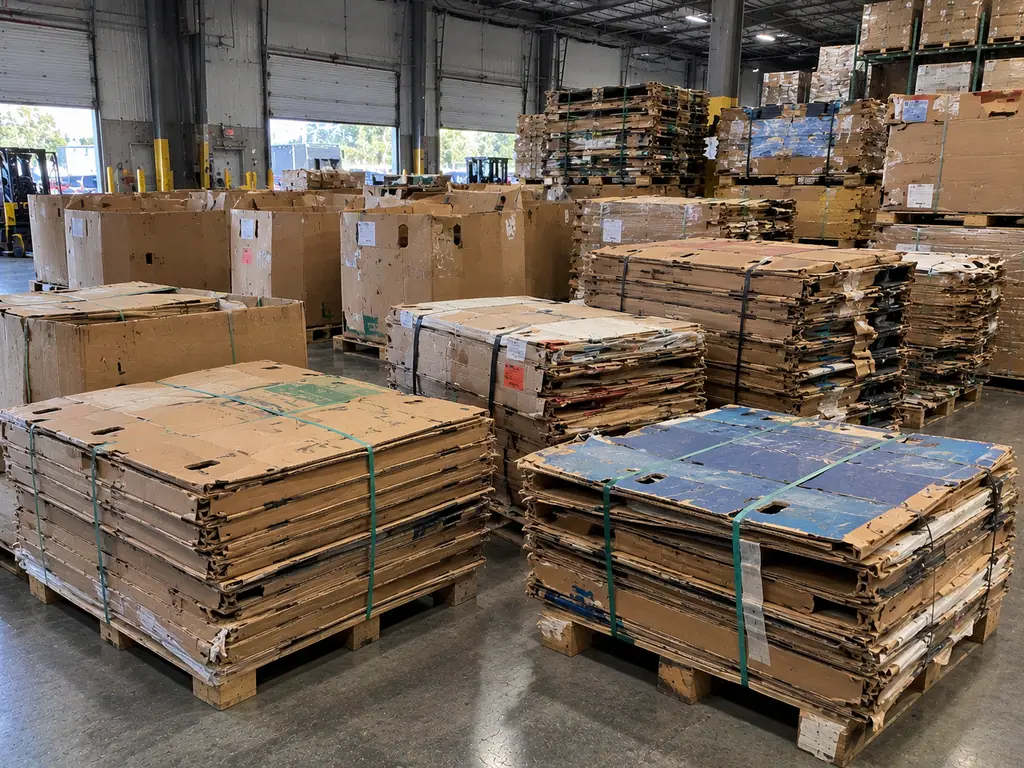
Warehouse floor with pallets of knocked-down gaylord boxes, racking and a forkliftUsed stock
Used containers on pallets, sorted and waiting to be graded.
Best fit

Where this product earns its place

Export loadsRetail complianceBranded bulkKnown-history programsCustom footprints
Reference

Everything you need to specify it

Grades, construction limits, load weights and stacking guidance, as general reference for your request.

The four grades, attribute by attribute
AttributeGrade AGrade BGrade CGrade D
Vertical cornersSquare, no repairSound, light scuffingRepaired or trimmedFailed
Bottom flapsFull strengthSound, minor wearOne replacement allowedDead scores
InteriorClean, no filmLight dustVisible useResidue or staining
PrintNo conflicting marksOld labels presentMultiple marksIrrelevant
SquarenessWithin 1/8"Within 3/8"Visible rackOut of square
Moisture / odourNoneNoneNoneDisqualifying at any grade
Typical useFood-adjacent, customer-facingGeneral bulk, reusable poolsInternal staging, scrapPads, dividers, OCC
Construction, thickness and typical working capacity
ConstructionThicknessTypical max weightStackingTypical use
Single wall C5/32" (4.0 mm)65 lbNot for bulkLids, layer pads, dividers
Double wall BC9/32" (7.1 mm)900 – 1,200 lb1 high loadedGeneral bulk under 1,200 lb
Double wall CC5/16" (7.9 mm)1,000 – 1,300 lb1 high loadedSlightly better cushioning than BC
Triple wall BCC7/16" (11.1 mm)2,200 – 2,500 lb2 high loadedThe bulk workhorse
Triple wall ACC1/2" (12.7 mm)2,400 – 2,700 lb2 high loadedDense product with cushioning need
Five wall AAC5/8" (15.9 mm)3,000 lb+3 high, matched palletsCastings, stampings, export
What a 48 × 40 × 36 inch container weighs when filled — by product
ProductBulk densityLoaded weightConstructionNotes
Mixed apparel, unbaled6 – 9 lb/ft³200 – 300 lbDouble wallVolume-limited. Buy tall, not strong.
Loose foam / film2 – 5 lb/ft³70 – 170 lbDouble wall44 inch bodies pay for themselves here.
Cardboard offcuts7 – 12 lb/ft³230 – 400 lbDouble wallKeep dry or the weight is water.
Plastic regrind flake20 – 30 lb/ft³660 – 1,000 lbDouble / tripleStatic — specify antistatic liner.
Resin pellets (PE, PP)32 – 38 lb/ft³1,050 – 1,250 lbTriple wallOctabin preferred above 1,200 lb.
PET flake22 – 28 lb/ft³730 – 930 lbDouble wallAbrasive — 5 mil liner minimum.
Apples / citrus30 – 35 lb/ft³1,000 – 1,150 lbTriple wallField heat and condensation; 40 inch is the produce default.
Potatoes / root crops38 – 45 lb/ft³1,250 – 1,500 lbTriple wallBottom-layer bruising — use a layer pad.
Frozen fruit / vegetable35 – 42 lb/ft³1,150 – 1,400 lbTriple wallManage the freezer-to-dock transition before stacking.
Grain / seed42 – 50 lb/ft³1,400 – 1,650 lbTriple wallOctabin or bin — hoop stress matters.
Mineral powder55 – 75 lb/ft³1,800 – 2,480 lbTriple / five wallAt the top of what fiber should carry. Check the pallet.
Glass cullet80 – 95 lb/ft³2,650 lb+Five wallFill to weight, not to height. Never fill to the top.
Metal stampings90 – 140 lb/ft³Fill by weightFive wall + V-boardSharp edges: burst strength and corner protection both matter.
Electronic returns, mixed10 – 16 lb/ft³330 – 530 lbDouble wallMixed-height pools work best here.
Books / paper records35 – 45 lb/ft³1,150 – 1,500 lbTriple wallDense and deceptive — people routinely overfill.
Nuts / dried goods28 – 34 lb/ft³930 – 1,120 lbTriple wallGusseted liner, plus eight inches of height.
Safe stacking by construction and storage duration
ConstructionFirst weekAfter 30 daysAfter 90 daysNotes
Double wall BC2 high1 high1 high, inspect weeklyNever stack a partly filled unit.
Triple wall BCC3 high2 high2 high, inspect weeklyTwo high loaded is a common working figure that already allows for storage.
Five wall AAC4 high3 high2 – 3 highMatched pallets only; check deck boards each move.
Empty, nested8 high6 high6 highAbove that the bottom scores compress and will not re-erect square.
Knocked down, flatTo 60 inchesTo 60 inchesTo 48 inchesScores aligned, off the floor, indoors.
Humidity and dwell-time derating — apply before you decide a stack height
Relative humidityDuration under loadStrength factorWhat to do
Below 50%Under 30 days1.00Published stacking limits apply as stated.
Below 50%Over 30 days0.25 – 0.30Divide laboratory compression by about four.
50 – 70%Under 30 days0.85Reduce stack height by one unit on marginal loads.
50 – 70%Over 30 days0.22Two high loaded becomes one high for double wall.
70 – 85%Under 30 days0.65 – 0.75Specify one construction up, or stop stacking.
70 – 85%Over 30 days0.15 – 0.18Do not stack loaded containers. Shorten dwell time.
Above 85%Any0.10 – 0.14Fiber is the wrong container unless dwell is measured in hours.
Before you order

Twelve things to have in front of you

01

Loaded weight at your real fill level

Sets the construction. The single most common mis-specification.

02

Clear height under the lowest rack beam

Sets the maximum container height, minus pallet and clearance.

03

Reach height of whoever loads by hand

Frequently lower than the rack, and the real constraint.

04

Settled product height at target weight

Stops you buying cube you will never fill.

05

Footprint of anything rigid going inside

Inside dimensions, not outside, decide whether it fits.

06

Trips you need from each unit

Decides grade and corner protection.

07

Warehouse humidity and dwell time

Drives the derating, and sometimes a construction step.

08

Dock hours, equipment and trailer limits

Keeps accessorials off your invoice.

09

Liner requirement and food-contact status

Gauge, gusset, grade and length.

10

Pallet grade and footprint

Buy it on the same quote or expect corner failures.

11

Your real deadline

A date gets a date. 'ASAP' gets a question and loses a day.

12

What happens to the empties

Usually the largest single saving in the whole exercise.

Quality control

The twelve-point inspection, in order

What a careful supplier checks on every used unit, and what you can check at receiving. The cheapest rejection happens first, which is why odor and moisture come before anything cosmetic.

01

Odor

Thirty seconds in open air, nose at the opening.

Any persistent smell — instant rejection.
02

Moisture

Hand and meter at the bottom score line where it hides.

Staining above the bottom score, or any delamination.
03

Vertical corners

Thumb pressure at knee, waist and shoulder height.

Hollow give, shear, or crush longer than four inches.
04

Bottom flaps

Fold test on each flap; the score must hold.

Two or more dead scores sends the unit to cutting.
05

Squareness

Diagonal measurement across the open top.

Over 3/8 inch of rack drops the grade.
06

Interior cleanliness

Visual plus a wipe for residue and dust film.

Grease strike-through, product residue, staining.
07

Pest evidence

Corners, flutes and under the bottom flaps.

Frass, gnaw marks or webbing — rejected outright.
08

Wall thickness

Caliper at two points on a cut edge.

Mislabelled construction should be re-specified before it is quoted.
09

Print & labels

Check for conflicting brands and old spec marks.

Covered, or graded down if legibility matters.
10

Top edge

Fray, crush and compression over the perimeter.

Over a quarter of the perimeter → trim candidate.
11

Previous repair

Tape, V-board inserts, replaced flaps from another life.

Should be declared on the quote, not presented as original.
12

Origin lane

Where the unit came from and what was in it.

Industrial origins never enter the food-adjacent lane.
Diagnostics

Eight ways bulk packaging fails

Damage is evidence. Where it appears tells you whether the problem is the container, the pallet, the aisle or the weather.

Failure modes, causes and the fix
FailureWhat it looks likeCausePrevention
Strap cutCrushed line across a vertical corner, half an inch wide.Polyester strap tensioned over an unprotected edge.A V-board corner protector under every strap.
Forklift shearScuff outside, hollow feel inside over a six-inch band.Lateral contact delaminating liner from medium.Floor guides at pinch points; operator training.
Overhang crushFailure at the bottom score, two corners only.Container footprint larger than the pallet deck.Buy pallet and container on the same quote.
Humidity creepBulging walls, leaning stack after weeks of storage.Compression loss above 70% RH compounding under load.Reduce stack height; one construction up; shorter dwell.
Condensation cyclingSoft outer liner after a freezer-to-dock move.Surface below dew point for twenty minutes.No stacking for 24 hours after a temperature transition.
Liner bridgeUneven settle, container out of square after filling.Flat liner bridging the corners under free-flowing product.Gusseted liner sized to the footprint.
Dead scoreBottom flap will not hold its fold.Repeated knock-down and re-erection, or wrong fold line.Collapse along original scores only; train receiving.
Tine puncturePaired holes about four inches above the base.Tines entering at the wrong height on a stacked position.Position signage and double-stack rules.
Bulk container styles, with the code to put on a drawing
StyleCodeDescriptionBottomUsed for
Full-flap bulk boxFEFCO 0201 scaledFour-panel body with top and bottom flaps meeting at the centre.Full overlapThe strongest common bottom. Heavy and dense loads.
Partial-overlap bulk boxFEFCO 0203 scaledFlaps overlap partially rather than fully.Partial overlapLighter loads; slightly less material, meaningfully less bottom strength.
Open-bottom sleeve on trayFEFCO 0300 seriesBody sleeve sitting on a separate die-cut tray or pallet-top sheet.Separate trayReusable pools — the body can be replaced without the tray.
Octagonal body (octabin)Custom scoredEight-sided body, usually with top and bottom frames.Frame or trayFree-flowing solids: resin, grain, powders, nuts.
Telescoping lidFEFCO 0301 capCap sliding over the outside of the body.n/aProtects contents and enables stacking. Order matched to body footprint.
Pallet capDie-cut coverFlat cap sitting over a loaded pallet or container.n/aDust and light protection where a full lid is unnecessary.
Bulk bin with discharge chuteCustom die-cutBody with a die-cut chute panel for gravity discharge.Flat or framePowder and pellet handling lines.
Layer pad / tier sheetFlat blankFlat board between product layers.n/aLoad stability and crush distribution inside the container.
Slotted divider setFEFCO 0900 seriesInterlocking slotted boards forming cells.n/aParts separation — from two to twenty-four cells.
Trim-to-height bodyCut from stockA taller stock body knife-cut down to a true score line.OriginalWhen the height you need is not the height the market has.
Quick conversions for bulk packaging
MeasureImperialMetricNotes
Standard footprint48 × 40 in1,219 × 1,016 mmThe GMA pallet that standardised US distribution.
Triple wall thickness7/16 in11.1 mmTakes about 7/8 in off interior width across both walls.
Typical capacity2,200 lb998 kgTriple wall BCC, evenly distributed, matched pallet.
Container cube at 36"33.3 ft³0.943 m³Outside dimensions, before board thickness.
OCC bale1,000 – 1,400 lb454 – 635 kgTypical bale from a horizontal baler.
Trailer capacity, knocked down400 – 600 units—53-foot dry van; cube limited, never weight limited.
Moisture ceiling for OCC12%12%Above this you are selling water at a penalty.
FAQ

Common questions on this subject

Short answers to common questions. If yours is not covered, ask it on the form and a partner supplier in our network can answer it with your quote.

All 33 answers
Can a logo be printed on used containers?
It is rarely a good idea. Printing on recovered board gives poor registration and inconsistent colour. For branded bulk containers, new production with one or two colour flexo printing is the usual route, and partner suppliers can quote it.
How do I reduce my packaging spend fastest?
Three moves, in order: buy used where it performs as well as new, measure your settled product height and drop unnecessary container height, and sell your empties instead of paying to have them removed.
What exactly is a gaylord box?
A bulk corrugated container sized to a pallet footprint, usually 48×40 inches, built from two to five layers of corrugated board and handled by forklift. The name comes from the Gaylord Container Company; it is now a generic industry term.
Are used gaylord boxes strong enough?
For most applications, yes, provided they are graded properly. Corrugated loses much of its strength on its first compression cycle and much less on later trips. Ask the supplier to state wall count, flute and grade on the quote so you can check it against your load.
How much do used gaylords cost?
Pricing is set by the partner supplier who quotes your request. Grade, wall count, height, quantity and freight all move the number, and freight is usually the biggest variable, so ask for it as a separate line.
What is the minimum order?
It depends on the partner supplier. Used gaylords are usually sold by the banded bundle or the truckload. Put the quantity you need on the form and the supplier will tell you what they can do.
Next step

Ready to price new gaylord boxes?

Send quantity, footprint, height and what goes inside. A partner supplier in our network follows up with grade, construction, quantity and freight.