A trade name that outlived its company
The Gaylord Container Company of Gaylord, Michigan, began producing very large corrugated bulk containers in the mid-twentieth century. The company was absorbed, resold and eventually dissolved; the name stayed attached to the product so firmly that it is now a generic industry term, written lowercase as often as not.
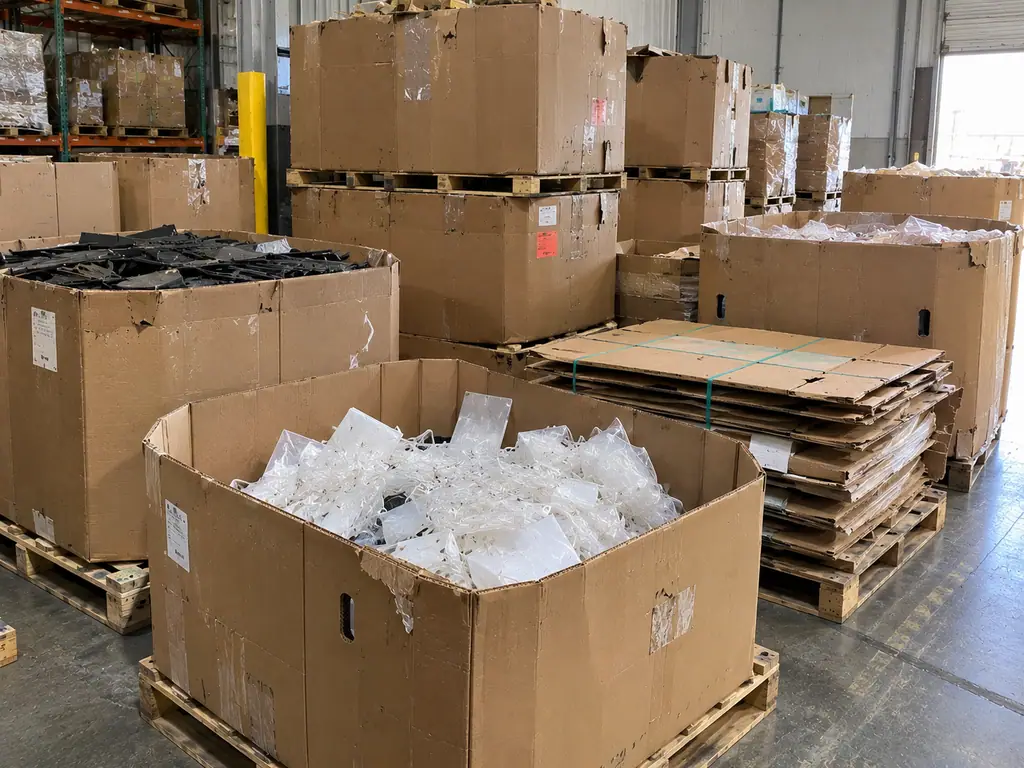
Today a gaylord box means a bulk corrugated container sized to sit on a standard pallet, tall enough to hold between 800 and 3,000 pounds, built from two to five layers of corrugated board, and almost always handled with a forklift rather than by hand.
Anatomy in four parts
Understanding the four components explains nearly every sizing and performance question that follows.
- The body — a single corrugated sheet folded into four or eight sides. Wall count and flute combination determine stacking strength.
- The bottom — full-flap, partial overlap, or an open body riding on a pallet-top sheet. Full flap carries the most weight.
- The lid or cap — telescoping over the body, protecting contents and allowing load stacking.
- The pallet — technically separate, practically inseparable. Footprint mismatch here causes most corner failures.
Why used outperforms expectation
Corrugated board loses a share of its strength on its first compression cycle. After that, loss per cycle is smaller, so a properly graded used triple-wall gaylord often performs close to how it did on its previous trip.
That curve is the entire economic argument for second life: most of the strength depreciation happens before the box ever reaches a resale market, so the buyer of a graded used box captures a container that is both substantially cheaper and functionally comparable.
When to buy new instead
Direct food contact with no liner, export loads under phytosanitary documentation, printed retail compliance panels, and any application where a container failure endangers a person — these justify new construction. Everywhere else, graded used is the better purchase for both the budget and the planet.