Five lists that run a bulk packaging operation
Ordering, receiving, storage, safety and the mistakes to avoid. Written to be printed, laminated and stuck on the wall at the station where each one applies.
- 01Quote request
- Free, no obligation
- 02Fulfilled by
- Partner suppliers
- 03Requests from
- Across the US
- 04Pricing
- By written quote
Twelve things to have in front of you
Have these twelve answers in front of you and any competent supplier can specify your container in one email.
Loaded weight at your real fill level
Sets the construction. The single most common mis-specification.
Clear height under the lowest rack beam
Sets the maximum container height, minus pallet and clearance.
Reach height of whoever loads by hand
Frequently lower than the rack, and the real constraint.
Settled product height at target weight
Stops you buying cube you will never fill.
Footprint of anything rigid going inside
Inside dimensions, not outside, decide whether it fits.
Trips you need from each unit
Decides grade and corner protection.
Warehouse humidity and dwell time
Drives the derating, and sometimes a construction step.
Dock hours, equipment and trailer limits
Keeps accessorials off your invoice.
Liner requirement and food-contact status
Gauge, gusset, grade and length.
Pallet grade and footprint
Buy it on the same quote or expect corner failures.
Your real deadline
A date gets a date. 'ASAP' gets a question and loses a day.
What happens to the empties
Usually the largest single saving in the whole exercise.
The receiving routine, in order
Thirty minutes of structured receiving prevents most disputes that would otherwise surface in week three, when nobody can prove anything.
Photograph the load inside the trailer before unloading
Converts every later conversation from memory into evidence.
Check the trailer floor and bottom layer for water
Corrugated has almost no wet strength; wet stock is fiber.
Count bundles against the bill of lading with the driver present
A shortage found later is an accusation, not a correction.
Open one bundle per pallet and count it
Banding counts are occasionally wrong.
Sample five percent at random, from the middle of bundles
Top-layer inspection is how people get surprised.
Run the odour, moisture, corner, flap and caliper checks
Five tests, fifteen seconds per unit.
Note any exception on the bill of lading before signing
A clean signed BOL weakens every later claim.
Record the sample size and findings on the receiving note
A documented pass protects you as much as a documented fail.
Raise claims promptly, with photographs
Claim windows are short; check the supplier's terms before delivery.
Keep rejected material intact until the claim closes
Nobody can assess material that has been used or disposed of.
Ten rules that keep empties worth money
Empty containers are inventory. They depreciate faster in a yard than almost anything else on your site.
Indoors, always
One serious rain event converts sellable stock into fiber worth a fraction of its value.
Off the floor
Concrete wicks moisture even when it looks dry. Pallet or dunnage underneath.
Flat, scores aligned
Collapsed along original score lines only — never across a vertical corner.
Cap flat stacks at 60 inches
Higher and the bottom scores compress; units will not re-erect square.
Away from dock doors
Door-side stacks take weather, forklift traffic and temperature swings.
Date the stack
A month-year mark makes rotation a decision rather than a guess.
Oldest first
Without a rule, a forgotten pile forms at the back and quietly dies.
Separate food-adjacent stock
Never cross-stack food-origin and industrial-origin containers.
Cover anything that must sit outside
Weighted cover, pallet underneath, edges clear of standing water.
Collect rather than store badly
An extra collection costs freight. A ruined stack costs the whole asset.
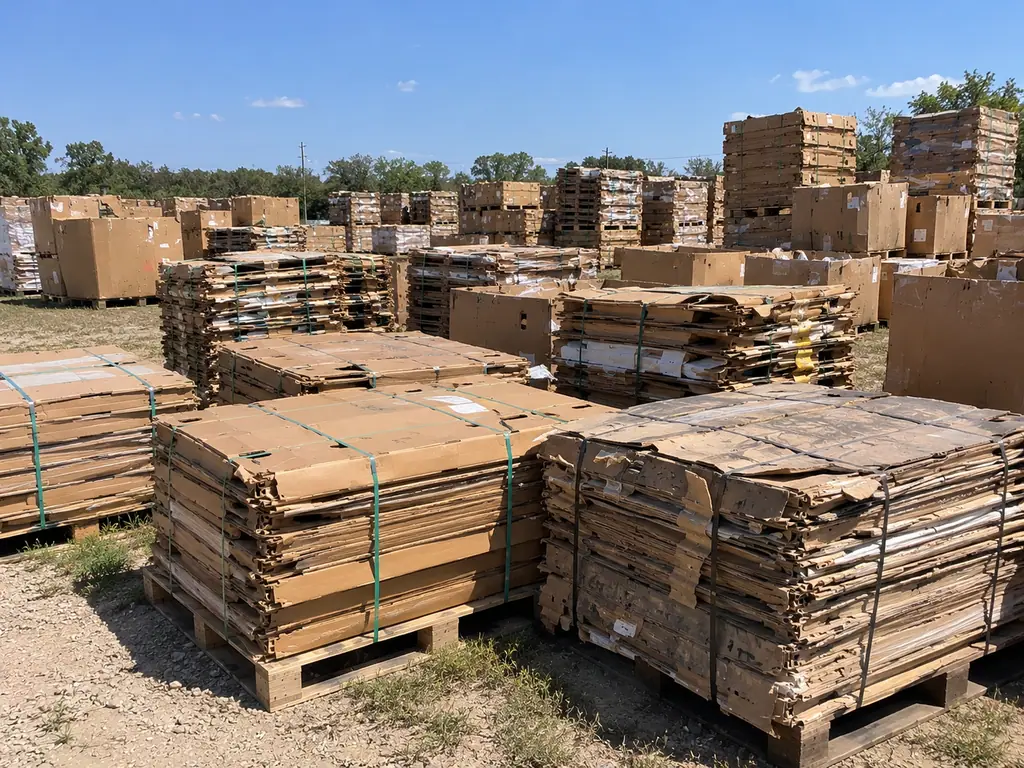 Storage
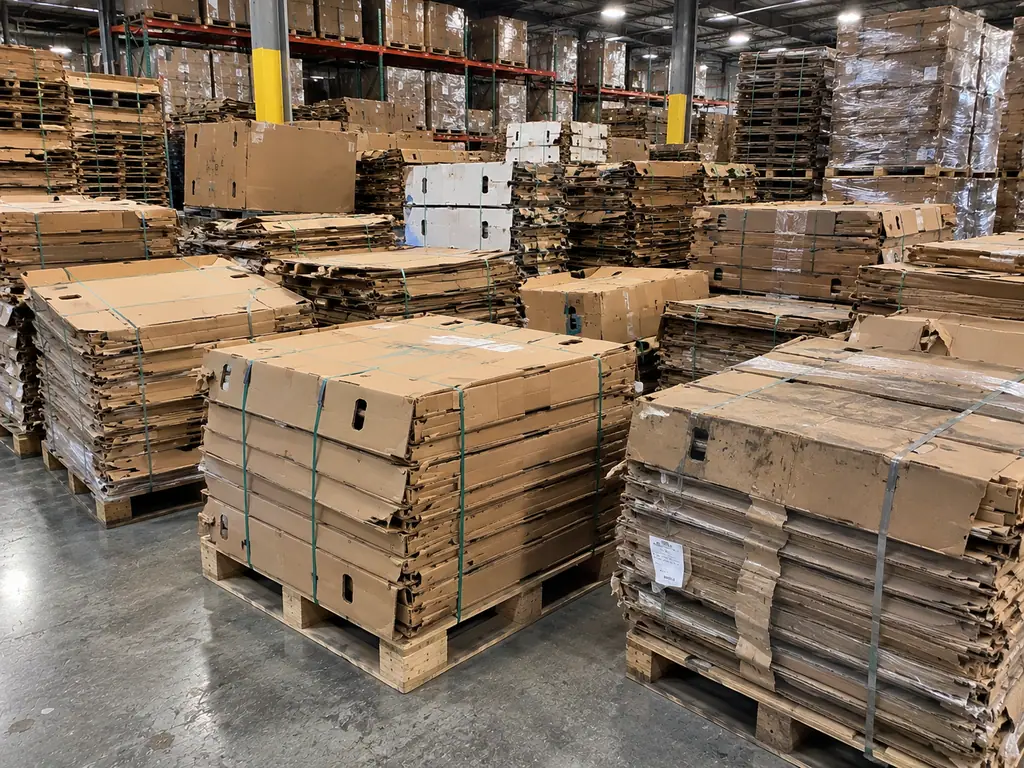 Bundles
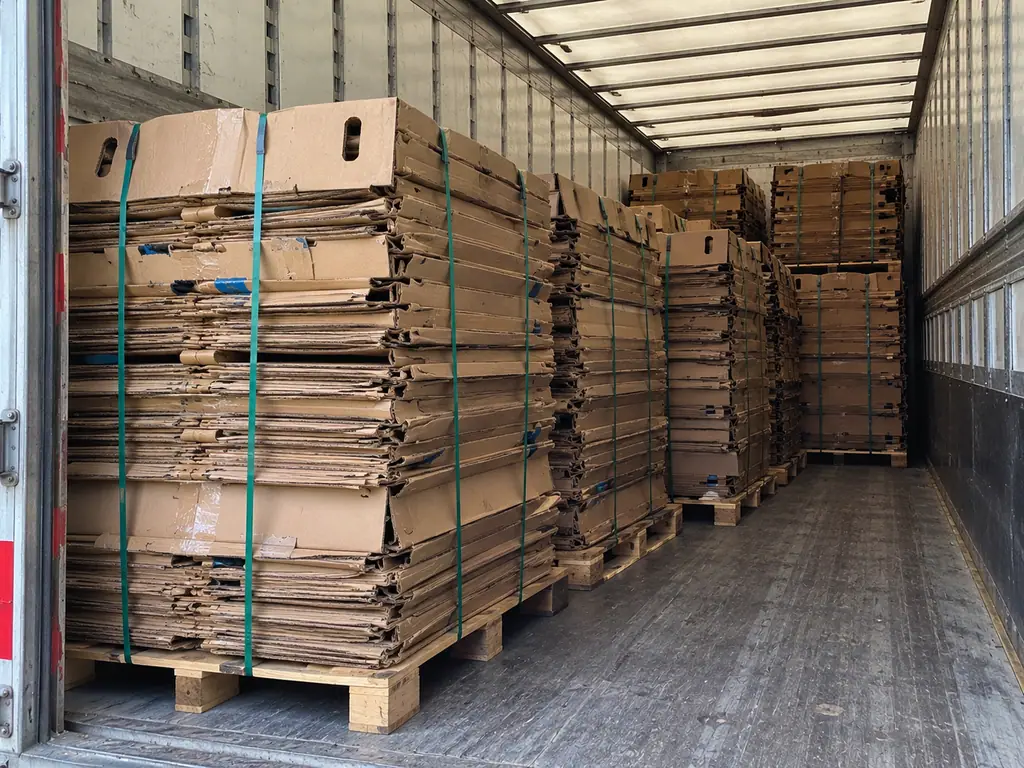 Freight
Ten floor safety rules worth adopting
Sensible floor rules for any dock. Adopt them, particularly the first one.
Never climb into a bulk container
Walls carry vertical load, not point loads. They will fail under a person.
Stack to the derated figure, not the catalogue one
Day one capacity is not day thirty capacity.
Never stack on a partly filled unit
It carries the load entirely on its walls with no internal support.
Inspect corners before stacking
Thumb pressure at three heights. Fifteen seconds per unit.
Keep aisles clear of collapsed stock
Flat board on a floor is a slip hazard and hides spills.
Use two people for tall empties
A 44 inch empty body catches wind and sight lines on a dock.
Cut away from the body, on a table
Most cutting injuries here involve a hand-held blade and a vertical panel.
Ground the discharge station for resin
Antistatic film dissipates charge only if the assembly has somewhere to send it.
Boots and high-visibility vests past the dock line
A reasonable rule for any dock handling bulk containers.
Report every near miss on the stack
A leaning stack is data. It tells you the derating was wrong.
The twelve-point inspection, in order
What a careful supplier checks on every used unit, and what you can check at receiving. The cheapest rejection happens first, which is why odor and moisture come before anything cosmetic.
Odor
Thirty seconds in open air, nose at the opening.
Any persistent smell — instant rejection.Moisture
Hand and meter at the bottom score line where it hides.
Staining above the bottom score, or any delamination.Vertical corners
Thumb pressure at knee, waist and shoulder height.
Hollow give, shear, or crush longer than four inches.Bottom flaps
Fold test on each flap; the score must hold.
Two or more dead scores sends the unit to cutting.Squareness
Diagonal measurement across the open top.
Over 3/8 inch of rack drops the grade.Interior cleanliness
Visual plus a wipe for residue and dust film.
Grease strike-through, product residue, staining.Pest evidence
Corners, flutes and under the bottom flaps.
Frass, gnaw marks or webbing — rejected outright.Wall thickness
Caliper at two points on a cut edge.
Mislabelled construction should be re-specified before it is quoted.Print & labels
Check for conflicting brands and old spec marks.
Covered, or graded down if legibility matters.Top edge
Fray, crush and compression over the perimeter.
Over a quarter of the perimeter → trim candidate.Previous repair
Tape, V-board inserts, replaced flaps from another life.
Should be declared on the quote, not presented as original.Origin lane
Where the unit came from and what was in it.
Industrial origins never enter the food-adjacent lane.Twelve common, expensive mistakes
None of these are exotic. All of them are expensive, and most cost nothing to fix.
| Mistake | What it costs | The fix |
|---|---|---|
| One container specification for every load | Paying for strength and cube most loads never use | Weigh ten loaded containers and split the spec by weight band. |
| Buying new where used performs identically | A higher unit price for the same job | Trial a small batch of graded used units against your worst load. |
| Paying to dispose of sellable empties | Disposal fees on material that could be sold | Collapse along the scores, store indoors, and ask for an offer. |
| Mismatched pallet footprint | Damage claims plus a lost rack level | Buy pallet and container on the same quote. |
| Skipping corner protection on strapped loads | Premature failure of otherwise sound units | V-board under every strap that crosses an edge. |
| Specifying height from habit | Wasted cube and a higher unit price | Measure settled product height and clear rack height. |
| Liner cut flush to the container | Contamination and rework | Interior height plus eight inches, twelve if twist-tied. |
| Flattening containers across the corner | A resellable container becomes recycling | One laminated card at the unload station. |
| Storing empties outdoors over winter | The entire value of the stack | Indoors, off the floor, or more frequent collection. |
| Accepting per-lot grading | Unpredictable receiving and disputes | Ask whether grading is per unit, and what the reject rate is. |
| Comparing unit prices instead of cost per trip | Misdirects every other decision | Divide total annual packaging cost by trips delivered. |
| Buying the annual pool at the seasonal peak | Paying peak prices for stock you could have bought earlier | Shift the buy into the post-peak window where storage allows. |
Common questions on this subject
Short answers to common questions. If yours is not covered, ask it on the form and a partner supplier in our network can answer it with your quote.
All 33 answersWhat is the minimum order?
Who am I dealing with?
What happens if a load arrives damaged?
Can I buy a single box?
How long will containers last in outdoor storage?
How do I reduce my packaging spend fastest?
Related reading
How to Sell Your Empty Gaylords
A dock-level playbook: photographing, counting, grading honestly and getting paid for material you were about to pay to remove.
Read →How to Store 600 Empty Gaylords Without Ruining Them
Empty containers are inventory, not waste — and they depreciate faster in a yard than almost anything else on your site.
Read →Teaching Receiving to Knock Down a Box Correctly
The difference between a resellable container and a sheet of baled fiber is which line somebody folded it on.
Read →A Dock Manager's Guide to Receiving Used Bulk Containers
Thirty minutes of structured receiving prevents the disputes that otherwise surface three weeks later, when nobody can prove anything.
Read →Print them for your dock
Use your browser's print option on this page. Each list is written to be laminated and posted at its station.