The standards, and what each one actually decides
Packaging documentation is full of codes nobody explains. This page lists the ones that commonly govern bulk corrugated and states what each covers. Check the current edition of any standard before you rely on it.
- 01Quote request
- Free, no obligation
- 02Fulfilled by
- Partner suppliers
- 03Requests from
- Across the US
- 04Pricing
- By written quote
What governs what
Some apply to the board, some to the pallet and one to your bales. Knowing which is which saves a lot of correspondence.
| Reference | Body | What it covers | Why it matters here |
|---|---|---|---|
| ASTM D4727 | ASTM International | Corrugated and solid fibreboard specification — board grades, construction and tolerances. | The document a packaging engineer cites when specifying board. |
| ASTM D642 | ASTM International | Compression testing of shipping containers. | The laboratory basis for compression figures, before real-world derating. |
| ASTM D4169 | ASTM International | Performance testing of shipping containers and systems. | Where a customer needs a distribution-cycle test rather than a static number. |
| TAPPI T 811 | TAPPI | Edge crush test of corrugated board. | The procedure behind published ECT values. |
| TAPPI T 810 | TAPPI | Bursting strength (Mullen) of corrugated board. | Legacy carrier metric; still relevant for sharp-edged contents. |
| ISPM-15 | IPPC / FAO | Heat treatment and marking of wood packaging in international trade. | Applies to the pallet, never to the corrugated. Most export holds trace to an illegible stamp. |
| FEFCO codes | FEFCO / ESBO | International numbering for box styles — 0201, 0300 series, trays and sleeves. | The unambiguous way to describe a style on a drawing, instead of 'the normal one'. |
| GMA pallet standard | Grocery Manufacturers Association | 48 × 40 inch stringer pallet dimensions and construction. | Defines the footprint three quarters of the used market sits on. |
| ANSI MH1 | ANSI / MHI | Pallet dimensions, performance and terminology. | The reference for rack load versus floor load figures. |
| ISTA 1A / 3E | ISTA | Pre-shipment transit testing procedures. | Occasionally requested by retail customers for unitised loads. |
| NMFC / freight class | NMFTA | Freight classification for LTL shipments. | Empty corrugated is bulky and light, so class is driven by density — this is why LTL quotes surprise people. |
| Recovered paper grade 11 | ISRI specifications | Old Corrugated Containers, including prohibitive material limits. | What your bales are graded against, and where contamination penalties come from. |
How the standards turn into numbers on a quote
A code is only useful when it produces a figure you can plan around. These three tables are those figures.
| Construction | Thickness | Typical max weight | Stacking | Typical use |
|---|---|---|---|---|
| Single wall C | 5/32" (4.0 mm) | 65 lb | Not for bulk | Lids, layer pads, dividers |
| Double wall BC | 9/32" (7.1 mm) | 900 – 1,200 lb | 1 high loaded | General bulk under 1,200 lb |
| Double wall CC | 5/16" (7.9 mm) | 1,000 – 1,300 lb | 1 high loaded | Slightly better cushioning than BC |
| Triple wall BCC | 7/16" (11.1 mm) | 2,200 – 2,500 lb | 2 high loaded | The bulk workhorse |
| Triple wall ACC | 1/2" (12.7 mm) | 2,400 – 2,700 lb | 2 high loaded | Dense product with cushioning need |
| Five wall AAC | 5/8" (15.9 mm) | 3,000 lb+ | 3 high, matched pallets | Castings, stampings, export |
| Attribute | Grade A | Grade B | Grade C | Grade D |
|---|---|---|---|---|
| Vertical corners | Square, no repair | Sound, light scuffing | Repaired or trimmed | Failed |
| Bottom flaps | Full strength | Sound, minor wear | One replacement allowed | Dead scores |
| Interior | Clean, no film | Light dust | Visible use | Residue or staining |
| No conflicting marks | Old labels present | Multiple marks | Irrelevant | |
| Squareness | Within 1/8" | Within 3/8" | Visible rack | Out of square |
| Moisture / odour | None | None | None | Disqualifying at any grade |
| Typical use | Food-adjacent, customer-facing | General bulk, reusable pools | Internal staging, scrap | Pads, dividers, OCC |
| Style | Code | Description | Bottom | Used for |
|---|---|---|---|---|
| Full-flap bulk box | FEFCO 0201 scaled | Four-panel body with top and bottom flaps meeting at the centre. | Full overlap | The strongest common bottom. Heavy and dense loads. |
| Partial-overlap bulk box | FEFCO 0203 scaled | Flaps overlap partially rather than fully. | Partial overlap | Lighter loads; slightly less material, meaningfully less bottom strength. |
| Open-bottom sleeve on tray | FEFCO 0300 series | Body sleeve sitting on a separate die-cut tray or pallet-top sheet. | Separate tray | Reusable pools — the body can be replaced without the tray. |
| Octagonal body (octabin) | Custom scored | Eight-sided body, usually with top and bottom frames. | Frame or tray | Free-flowing solids: resin, grain, powders, nuts. |
| Telescoping lid | FEFCO 0301 cap | Cap sliding over the outside of the body. | n/a | Protects contents and enables stacking. Order matched to body footprint. |
| Pallet cap | Die-cut cover | Flat cap sitting over a loaded pallet or container. | n/a | Dust and light protection where a full lid is unnecessary. |
| Bulk bin with discharge chute | Custom die-cut | Body with a die-cut chute panel for gravity discharge. | Flat or frame | Powder and pellet handling lines. |
| Layer pad / tier sheet | Flat blank | Flat board between product layers. | n/a | Load stability and crush distribution inside the container. |
| Slotted divider set | FEFCO 0900 series | Interlocking slotted boards forming cells. | n/a | Parts separation — from two to twenty-four cells. |
| Trim-to-height body | Cut from stock | A taller stock body knife-cut down to a true score line. | Original | When the height you need is not the height the market has. |
| Measure | Imperial | Metric | Notes |
|---|---|---|---|
| Standard footprint | 48 × 40 in | 1,219 × 1,016 mm | The GMA pallet that standardised US distribution. |
| Triple wall thickness | 7/16 in | 11.1 mm | Takes about 7/8 in off interior width across both walls. |
| Typical capacity | 2,200 lb | 998 kg | Triple wall BCC, evenly distributed, matched pallet. |
| Container cube at 36" | 33.3 ft³ | 0.943 m³ | Outside dimensions, before board thickness. |
| OCC bale | 1,000 – 1,400 lb | 454 – 635 kg | Typical bale from a horizontal baler. |
| Trailer capacity, knocked down | 400 – 600 units | — | 53-foot dry van; cube limited, never weight limited. |
| Moisture ceiling for OCC | 12% | 12% | Above this you are selling water at a penalty. |
“A certified number on recovered fiber is a measurement from a different box, on a different day, at a different humidity.”
The honest position on standards and recovered material is this: construction can be checked per unit with a caliper. Laboratory-certified performance values belong to a production run, which means they belong to new board.
Where your customer or your auditor requires a certificate, ask for new production with the certificate stated on the quote. Everywhere else, a typical range plus per-unit checks is usually enough.
What the standards look like on the dock
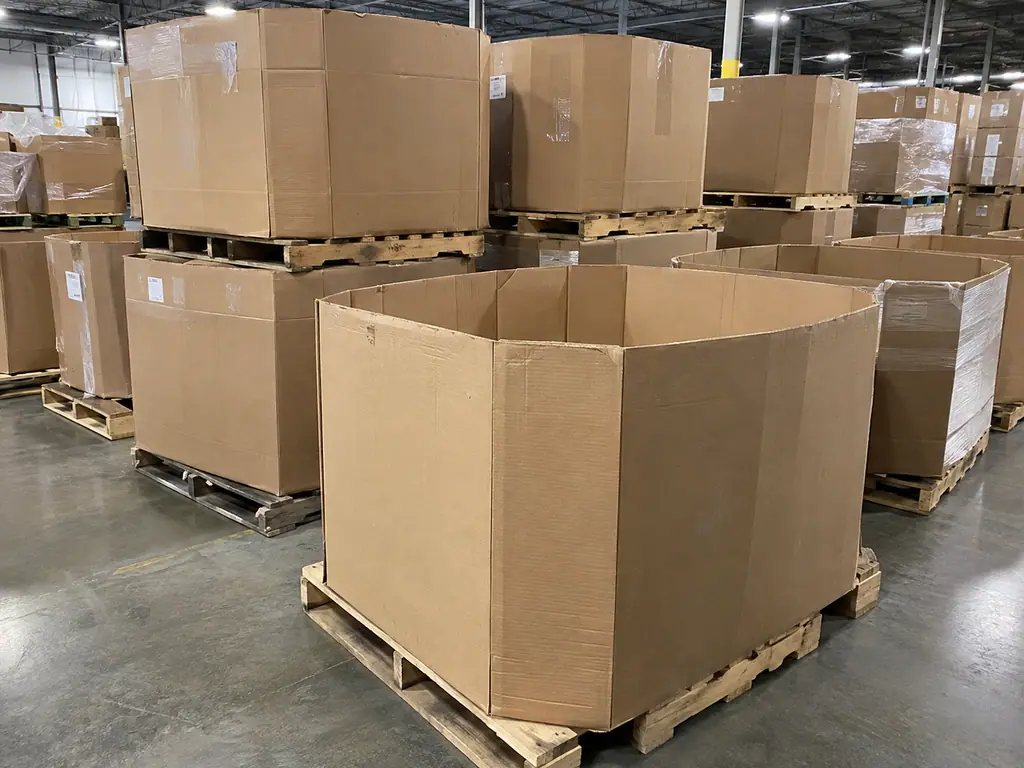 Triple wall
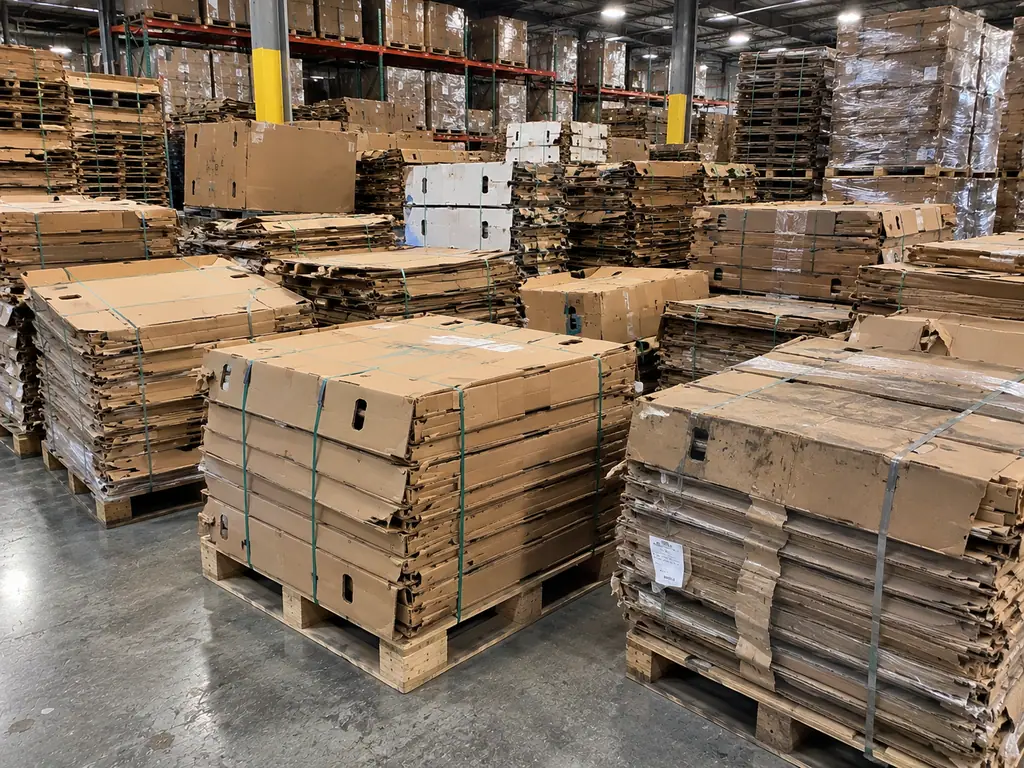 Bundles
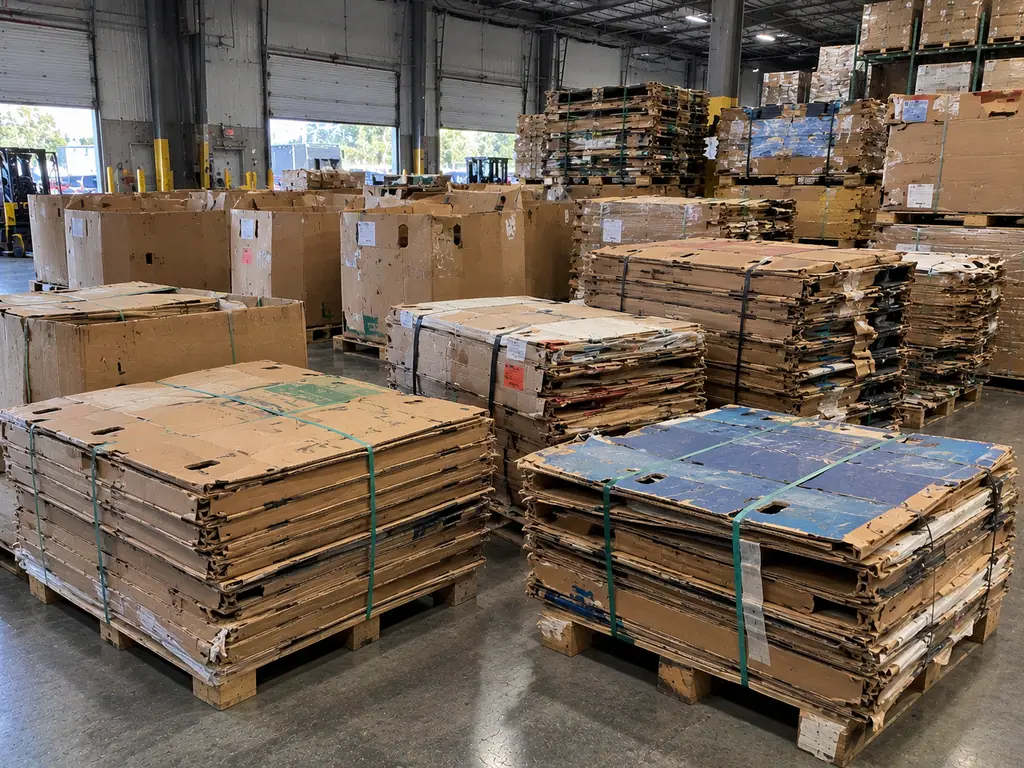 Used stock
Common questions on this subject
Short answers to common questions. If yours is not covered, ask it on the form and a partner supplier in our network can answer it with your quote.
All 33 answersCan I sell my used boxes?
What areas do you serve?
Can I get pallets and liners too?
Can I collect a load myself?
How does selling empties work?
How long will containers last in outdoor storage?
Related reading
ECT, Burst and Stacking Strength
A plain-language guide to the three numbers printed in the box maker's certificate — and which one to actually use.
Read →How to Read a Box Maker's Certificate
That round stamp on the bottom flap contains four claims. Two of them matter, one is historical, and one is frequently wrong on used stock.
Read →How Used Gaylords Are Graded
A, B, C and D are not vibes. Here is what a careful grader looks at, in what order, and what gets rejected outright.
Read →How to Sell Your Empty Gaylords
A dock-level playbook: photographing, counting, grading honestly and getting paid for material you were about to pay to remove.
Read →Send the standard with your request
A partner supplier in our network can say whether they can quote against it, or whether it applies to the material you are buying.