One form, one written reply
The quote form is the way to reach Gaylord Boxes. Your request goes to a partner supplier in our network, who follows up in writing about pricing and availability.
- 01Quote request
- Free, no obligation
- 02Fulfilled by
- Partner suppliers
- 03Requests from
- Across the US
- 04Pricing
- By written quote
What to include
Product, quantity, footprint, height, what goes inside and roughly how heavy it is, your ZIP code, dock hours and your deadline.
Empties to sell
Footprint, wall count, roughly how many and their condition. A partner supplier who buys used containers can follow up with an offer if the numbers work.
Partner suppliers
Gaylord Boxes is a referral service. The supplier who quotes your request sets the price, delivery and terms. See the terms and privacy policy.
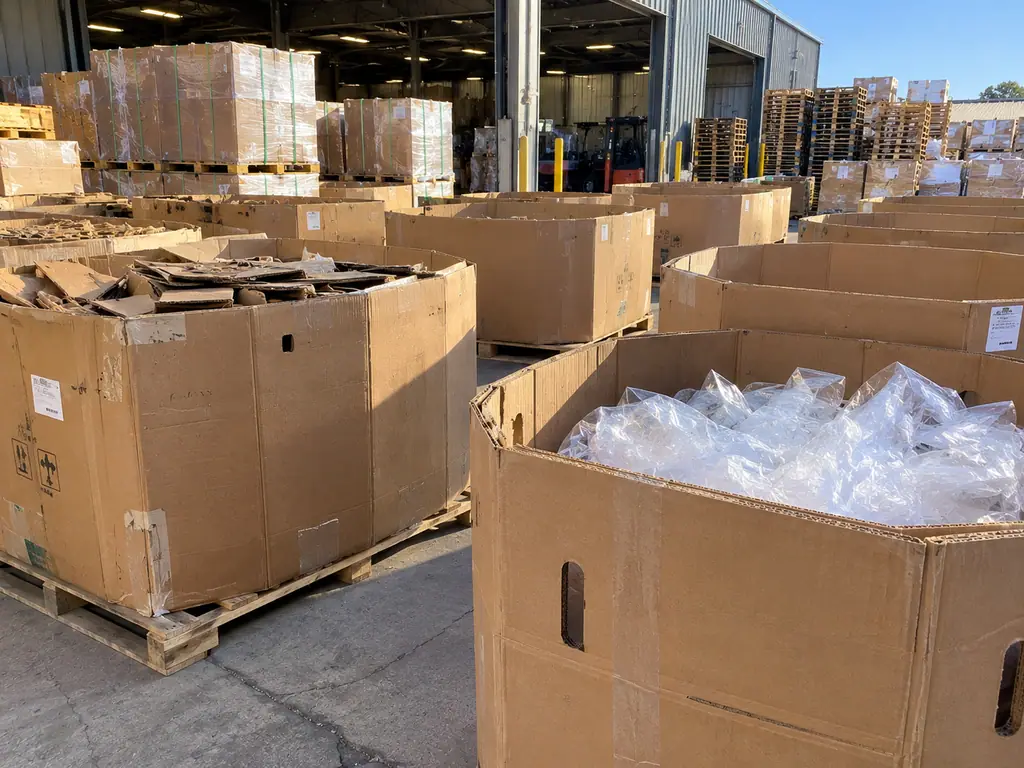 On the dock
Written requests make better quotes
A specification described over a bad line is a specification someone will remember differently. In a business where the difference between double and triple wall is a thousand pounds of capacity, that matters.
So the request is written down: the product, the wall count, the height, the quantity, the location and the date. The supplier quotes against it, and you both have the same record.
“If it is not in writing, it is not a quote.”
Twelve things to have in front of you
Loaded weight at your real fill level
Sets the construction. The single most common mis-specification.
Clear height under the lowest rack beam
Sets the maximum container height, minus pallet and clearance.
Reach height of whoever loads by hand
Frequently lower than the rack, and the real constraint.
Settled product height at target weight
Stops you buying cube you will never fill.
Footprint of anything rigid going inside
Inside dimensions, not outside, decide whether it fits.
Trips you need from each unit
Decides grade and corner protection.
Warehouse humidity and dwell time
Drives the derating, and sometimes a construction step.
Dock hours, equipment and trailer limits
Keeps accessorials off your invoice.
Liner requirement and food-contact status
Gauge, gusset, grade and length.
Pallet grade and footprint
Buy it on the same quote or expect corner failures.
Your real deadline
A date gets a date. 'ASAP' gets a question and loses a day.
What happens to the empties
Usually the largest single saving in the whole exercise.
The receiving routine, in order
Photograph the load inside the trailer before unloading
Converts every later conversation from memory into evidence.
Check the trailer floor and bottom layer for water
Corrugated has almost no wet strength; wet stock is fiber.
Count bundles against the bill of lading with the driver present
A shortage found later is an accusation, not a correction.
Open one bundle per pallet and count it
Banding counts are occasionally wrong.
Sample five percent at random, from the middle of bundles
Top-layer inspection is how people get surprised.
Run the odour, moisture, corner, flap and caliper checks
Five tests, fifteen seconds per unit.
Note any exception on the bill of lading before signing
A clean signed BOL weakens every later claim.
Record the sample size and findings on the receiving note
A documented pass protects you as much as a documented fail.
Raise claims promptly, with photographs
Claim windows are short; check the supplier's terms before delivery.
Keep rejected material intact until the claim closes
Nobody can assess material that has been used or disposed of.
Common questions on this subject
Short answers to common questions. If yours is not covered, ask it on the form and a partner supplier in our network can answer it with your quote.
All 33 answersHow does selling empties work?
What is the minimum order?
Who am I dealing with?
Can I collect a load myself?
Related reading
How to Sell Your Empty Gaylords
A dock-level playbook: photographing, counting, grading honestly and getting paid for material you were about to pay to remove.
Read →What Is a Gaylord Box, Really?
The container named after a Michigan paper company that became the standard bulk box of American warehouses.
Read →How Used Gaylords Are Graded
A, B, C and D are not vibes. Here is what a careful grader looks at, in what order, and what gets rejected outright.
Read →Gaylord Box Sizes Explained
Why 48×40 dominates, when 40×40 is smarter, and how to choose a height that fits your racking rather than your habit.
Read →Send it now
A free, no-obligation quote request. A partner supplier in our network follows up in writing.