Technical · 7 min read

ECT, Burst and Stacking Strength

A plain-language guide to the three numbers printed in the box maker's certificate — and which one to actually use.

At a glance
Quote request
Free, no obligation
Fulfilled by
Partner suppliers
Requests from
Across the US
Pricing
By written quote
Request a quote

Questions on this piece?

Send them with your request. The source page is attached automatically.

US or Canada numbers only

US ZIP code or Canadian postal code

✳ required. Every field is checked before sending so genuine requests never sit behind spam. Your details are shared with partner suppliers in our network to prepare this quote. See the privacy policy.
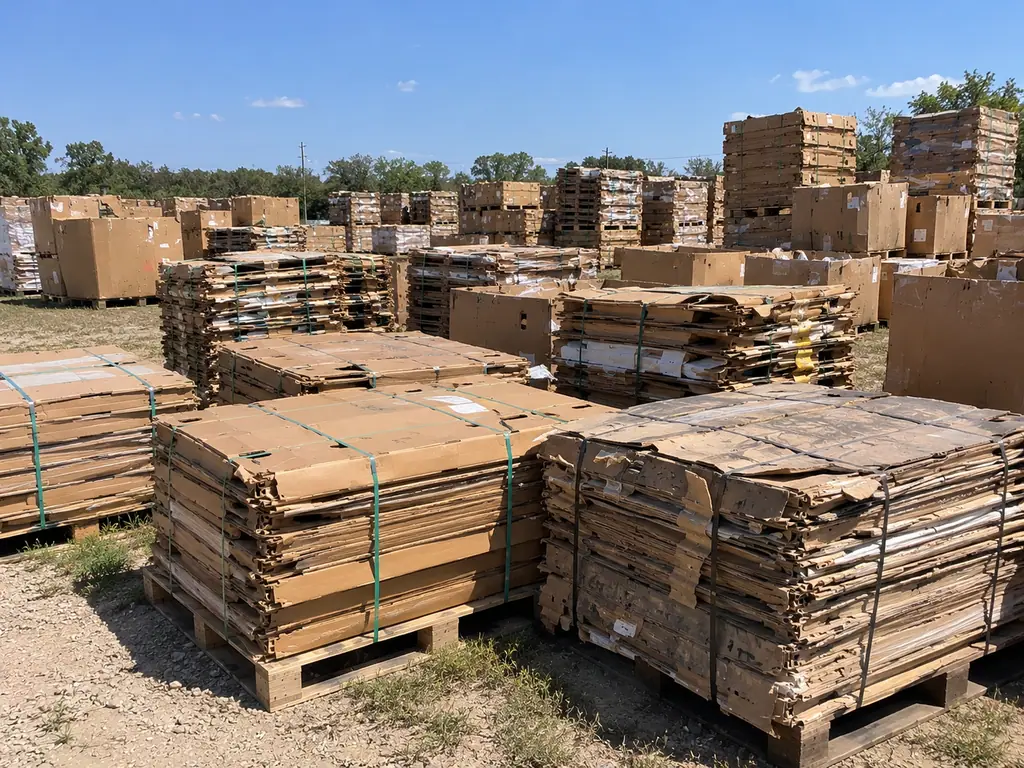
Outdoor storage area with banded pallets of flattened gaylord boxes under a blue skyStorage
Flattened containers on pallets outdoors. Corrugated has little wet strength, so cover it quickly.

Edge Crush Test is the one that matters

ECT measures how much force, in pounds per linear inch, a board edge withstands before crushing. Since a stacked load is carried almost entirely by the vertical walls and corners, ECT predicts stacking performance far better than any other single figure.

Burst strength is a legacy number

Mullen burst test measures puncture resistance and was the historical basis for carrier rules. It still appears on certificates and still matters for sharp-edged contents, but it tells you little about whether you can stack two loaded gaylords.

Deriving a safe stack

Compression strength falls with time under load, humidity and handling. Industry practice applies substantial safety factors, and bulk handling deserves the conservative end.

  • Storage over 30 days: divide laboratory compression by about 4.
  • Humidity above 70% RH: reduce a further 25 – 35%.
  • Any hand-stacking or repeated forklift contact: reduce a further 10 – 15%.
  • Then stack to the result, not to what the corner will physically bear on day one.

A practical rule of thumb

Two high loaded for triple wall, one high loaded for double wall, six high nested empty, and never stack a loaded gaylord on a unit whose corners you have not personally looked at. Following those three rules prevents most stack collapses.

Reference

The tables behind this guide

Construction limits and conversions: the working sheets that sit under the prose.

Construction, thickness and typical working capacity
ConstructionThicknessTypical max weightStackingTypical use
Single wall C5/32" (4.0 mm)65 lbNot for bulkLids, layer pads, dividers
Double wall BC9/32" (7.1 mm)900 – 1,200 lb1 high loadedGeneral bulk under 1,200 lb
Double wall CC5/16" (7.9 mm)1,000 – 1,300 lb1 high loadedSlightly better cushioning than BC
Triple wall BCC7/16" (11.1 mm)2,200 – 2,500 lb2 high loadedThe bulk workhorse
Triple wall ACC1/2" (12.7 mm)2,400 – 2,700 lb2 high loadedDense product with cushioning need
Five wall AAC5/8" (15.9 mm)3,000 lb+3 high, matched palletsCastings, stampings, export
Height selection on a 48 × 40 footprint
HeightCubeFitsBest forWatch for
28"25.9 ft³Low-clearance racking, pick facesDense product, ergonomic sortingDoubles your container count on light goods
36"33.3 ft³Most standard rackingThe default — best price and availabilityCheck reach height if hand-loaded
40"37.0 ft³Cooler racks, harvest linesProduce, bakery, mixed DCTop-edge wear climbs with reach
44"40.7 ft³Tall bays, textile sortingLight bulky goods — foam, film, apparelHand-loading above 44" is uncomfortable
48"44.4 ft³Dedicated tall programsVery light, very bulky loadsTriple wall only; never stack loaded
Quick conversions for bulk packaging
MeasureImperialMetricNotes
Standard footprint48 × 40 in1,219 × 1,016 mmThe GMA pallet that standardised US distribution.
Triple wall thickness7/16 in11.1 mmTakes about 7/8 in off interior width across both walls.
Typical capacity2,200 lb998 kgTriple wall BCC, evenly distributed, matched pallet.
Container cube at 36"33.3 ft³0.943 m³Outside dimensions, before board thickness.
OCC bale1,000 – 1,400 lb454 – 635 kgTypical bale from a horizontal baler.
Trailer capacity, knocked down400 – 600 units—53-foot dry van; cube limited, never weight limited.
Moisture ceiling for OCC12%12%Above this you are selling water at a penalty.
FAQ

Common questions on this subject

Short answers to common questions. If yours is not covered, ask it on the form and a partner supplier in our network can answer it with your quote.

All 33 answers
Can I collect a load myself?
Often, yes. Whether a dock pickup is possible depends on the partner supplier who quotes your request. Say on the form that you would like to collect, and the supplier will confirm whether that works and when.
What exactly is a gaylord box?
A bulk corrugated container sized to a pallet footprint, usually 48×40 inches, built from two to five layers of corrugated board and handled by forklift. The name comes from the Gaylord Container Company; it is now a generic industry term.
Are used gaylord boxes strong enough?
For most applications, yes, provided they are graded properly. Corrugated loses much of its strength on its first compression cycle and much less on later trips. Ask the supplier to state wall count, flute and grade on the quote so you can check it against your load.
How much do used gaylords cost?
Pricing is set by the partner supplier who quotes your request. Grade, wall count, height, quantity and freight all move the number, and freight is usually the biggest variable, so ask for it as a separate line.
What is the minimum order?
It depends on the partner supplier. Used gaylords are usually sold by the banded bundle or the truckload. Put the quantity you need on the form and the supplier will tell you what they can do.
Can I sell my used boxes?
Often, yes. Send photographs and a count through the form. A partner supplier who buys used containers reviews them and, if the numbers work, makes an offer and arranges collection.
Next step

Apply this to your load

One form and a free, no-obligation request. A partner supplier in our network follows up with grade, construction and freight.