Practical guides, written down
No gated PDFs, no email walls, no webinars. Grading standards, sizing logic, stacking strength, liner selection and dock-level selling advice, all readable right now.
- 01Quote request
- Free, no obligation
- 02Fulfilled by
- Partner suppliers
- 03Requests from
- Across the US
- 04Pricing
- By written quote
Pick where to start
Articles & Guides
6 long-form pieces on grading, sizing, strength, liners and selling.
Open →FAQ
14 direct answers on pricing, minimums, strength and more.
Open →Fiber Glossary
24 terms from bale to wet strength, defined without jargon.
Open →The Blog
Long-form posts on operations, freight and buying, filed by category and year.
Open →Load Weights
What a filled container weighs, for sixteen common products.
Open →Standards
ASTM, TAPPI, FEFCO, ISPM-15 and what each one actually decides.
Open →Troubleshooting
Twelve symptoms with cause, immediate action and prevention.
Open →Operating Checklists
Ordering, receiving, storage and safety — written to be printed.
Open →Start with these four
What Is a Gaylord Box, Really?
The container named after a Michigan paper company that became the standard bulk box of American warehouses.
Buying Guide · 6 minHow Used Gaylords Are Graded
A, B, C and D are not vibes. Here is what a careful grader looks at, in what order, and what gets rejected outright.
Sizing · 8 minGaylord Box Sizes Explained
Why 48×40 dominates, when 40×40 is smarter, and how to choose a height that fits your racking rather than your habit.
Technical · 7 minECT, Burst and Stacking Strength
A plain-language guide to the three numbers printed in the box maker's certificate — and which one to actually use.
“A buyer who understands flute combinations gets better quotes and fewer surprises.”
Packaging is sold on confusion more often than it should be. Specification knowledge kept behind a sales call leads to more mistakes per load.
Read everything, specify it yourself, and then request a quote with the grade and construction you want. The size guide is the best place to start.
The tables, not just the prose
Construction limits and conversions, as general reference.
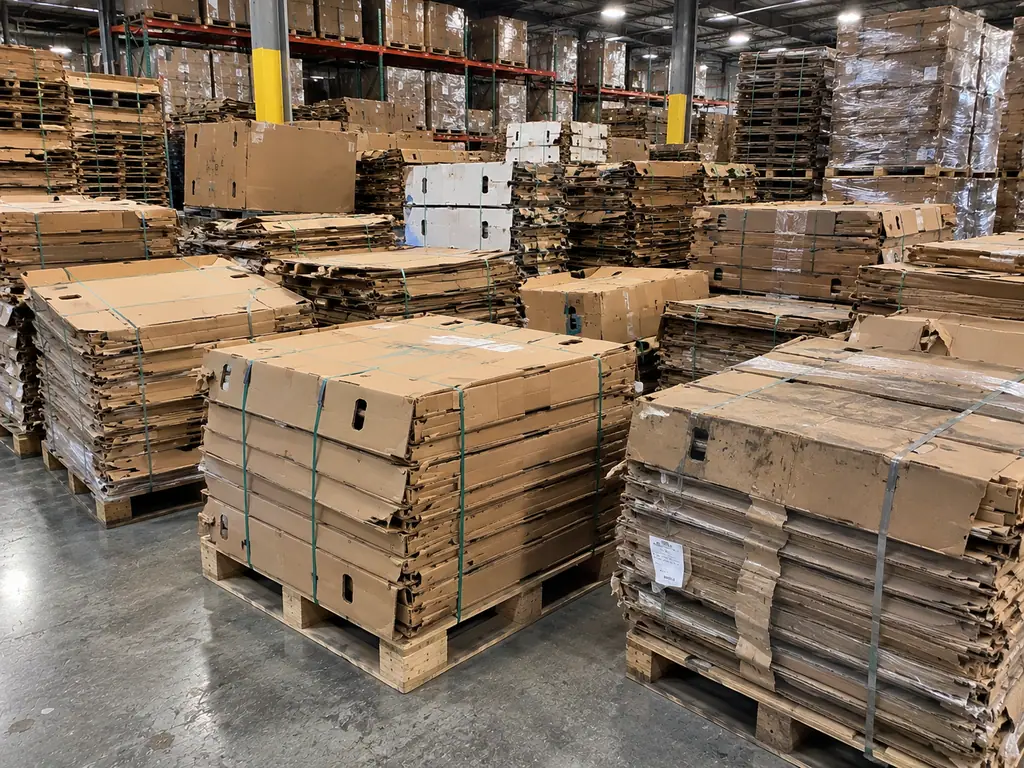 Bundles
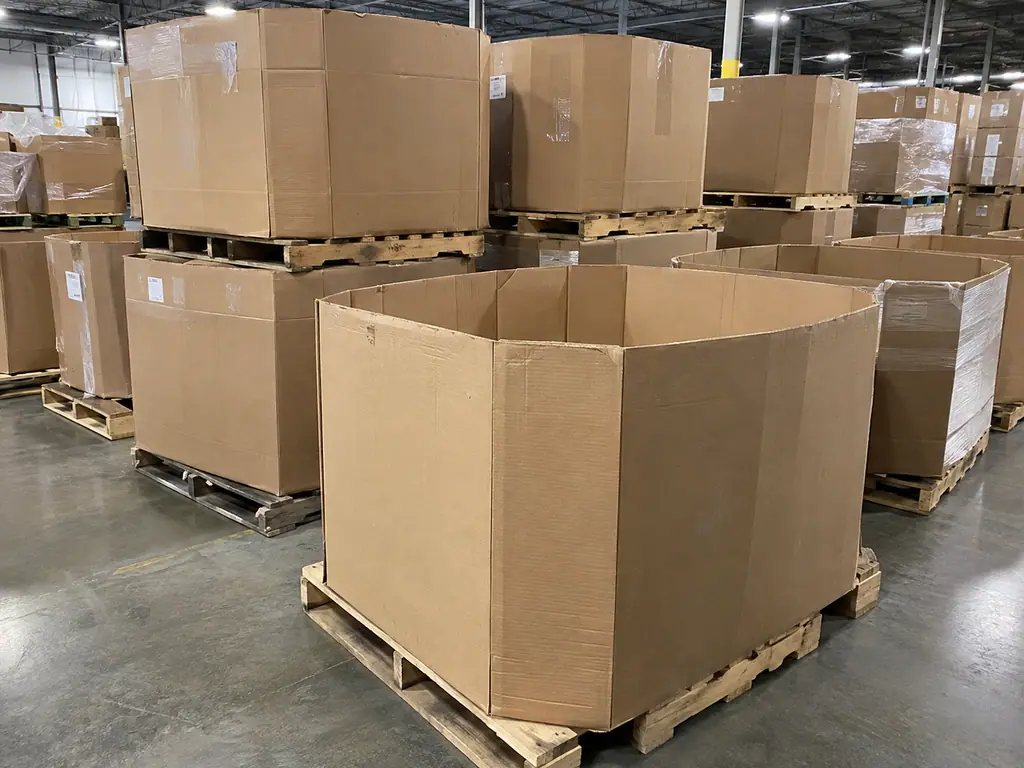 Triple wall
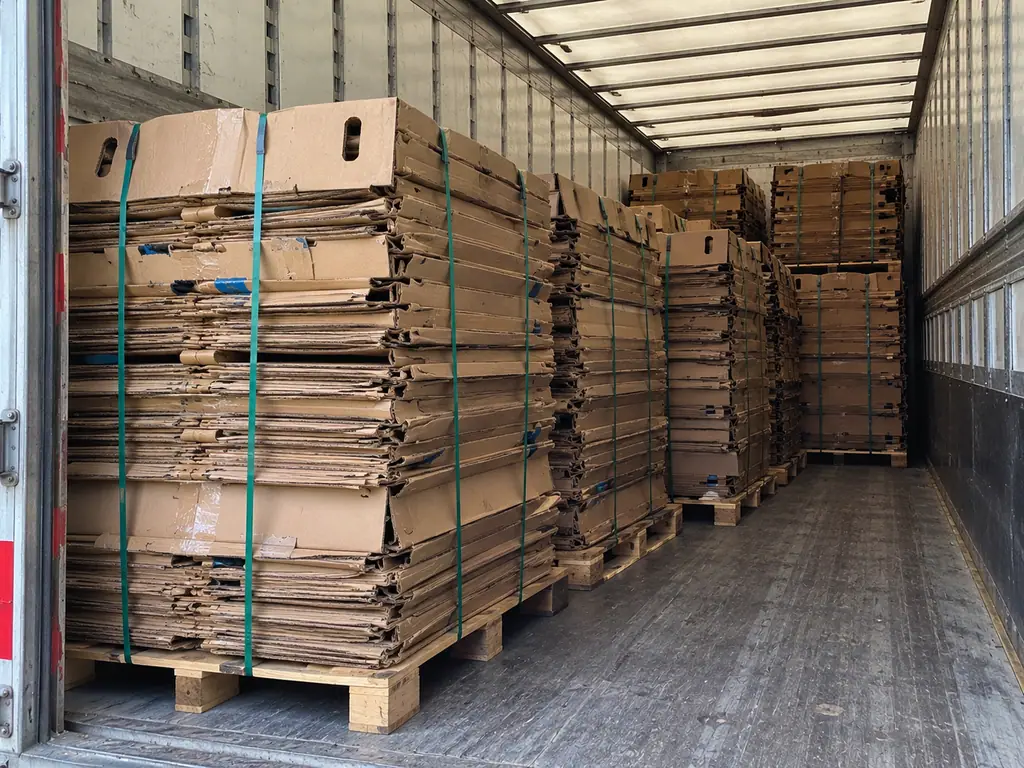 Freight
| Construction | Thickness | Typical max weight | Stacking | Typical use |
|---|---|---|---|---|
| Single wall C | 5/32" (4.0 mm) | 65 lb | Not for bulk | Lids, layer pads, dividers |
| Double wall BC | 9/32" (7.1 mm) | 900 – 1,200 lb | 1 high loaded | General bulk under 1,200 lb |
| Double wall CC | 5/16" (7.9 mm) | 1,000 – 1,300 lb | 1 high loaded | Slightly better cushioning than BC |
| Triple wall BCC | 7/16" (11.1 mm) | 2,200 – 2,500 lb | 2 high loaded | The bulk workhorse |
| Triple wall ACC | 1/2" (12.7 mm) | 2,400 – 2,700 lb | 2 high loaded | Dense product with cushioning need |
| Five wall AAC | 5/8" (15.9 mm) | 3,000 lb+ | 3 high, matched pallets | Castings, stampings, export |
| Measure | Imperial | Metric | Notes |
|---|---|---|---|
| Standard footprint | 48 × 40 in | 1,219 × 1,016 mm | The GMA pallet that standardised US distribution. |
| Triple wall thickness | 7/16 in | 11.1 mm | Takes about 7/8 in off interior width across both walls. |
| Typical capacity | 2,200 lb | 998 kg | Triple wall BCC, evenly distributed, matched pallet. |
| Container cube at 36" | 33.3 ft³ | 0.943 m³ | Outside dimensions, before board thickness. |
| OCC bale | 1,000 – 1,400 lb | 454 – 635 kg | Typical bale from a horizontal baler. |
| Trailer capacity, knocked down | 400 – 600 units | — | 53-foot dry van; cube limited, never weight limited. |
| Moisture ceiling for OCC | 12% | 12% | Above this you are selling water at a penalty. |
The twelve-point inspection, in order
What a careful supplier checks on every used unit, and what you can check at receiving. The cheapest rejection happens first, which is why odor and moisture come before anything cosmetic.
Odor
Thirty seconds in open air, nose at the opening.
Any persistent smell — instant rejection.Moisture
Hand and meter at the bottom score line where it hides.
Staining above the bottom score, or any delamination.Vertical corners
Thumb pressure at knee, waist and shoulder height.
Hollow give, shear, or crush longer than four inches.Bottom flaps
Fold test on each flap; the score must hold.
Two or more dead scores sends the unit to cutting.Squareness
Diagonal measurement across the open top.
Over 3/8 inch of rack drops the grade.Interior cleanliness
Visual plus a wipe for residue and dust film.
Grease strike-through, product residue, staining.Pest evidence
Corners, flutes and under the bottom flaps.
Frass, gnaw marks or webbing — rejected outright.Wall thickness
Caliper at two points on a cut edge.
Mislabelled construction should be re-specified before it is quoted.Print & labels
Check for conflicting brands and old spec marks.
Covered, or graded down if legibility matters.Top edge
Fray, crush and compression over the perimeter.
Over a quarter of the perimeter → trim candidate.Previous repair
Tape, V-board inserts, replaced flaps from another life.
Should be declared on the quote, not presented as original.Origin lane
Where the unit came from and what was in it.
Industrial origins never enter the food-adjacent lane.Eight ways bulk packaging fails
Damage is evidence. Where it appears tells you whether the problem is the container, the pallet, the aisle or the weather.
| Failure | What it looks like | Cause | Prevention |
|---|---|---|---|
| Strap cut | Crushed line across a vertical corner, half an inch wide. | Polyester strap tensioned over an unprotected edge. | A V-board corner protector under every strap. |
| Forklift shear | Scuff outside, hollow feel inside over a six-inch band. | Lateral contact delaminating liner from medium. | Floor guides at pinch points; operator training. |
| Overhang crush | Failure at the bottom score, two corners only. | Container footprint larger than the pallet deck. | Buy pallet and container on the same quote. |
| Humidity creep | Bulging walls, leaning stack after weeks of storage. | Compression loss above 70% RH compounding under load. | Reduce stack height; one construction up; shorter dwell. |
| Condensation cycling | Soft outer liner after a freezer-to-dock move. | Surface below dew point for twenty minutes. | No stacking for 24 hours after a temperature transition. |
| Liner bridge | Uneven settle, container out of square after filling. | Flat liner bridging the corners under free-flowing product. | Gusseted liner sized to the footprint. |
| Dead score | Bottom flap will not hold its fold. | Repeated knock-down and re-erection, or wrong fold line. | Collapse along original scores only; train receiving. |
| Tine puncture | Paired holes about four inches above the base. | Tines entering at the wrong height on a stacked position. | Position signage and double-stack rules. |
Read it all, then send the hard question
Add it to your quote request and a partner supplier in our network can answer it.