Technical · October 12, 2023 · 7 min read

Humidity, Gulf Warehouses and the Strength You Quietly Lose

Corrugated loses a meaningful share of its compression strength in high humidity. Most plants have never measured theirs.

At a glance
Quote request
Free, no obligation
Fulfilled by
Partner suppliers
Requests from
Across the US
Pricing
By written quote
Request a quote

Put this to work on your load

Free and no obligation. The form notes which page you were reading, and a partner supplier in our network follows up.

US or Canada numbers only

US ZIP code or Canadian postal code

✳ required. Every field is checked before sending so genuine requests never sit behind spam. Your details are shared with partner suppliers in our network to prepare this quote. See the privacy policy.
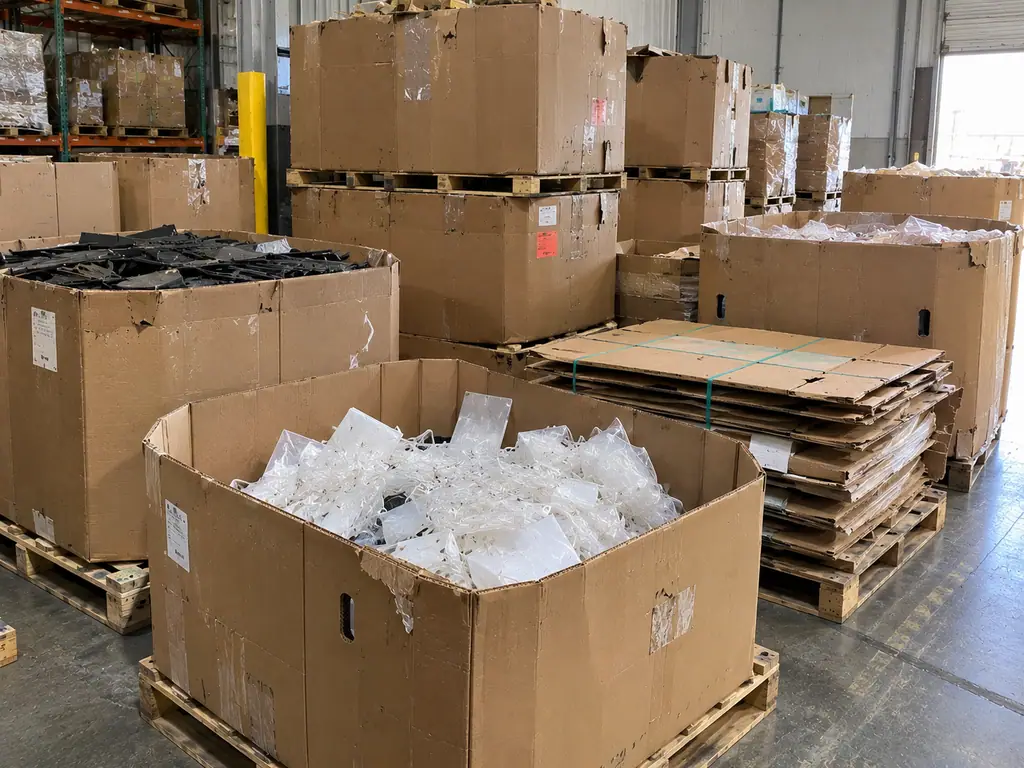
Bulk containers filled with lined plastic components beside stacks of flattened boardIn service
Lined containers in service on a 48×40 footprint.

Paper is hygroscopic, and that is the whole problem

Corrugated board absorbs moisture from the air until it reaches equilibrium with its surroundings. As moisture content rises, the hydrogen bonds between cellulose fibres weaken, and the board's compression strength falls. This is not a defect; it is what paper is.

The relationship is steeper than most people expect. As relative humidity climbs, corrugated board loses a large share of its compression strength, and ordinary summer conditions across much of the southeastern United States are enough to matter.

Where this bites

Unconditioned warehouses in the Gulf states and the lower Mississippi valley routinely sit above seventy percent for months. So do cold-storage anterooms, wash-down areas in food plants, and any dock with an open door in August.

The failure mode is not dramatic. Stacks lean. Bottom units bulge slightly. Then one unit buckles, usually on a Monday after a humid weekend, and a thousand pounds of product arrives on the floor.

What to do about it

The first move is to find out what your actual conditions are. A hygrometer is inexpensive. Put it on a rack upright at pallet height, not in the office, and read it weekly for a month across the worst season you have.

With that number in hand, three responses are available, in order of cost.

  • Reduce stack height. Free, immediate, and the right first response in a humid building.
  • Specify one construction up — double wall to triple, triple to five wall — for the affected area only.
  • Shorten dwell time. Compression loss under sustained load compounds with humidity; a container stored four days is in a different world from one stored four months.
  • Condition the space. Expensive, and almost never justified by packaging alone, but sometimes the product requires it anyway.

The cold-storage special case

Cold itself does very little harm to corrugated. The damage happens in the transition: a container moving from a 0°F freezer into a 75°F dock at eighty percent humidity will condense moisture across its entire surface within minutes.

Rules that work: specify one construction up, keep liners gathered rather than sealed so the interior can breathe, and do not stack anything during the first twenty-four hours after a temperature transition. Plants that follow those three rules stop having cold-chain packaging failures almost entirely.

Why used stock comes in ranges

People occasionally ask why used stock is described by a strength range rather than a single number. Humidity is a large part of the answer. A board's measured strength depends on the moisture it is carrying at the moment of the test, which depends on where it has been.

What can be checked per unit is the construction — wall count and flute combination, measured with a caliper. The strength range follows from the construction. A single certified number on recovered fiber is a measurement from a different box on a different day.

Takeaway: An inexpensive hygrometer on a rack upright is about the cheapest packaging engineering available.
Newer postWhat a 53-Foot Trailer Really HoldsOlder postThe Used Gaylord Market, Month by Month
Reference

The tables this post refers to

Construction reference for the figures discussed above.

Construction, thickness and typical working capacity
ConstructionThicknessTypical max weightStackingTypical use
Single wall C5/32" (4.0 mm)65 lbNot for bulkLids, layer pads, dividers
Double wall BC9/32" (7.1 mm)900 – 1,200 lb1 high loadedGeneral bulk under 1,200 lb
Double wall CC5/16" (7.9 mm)1,000 – 1,300 lb1 high loadedSlightly better cushioning than BC
Triple wall BCC7/16" (11.1 mm)2,200 – 2,500 lb2 high loadedThe bulk workhorse
Triple wall ACC1/2" (12.7 mm)2,400 – 2,700 lb2 high loadedDense product with cushioning need
Five wall AAC5/8" (15.9 mm)3,000 lb+3 high, matched palletsCastings, stampings, export
FAQ

Common questions on this subject

Short answers to common questions. If yours is not covered, ask it on the form and a partner supplier in our network can answer it with your quote.

All 33 answers
How long will containers last in outdoor storage?
Not long. Corrugated has almost no wet strength; one serious rain event can turn sellable stock into recycling. If you have no indoor space, schedule collections more often instead.
What exactly is a gaylord box?
A bulk corrugated container sized to a pallet footprint, usually 48×40 inches, built from two to five layers of corrugated board and handled by forklift. The name comes from the Gaylord Container Company; it is now a generic industry term.
Are used gaylord boxes strong enough?
For most applications, yes, provided they are graded properly. Corrugated loses much of its strength on its first compression cycle and much less on later trips. Ask the supplier to state wall count, flute and grade on the quote so you can check it against your load.
How much do used gaylords cost?
Pricing is set by the partner supplier who quotes your request. Grade, wall count, height, quantity and freight all move the number, and freight is usually the biggest variable, so ask for it as a separate line.
What is the minimum order?
It depends on the partner supplier. Used gaylords are usually sold by the banded bundle or the truckload. Put the quantity you need on the form and the supplier will tell you what they can do.
Can I sell my used boxes?
Often, yes. Send photographs and a count through the form. A partner supplier who buys used containers reviews them and, if the numbers work, makes an offer and arranges collection.
Next step

Apply it to your actual containers

One free, no-obligation request. A partner supplier in our network follows up with grade, flute, height and freight.