Technical · January 16, 2024 · 7 min read

Gaylords in Cold Storage: Condensation, Not Cold, Is the Enemy

Freezers do not destroy corrugated. The twenty minutes between the freezer and the dock destroys corrugated.

At a glance
Quote request
Free, no obligation
Fulfilled by
Partner suppliers
Requests from
Across the US
Pricing
By written quote
Request a quote

Put this to work on your load

Free and no obligation. The form notes which page you were reading, and a partner supplier in our network follows up.

US or Canada numbers only

US ZIP code or Canadian postal code

✳ required. Every field is checked before sending so genuine requests never sit behind spam. Your details are shared with partner suppliers in our network to prepare this quote. See the privacy policy.
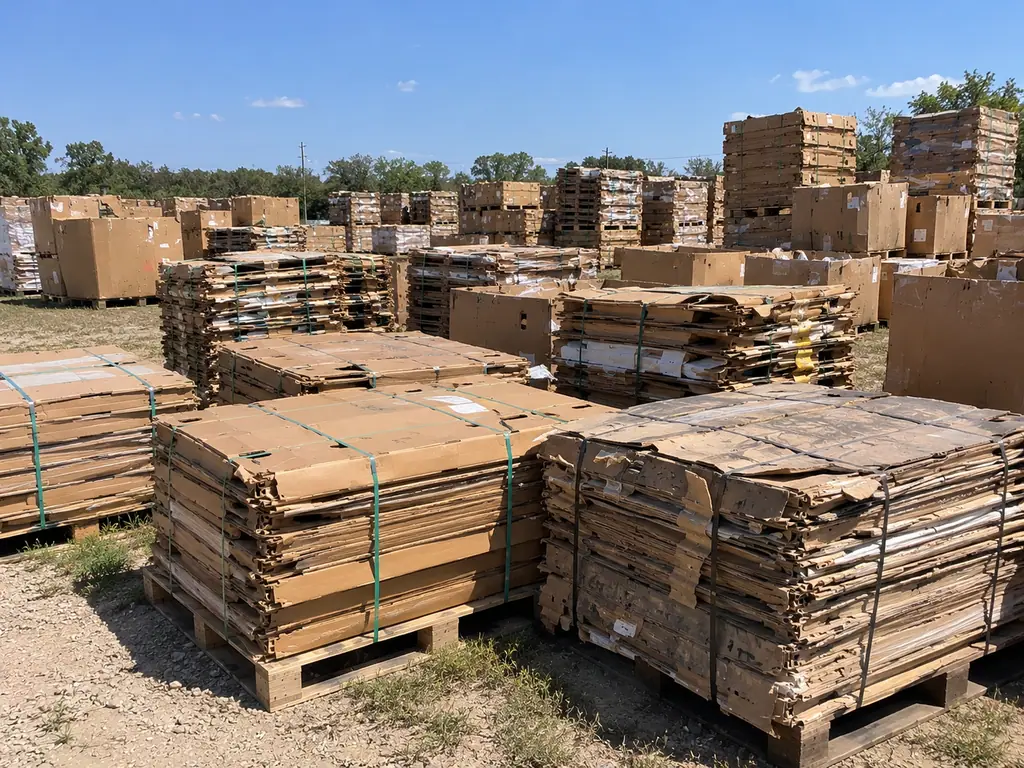
Outdoor storage area with banded pallets of flattened gaylord boxes under a blue skyStorage
Flattened containers on pallets outdoors. Corrugated has little wet strength, so cover it quickly.

A common misconception

Buyers in frozen and chilled supply chains frequently assume corrugated cannot handle their environment. In a steady-state freezer, the opposite is true: air at 0°F holds almost no moisture, board moisture content drops, and compression strength actually rises slightly compared with ambient conditions.

The problem is never the cold. It is every moment the container spends crossing a temperature boundary.

What happens during the transition

Move a frozen container into a warm, humid dock and the surface sits far below the dew point. Moisture condenses across the whole exterior within minutes, and the board begins absorbing it immediately.

Within twenty minutes the outer liner can gain enough moisture to lose a quarter of its compression strength. Stack another unit on it during that window and the bottom container deforms permanently, even though it was sound when it left the freezer.

Five rules that work

These come from watching cold-chain customers succeed and fail over about a decade. None of them requires capital spending.

  • Specify one construction up for cold chain — triple wall where ambient would use double.
  • Do not stack during the first twenty-four hours after a temperature transition.
  • Keep liners gathered rather than sealed, so the interior can equalise instead of trapping condensate.
  • Stage transitions through a tempered anteroom where one exists; the smaller the temperature step, the less condensate.
  • Never store empty containers in the freezer anteroom. They cycle constantly and degrade for no reason.

Liner choice in cold applications

Sealed polyethylene is the instinctive choice for frozen product and often the wrong one. A sealed liner traps moisture against the board when the container warms, producing exactly the sustained wet contact you were trying to avoid.

Gathered and twist-tied works better in most frozen applications. Where a true moisture barrier is required by the product, a foil-barrier liner with the seal above the fill line is the better compromise — it protects the contents without pressing a wet film against the inner liner.

A typical cold-chain setup

Cold-chain users commonly run triple-wall 48×40 at 36 or 40 inches, food-adjacent graded stock with documented origin, paired with suitable liners and sound pallets underneath. Ask your supplier about the condition of the top edge in particular, because that is the usual failure point in cold chain.

If you are currently buying new containers for a frozen application because someone decided used would not survive, that decision is probably worth revisiting with a sample run. It usually comes down to transition management, not to the box.

Takeaway: Manage the temperature transition and corrugated performs in cold chain indefinitely.
Newer postBuying Bulk Packaging Without a Packaging EngineerOlder postWhat a 53-Foot Trailer Really Holds
Reference

The tables this post refers to

Construction reference for the figures discussed above.

Construction, thickness and typical working capacity
ConstructionThicknessTypical max weightStackingTypical use
Single wall C5/32" (4.0 mm)65 lbNot for bulkLids, layer pads, dividers
Double wall BC9/32" (7.1 mm)900 – 1,200 lb1 high loadedGeneral bulk under 1,200 lb
Double wall CC5/16" (7.9 mm)1,000 – 1,300 lb1 high loadedSlightly better cushioning than BC
Triple wall BCC7/16" (11.1 mm)2,200 – 2,500 lb2 high loadedThe bulk workhorse
Triple wall ACC1/2" (12.7 mm)2,400 – 2,700 lb2 high loadedDense product with cushioning need
Five wall AAC5/8" (15.9 mm)3,000 lb+3 high, matched palletsCastings, stampings, export
FAQ

Common questions on this subject

Short answers to common questions. If yours is not covered, ask it on the form and a partner supplier in our network can answer it with your quote.

All 33 answers
Can used containers be used for food?
It depends on your process and your requirements. With food, a liner is the contact surface, and container origin matters. Check current regulations and your customer's specification, and say what you need on the form.
Are used containers safe for food handling?
The board is not the food-contact surface; a liner is. Whether a used container suits your food process depends on its history and your own requirements, so check current regulations and your customer's specification, and say so on the form.
What exactly is a gaylord box?
A bulk corrugated container sized to a pallet footprint, usually 48×40 inches, built from two to five layers of corrugated board and handled by forklift. The name comes from the Gaylord Container Company; it is now a generic industry term.
Are used gaylord boxes strong enough?
For most applications, yes, provided they are graded properly. Corrugated loses much of its strength on its first compression cycle and much less on later trips. Ask the supplier to state wall count, flute and grade on the quote so you can check it against your load.
How much do used gaylords cost?
Pricing is set by the partner supplier who quotes your request. Grade, wall count, height, quantity and freight all move the number, and freight is usually the biggest variable, so ask for it as a separate line.
What is the minimum order?
It depends on the partner supplier. Used gaylords are usually sold by the banded bundle or the truckload. Put the quantity you need on the form and the supplier will tell you what they can do.
Next step

Apply it to your actual containers

One free, no-obligation request. A partner supplier in our network follows up with grade, flute, height and freight.