Market · July 19, 2023 · 8 min read

The Used Gaylord Market, Month by Month

Supply and demand for recovered bulk containers swing hard with harvest, retail peak and the January reset. Buying against the cycle is free money.

At a glance
Quote request
Free, no obligation
Fulfilled by
Partner suppliers
Requests from
Across the US
Pricing
By written quote
Request a quote

Put this to work on your load

Free and no obligation. The form notes which page you were reading, and a partner supplier in our network follows up.

US or Canada numbers only

US ZIP code or Canadian postal code

✳ required. Every field is checked before sending so genuine requests never sit behind spam. Your details are shared with partner suppliers in our network to prepare this quote. See the privacy policy.
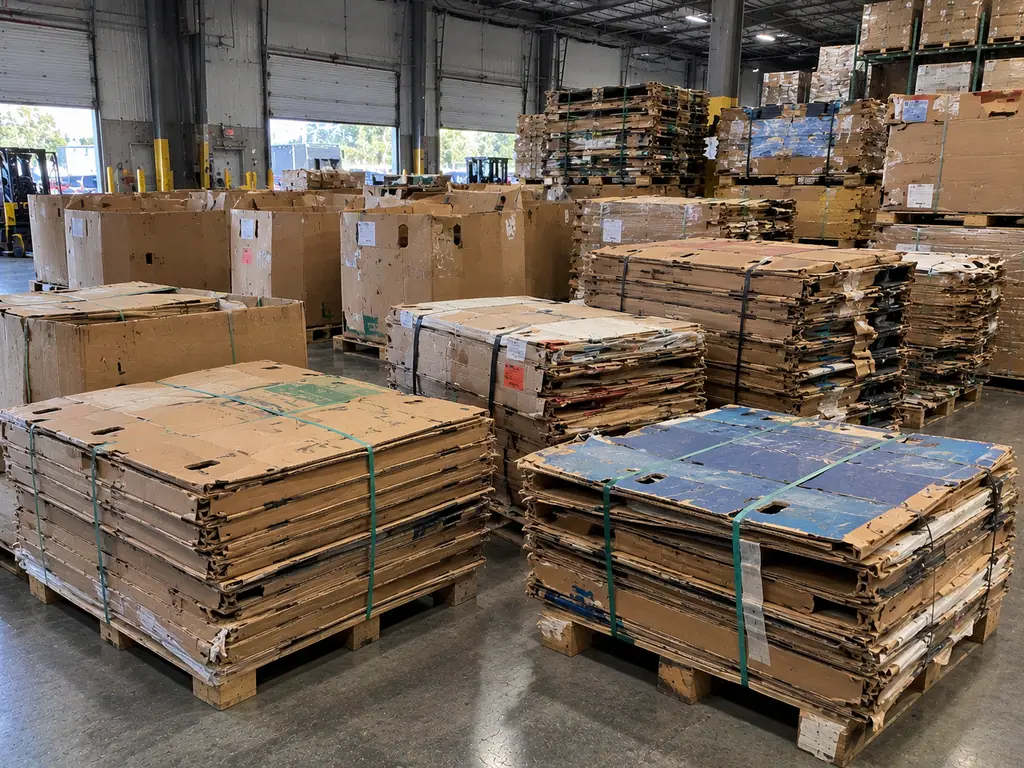
Warehouse floor with pallets of knocked-down gaylord boxes, racking and a forkliftUsed stock
Used containers on pallets, sorted and waiting to be graded.

This market has a calendar

Used bulk packaging is a recovered commodity, which means supply depends on what other industries are doing rather than on what manufacturers decide to produce. The result is a market with a strong and fairly predictable annual rhythm, and most buyers are completely unaware of it.

What follows is a general pattern. Regional detail varies — a Florida produce pattern is not an Ohio automotive pattern — but the shape tends to repeat.

January to March: the buyer's window

Retail peak has ended, distribution centres are unwinding, and an enormous quantity of empties hits the market at exactly the moment demand is at its annual low. Supply is high, quality is good because much of it only did one trip, and prices are softest.

If your purchasing is at all flexible, this is often a good time to buy a year's reusable pool, because demand is usually softer.

April to June: the slow climb

Spring brings early produce in the south, construction and landscaping ramping up, and the first serious demand for triple wall. Supply thins as the January glut is absorbed. Pricing firms gradually and lead times stretch from days into a week.

This is often a good window for trimming or repair work, before harvest season fills suppliers' schedules.

July to October: harvest and scarcity

Produce season is the hardest period to buy in and the best period to sell in. Packing houses need every tall triple-wall container they can find, often at twenty-four hours' notice, and they will pay for it. Supply of good 40 and 44 inch stock effectively disappears in September.

If you are holding empties, this is often when they are worth the most. If you need to buy, ask about availability in June rather than calling in September, because this demand peak is predictable.

November to December: the squeeze and the flood

Retail peak consumes containers through November, then releases a flood of them in the last ten days of December as distribution centres clear floor space before year end. Prices fall sharply in that window, but freight capacity is tight and expensive, which eats much of the gain.

The buyers who do best here are the ones who can take a truckload on short notice and have somewhere dry to put it.

How to use the calendar

Three practical moves follow from all of this, and none of them requires forecasting skill.

  • Shift your annual reusable-pool purchase into February where storage allows.
  • Sell accumulated empties in August and September, when demand peaks and haul economics are best.
  • Reserve harvest-season inventory in June rather than bidding for it in September.

The honest caveat

Freight runs on its own cycle and can easily overwhelm the commodity swing. A container that is cheaper in February is not a saving if freight costs more because carriers are repositioning. Always compare landed cost, and ask for freight as a separate visible line rather than buried in the unit price.

Takeaway: Buy in late winter, sell empties in autumn, and never source tall triple wall in September.
Newer postHumidity, Gulf Warehouses and the Strength You Quietly LoseOlder postA Dock Manager's Guide to Receiving Used Bulk Containers
Reference

The tables this post refers to

Construction reference for the figures discussed above.

Construction, thickness and typical working capacity
ConstructionThicknessTypical max weightStackingTypical use
Single wall C5/32" (4.0 mm)65 lbNot for bulkLids, layer pads, dividers
Double wall BC9/32" (7.1 mm)900 – 1,200 lb1 high loadedGeneral bulk under 1,200 lb
Double wall CC5/16" (7.9 mm)1,000 – 1,300 lb1 high loadedSlightly better cushioning than BC
Triple wall BCC7/16" (11.1 mm)2,200 – 2,500 lb2 high loadedThe bulk workhorse
Triple wall ACC1/2" (12.7 mm)2,400 – 2,700 lb2 high loadedDense product with cushioning need
Five wall AAC5/8" (15.9 mm)3,000 lb+3 high, matched palletsCastings, stampings, export
FAQ

Common questions on this subject

Short answers to common questions. If yours is not covered, ask it on the form and a partner supplier in our network can answer it with your quote.

All 33 answers
How much do used gaylords cost?
Pricing is set by the partner supplier who quotes your request. Grade, wall count, height, quantity and freight all move the number, and freight is usually the biggest variable, so ask for it as a separate line.
Can you match a competitor's price?
Pricing is set by the partner supplier who quotes your request. When comparing quotes, check that both are graded per unit, both include freight, and both are quoting the same wall count: those three differences explain most gaps.
What exactly is a gaylord box?
A bulk corrugated container sized to a pallet footprint, usually 48×40 inches, built from two to five layers of corrugated board and handled by forklift. The name comes from the Gaylord Container Company; it is now a generic industry term.
Are used gaylord boxes strong enough?
For most applications, yes, provided they are graded properly. Corrugated loses much of its strength on its first compression cycle and much less on later trips. Ask the supplier to state wall count, flute and grade on the quote so you can check it against your load.
What is the minimum order?
It depends on the partner supplier. Used gaylords are usually sold by the banded bundle or the truckload. Put the quantity you need on the form and the supplier will tell you what they can do.
Can I sell my used boxes?
Often, yes. Send photographs and a count through the form. A partner supplier who buys used containers reviews them and, if the numbers work, makes an offer and arranges collection.
Next step

Apply it to your actual containers

One free, no-obligation request. A partner supplier in our network follows up with grade, flute, height and freight.