Market · September 17, 2024 · 7 min read

Reading the OCC Index Without Getting Fooled

Recovered corrugated has a published price, a seasonal rhythm and a contamination penalty. Most generators never see any of the three.

At a glance
Quote request
Free, no obligation
Fulfilled by
Partner suppliers
Requests from
Across the US
Pricing
By written quote
Request a quote

Put this to work on your load

Free and no obligation. The form notes which page you were reading, and a partner supplier in our network follows up.

US or Canada numbers only

US ZIP code or Canadian postal code

✳ required. Every field is checked before sending so genuine requests never sit behind spam. Your details are shared with partner suppliers in our network to prepare this quote. See the privacy policy.
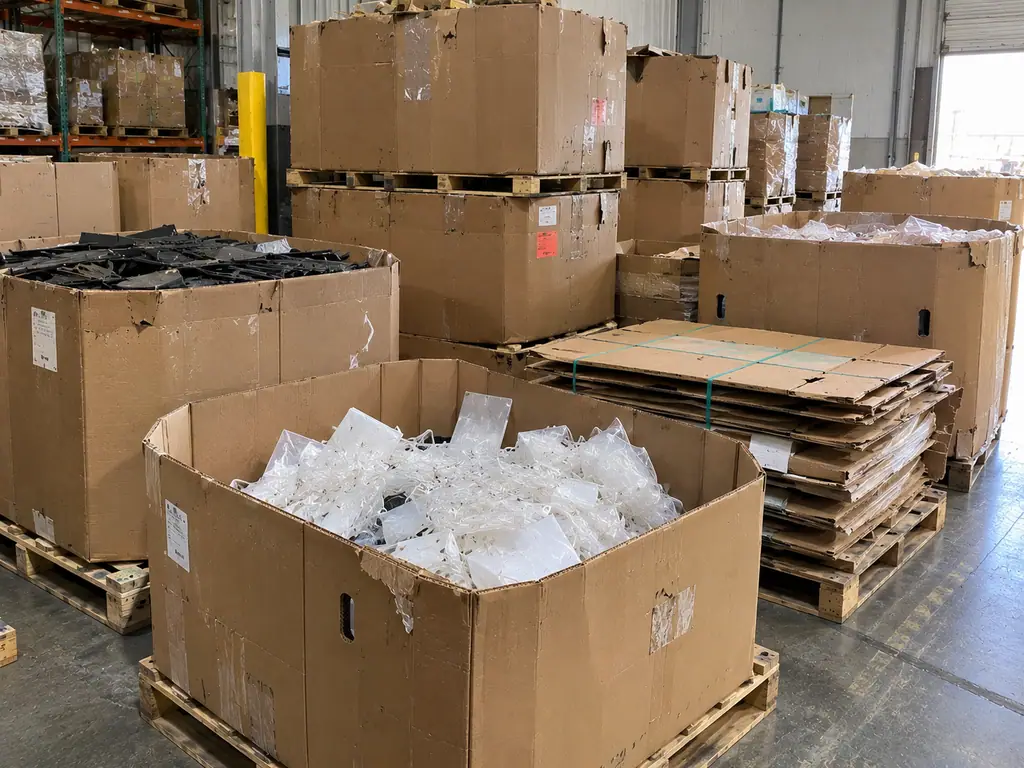
Bulk containers filled with lined plastic components beside stacks of flattened boardIn service
Lined containers in service on a 48×40 footprint.

There is a published price

Recovered paper grades trade on regional indices published monthly. Old Corrugated Containers — grade 11 in the standard specifications — is the most liquid of them. Your bales have a reference price whether or not anyone has mentioned it to you.

This matters because a great many disposal arrangements are priced as a service rather than as a sale. The material is worth money; the question is who captures it.

The question to ask

Ask two things of whoever takes your fiber: which index do you price against, and what is your discount to that index? A clear answer — for example, a named regional index less a stated per-ton processing charge — is a straightforward commercial relationship.

An answer that avoids the index entirely usually means the arrangement is priced against your lack of information rather than against the market.

Seasonality, briefly

Generation surges after retail peak and falls in late summer, while mill demand runs on its own cycle driven by containerboard production and export flows. The practical consequence for a plant generating twenty tons a month is that a fixed annual price is usually worse on average than an index-linked one.

It is less volatile, which has real value to a budget holder. Just be clear that you are paying for the smoothing.

Contamination is where the money leaks

Four things move bales down a grade, and three of them are decided on your dock rather than at the mill.

  • Wax-coated board. A separate and far cheaper grade — keep it out entirely.
  • Plastic film and liners left inside containers. A very common downgrade, and the easiest to fix.
  • Excess moisture. You are selling water, at a penalty.
  • Foreign material: banding, pallet fragments, product residue, occasional forklift damage to the bale itself.

Baled versus loose

A trailer of loose corrugated carries a fraction of the tonnage of a baled trailer, so freight per ton on loose material is punishing. Above roughly fifteen tons a month, a baler typically pays back within a year.

A baler is worth sizing carefully against your actual volume before you buy one. Gaylord Boxes does not sell balers.

The thing worth remembering

Recycling is the fourth-best thing to do with a bulk container, after reuse, reconditioning and repurposing. Before optimising your bale price, check how much of what you are baling could have been sold as containers instead — that gap is usually worth ten to twenty times the index.

Takeaway: Ask your hauler which index they price against and what their discount to it is. The answer is revealing.
Newer postOctabins Versus Square Gaylords for Free-Flowing SolidsOlder postHarvest Season: Produce Gaylords From Field to Cooler
Reference

The tables this post refers to

Construction reference for the figures discussed above.

Construction, thickness and typical working capacity
ConstructionThicknessTypical max weightStackingTypical use
Single wall C5/32" (4.0 mm)65 lbNot for bulkLids, layer pads, dividers
Double wall BC9/32" (7.1 mm)900 – 1,200 lb1 high loadedGeneral bulk under 1,200 lb
Double wall CC5/16" (7.9 mm)1,000 – 1,300 lb1 high loadedSlightly better cushioning than BC
Triple wall BCC7/16" (11.1 mm)2,200 – 2,500 lb2 high loadedThe bulk workhorse
Triple wall ACC1/2" (12.7 mm)2,400 – 2,700 lb2 high loadedDense product with cushioning need
Five wall AAC5/8" (15.9 mm)3,000 lb+3 high, matched palletsCastings, stampings, export
FAQ

Common questions on this subject

Short answers to common questions. If yours is not covered, ask it on the form and a partner supplier in our network can answer it with your quote.

All 33 answers
How much do used gaylords cost?
Pricing is set by the partner supplier who quotes your request. Grade, wall count, height, quantity and freight all move the number, and freight is usually the biggest variable, so ask for it as a separate line.
What happens to boxes that fail grading?
Boxes that cannot be reused are usually baled and recycled as Old Corrugated Containers (OCC), which is one of the most widely recycled packaging materials.
Can you match a competitor's price?
Pricing is set by the partner supplier who quotes your request. When comparing quotes, check that both are graded per unit, both include freight, and both are quoting the same wall count: those three differences explain most gaps.
What about confidential printing on our boxes?
Mention it on the form. Options include covering old marks, cutting the printed panel away, or sending the unit straight to recycling. The supplier handling your load will confirm what they can do.
How long will containers last in outdoor storage?
Not long. Corrugated has almost no wet strength; one serious rain event can turn sellable stock into recycling. If you have no indoor space, schedule collections more often instead.
Next step

Apply it to your actual containers

One free, no-obligation request. A partner supplier in our network follows up with grade, flute, height and freight.