Industry · August 27, 2024 · 8 min read

Harvest Season: Produce Gaylords From Field to Cooler

Eight weeks of the year decide the whole packaging budget for a packing house. Here is how the good ones plan it.

At a glance
Quote request
Free, no obligation
Fulfilled by
Partner suppliers
Requests from
Across the US
Pricing
By written quote
Request a quote

Put this to work on your load

Free and no obligation. The form notes which page you were reading, and a partner supplier in our network follows up.

US or Canada numbers only

US ZIP code or Canadian postal code

✳ required. Every field is checked before sending so genuine requests never sit behind spam. Your details are shared with partner suppliers in our network to prepare this quote. See the privacy policy.
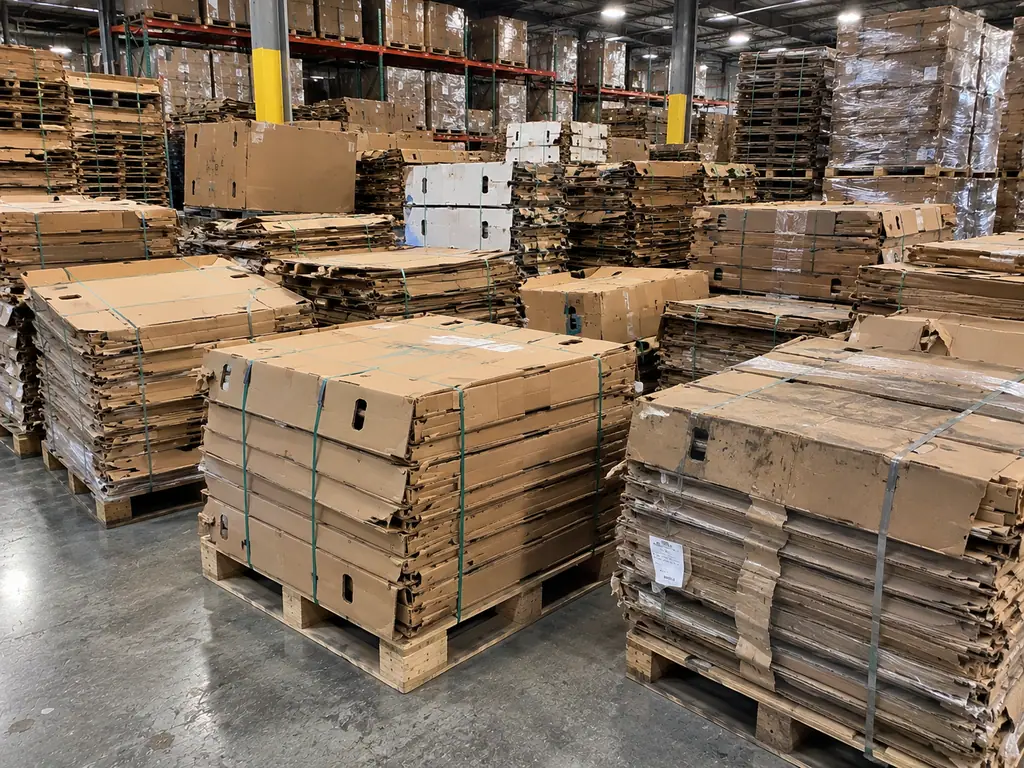
Warehouse aisles filled with banded pallets of knocked-down corrugated bulk boxesBundles
Banded bundles of knocked-down containers sorted by footprint and height.

The compression of the season

A packing house might move most of its annual volume in a few weeks. Every packaging decision is therefore made under time pressure, in a market where everyone else is making the same decision in the same fortnight.

The plants that handle it well are not the ones with the best purchasing. They are the ones that made their decisions in June.

What produce does to a container

Field heat, moisture, and repeated handling between the field, the cooler and the line. Containers get wet from condensation in the cooler, loaded above their rated weight when a crew is moving fast, and dropped by a tired forklift operator at the end of a long shift.

Which is why the typical produce specification is a 40 or 44 inch triple-wall 48×40, Grade B rather than A, with corner protection, bought in volume and expected to deliver three or four trips rather than nine.

Height is the whole conversation

Forty-four inch containers hold meaningfully more fruit per footprint, which matters enormously when cooler space is the binding constraint. They also fail at the top edge more often, because reaching over the lip is how crews load them.

Many produce users land on 40 inches as the compromise: most of the volume benefit, noticeably less top-edge damage, and a height that still fits a standard cooler rack with clearance for the forklift.

Planning the season in June

Supply of good tall triple wall effectively disappears in September. Not expensive — absent. The entire southeastern market is competing for the same recovered stock at the same moment.

  • June: confirm volumes against last season's actuals, not against the plan that was written in January.
  • June: ask about availability for the season ahead.
  • July: take delivery of the first third and inspect it. Finding a problem in July is fixable; finding it in September is not.
  • August: confirm dock windows and freight. Carrier capacity tightens alongside everything else.
  • October: arrange collection of empties while they are still worth the most.

The empties are worth more than people think

At the end of a season a packing house has a yard full of containers that did two or three trips and are still perfectly serviceable. Historically, many of those went to a baler or, worse, sat outdoors until spring rain finished them.

Autumn is often the peak of the resale market. Sound 40-inch triple-wall units sold then rather than baled months later can be worth a lot more, and it requires little except covering them and requesting a quote.

The storage mistake

If you remember one thing: do not leave collapsed containers outdoors over winter. Corrugated has essentially no wet strength, and one serious rain event converts a sellable asset into fiber worth a fraction of its value.

Indoors, off the floor, flat, scores aligned. Or arrange collection and let the value leave on a truck instead of into the ground.

Takeaway: Reserve harvest inventory in June. In September there is nothing left to reserve.
Newer postReading the OCC Index Without Getting FooledOlder postResin Pellets, Static and the Antistatic Liner Question
Reference

The tables this post refers to

Construction reference for the figures discussed above.

Construction, thickness and typical working capacity
ConstructionThicknessTypical max weightStackingTypical use
Single wall C5/32" (4.0 mm)65 lbNot for bulkLids, layer pads, dividers
Double wall BC9/32" (7.1 mm)900 – 1,200 lb1 high loadedGeneral bulk under 1,200 lb
Double wall CC5/16" (7.9 mm)1,000 – 1,300 lb1 high loadedSlightly better cushioning than BC
Triple wall BCC7/16" (11.1 mm)2,200 – 2,500 lb2 high loadedThe bulk workhorse
Triple wall ACC1/2" (12.7 mm)2,400 – 2,700 lb2 high loadedDense product with cushioning need
Five wall AAC5/8" (15.9 mm)3,000 lb+3 high, matched palletsCastings, stampings, export
FAQ

Common questions on this subject

Short answers to common questions. If yours is not covered, ask it on the form and a partner supplier in our network can answer it with your quote.

All 33 answers
What exactly is a gaylord box?
A bulk corrugated container sized to a pallet footprint, usually 48×40 inches, built from two to five layers of corrugated board and handled by forklift. The name comes from the Gaylord Container Company; it is now a generic industry term.
Are used gaylord boxes strong enough?
For most applications, yes, provided they are graded properly. Corrugated loses much of its strength on its first compression cycle and much less on later trips. Ask the supplier to state wall count, flute and grade on the quote so you can check it against your load.
How much do used gaylords cost?
Pricing is set by the partner supplier who quotes your request. Grade, wall count, height, quantity and freight all move the number, and freight is usually the biggest variable, so ask for it as a separate line.
What is the minimum order?
It depends on the partner supplier. Used gaylords are usually sold by the banded bundle or the truckload. Put the quantity you need on the form and the supplier will tell you what they can do.
Can I sell my used boxes?
Often, yes. Send photographs and a count through the form. A partner supplier who buys used containers reviews them and, if the numbers work, makes an offer and arranges collection.
Can used containers be used for food?
It depends on your process and your requirements. With food, a liner is the contact surface, and container origin matters. Check current regulations and your customer's specification, and say what you need on the form.
Next step

Apply it to your actual containers

One free, no-obligation request. A partner supplier in our network follows up with grade, flute, height and freight.