Technical · October 15, 2024 · 7 min read

Octabins Versus Square Gaylords for Free-Flowing Solids

Eight sides distribute hoop stress differently to four. Here is where that matters, and where it is just a more expensive box.

At a glance
Quote request
Free, no obligation
Fulfilled by
Partner suppliers
Requests from
Across the US
Pricing
By written quote
Request a quote

Put this to work on your load

Free and no obligation. The form notes which page you were reading, and a partner supplier in our network follows up.

US or Canada numbers only

US ZIP code or Canadian postal code

✳ required. Every field is checked before sending so genuine requests never sit behind spam. Your details are shared with partner suppliers in our network to prepare this quote. See the privacy policy.
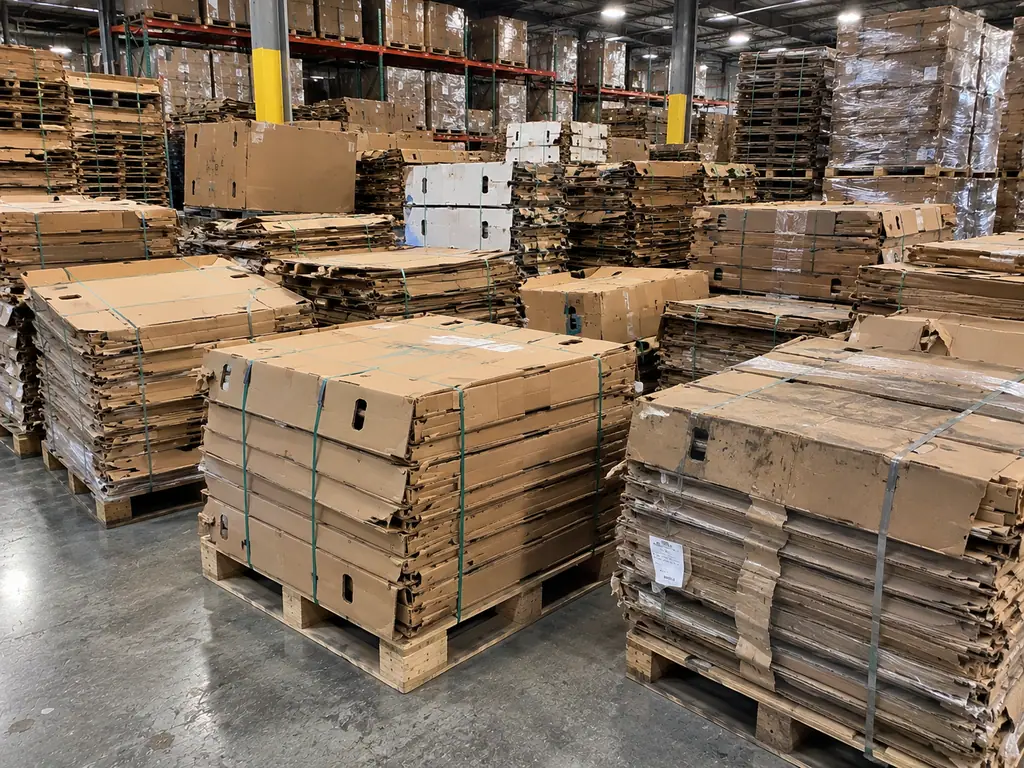
Warehouse aisles filled with banded pallets of knocked-down corrugated bulk boxesBundles
Banded bundles of knocked-down containers sorted by footprint and height.

What free-flowing product does to a container

A solid block of product sits in a container. A free-flowing one pushes against it. Pellets, grain, powders and granules behave partly like a fluid, exerting outward pressure on the walls that increases with depth and density.

In a square container, that outward pressure concentrates at four ninety-degree corners. The corner is a stress riser: it wants to open, and the panels either side of it bow outward, which in turn pulls the corner further open.

Why eight sides help

An octagonal container converts four ninety-degree corners into eight 135-degree ones. A shallower angle means less concentrated stress and a shape closer to the cylinder that the physics actually wants.

The practical result is that octabins hold significantly more free-flowing weight for the same board construction, and keep their shape through repeated fills in a way square containers do not. Resin producers standardised on them for a reason.

Where it genuinely matters

The premium is real — typically a third to double the price of an equivalent square container with frames — so it should be spent deliberately.

  • Dense free-flowing product above about 35 lb/ft³: resin, grain, minerals, nuts.
  • Repeated fill cycles in a reusable pool, where square containers go out of square progressively.
  • Discharge through a chute, where shape retention determines whether the flow bridges.
  • Anything where the container is lifted or tipped while full.

Where a square container is the better buy

Light bulky product — textiles, foam, film, returns — exerts almost no outward pressure, so the geometry advantage is irrelevant and you are paying for nothing.

Bagged or boxed contents inside the bulk container are similarly indifferent. And any application where the footprint must match a square pallet exactly, with no wasted deck, favours the square unit.

Frames, lids and the matched-set problem

Octabins ship as a system: body, top frame, bottom frame, lid, liner. Mixed sets are a common problem in used octabin inventory, because the parts separate during handling and nobody tracks them.

If you are buying used octabins from anyone, ask specifically how they handle frame matching and liner compatibility — a cheap price on bodies alone is not a cheap price.

Round bins, briefly

Fully round fiber bins exist and perform better again on hoop stress, at the cost of wasting footprint on a square pallet. They find their niche in cold-chain produce where corner crush is the dominant failure mode and the lost deck area is an acceptable trade.

For most applications an octabin is the right compromise between the physics and the pallet.

Takeaway: If the product pours and the density is above about 35 lb/ft³, the eight sides earn their premium.
Newer postForklift Damage Patterns and What They Tell YouOlder postReading the OCC Index Without Getting Fooled
Reference

The tables this post refers to

Construction reference for the figures discussed above.

Construction, thickness and typical working capacity
ConstructionThicknessTypical max weightStackingTypical use
Single wall C5/32" (4.0 mm)65 lbNot for bulkLids, layer pads, dividers
Double wall BC9/32" (7.1 mm)900 – 1,200 lb1 high loadedGeneral bulk under 1,200 lb
Double wall CC5/16" (7.9 mm)1,000 – 1,300 lb1 high loadedSlightly better cushioning than BC
Triple wall BCC7/16" (11.1 mm)2,200 – 2,500 lb2 high loadedThe bulk workhorse
Triple wall ACC1/2" (12.7 mm)2,400 – 2,700 lb2 high loadedDense product with cushioning need
Five wall AAC5/8" (15.9 mm)3,000 lb+3 high, matched palletsCastings, stampings, export
FAQ

Common questions on this subject

Short answers to common questions. If yours is not covered, ask it on the form and a partner supplier in our network can answer it with your quote.

All 33 answers
Can used containers be used for food?
It depends on your process and your requirements. With food, a liner is the contact surface, and container origin matters. Check current regulations and your customer's specification, and say what you need on the form.
Are used containers safe for food handling?
The board is not the food-contact surface; a liner is. Whether a used container suits your food process depends on its history and your own requirements, so check current regulations and your customer's specification, and say so on the form.
What exactly is a gaylord box?
A bulk corrugated container sized to a pallet footprint, usually 48×40 inches, built from two to five layers of corrugated board and handled by forklift. The name comes from the Gaylord Container Company; it is now a generic industry term.
Are used gaylord boxes strong enough?
For most applications, yes, provided they are graded properly. Corrugated loses much of its strength on its first compression cycle and much less on later trips. Ask the supplier to state wall count, flute and grade on the quote so you can check it against your load.
How much do used gaylords cost?
Pricing is set by the partner supplier who quotes your request. Grade, wall count, height, quantity and freight all move the number, and freight is usually the biggest variable, so ask for it as a separate line.
What is the minimum order?
It depends on the partner supplier. Used gaylords are usually sold by the banded bundle or the truckload. Put the quantity you need on the form and the supplier will tell you what they can do.
Next step

Apply it to your actual containers

One free, no-obligation request. A partner supplier in our network follows up with grade, flute, height and freight.