Buying · February 8, 2024 · 8 min read

Buying Bulk Packaging Without a Packaging Engineer

Most plants do not employ one. Here is the decision sequence that gets you to a correct specification anyway, in about twenty minutes.

At a glance
Quote request
Free, no obligation
Fulfilled by
Partner suppliers
Requests from
Across the US
Pricing
By written quote
Request a quote

Put this to work on your load

Free and no obligation. The form notes which page you were reading, and a partner supplier in our network follows up.

US or Canada numbers only

US ZIP code or Canadian postal code

✳ required. Every field is checked before sending so genuine requests never sit behind spam. Your details are shared with partner suppliers in our network to prepare this quote. See the privacy policy.
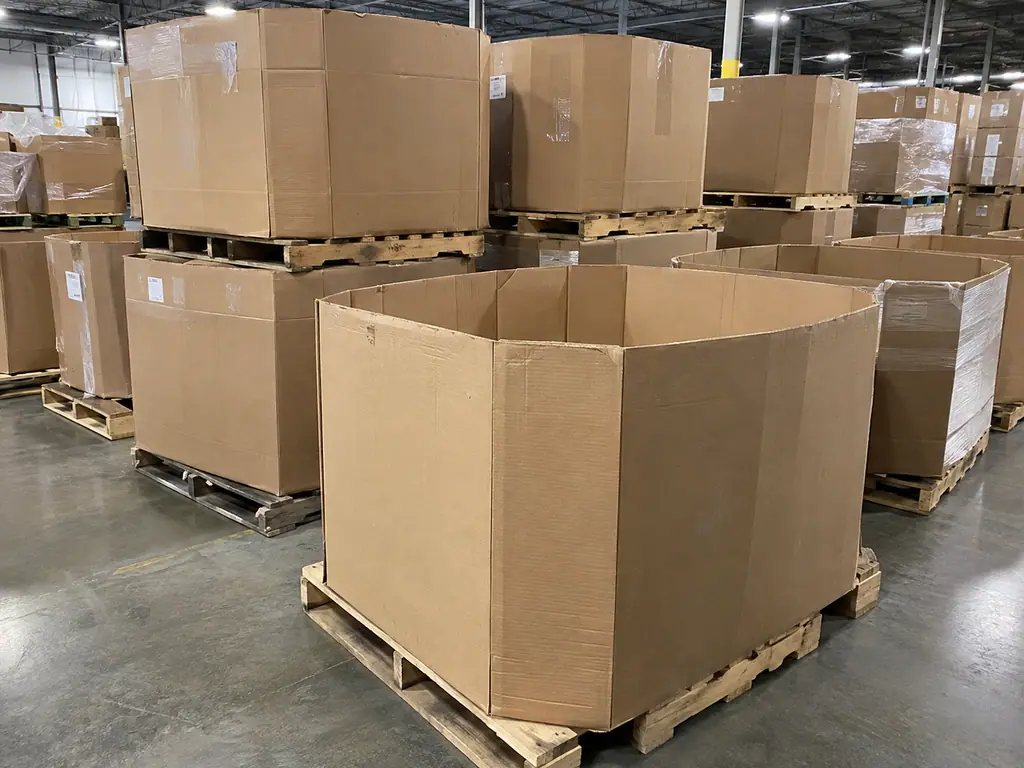
Assembled triple-wall gaylord boxes on wooden pallets inside a warehouseTriple wall
Assembled triple-wall gaylords on 48×40 pallets, staged indoors.

The gap this fills

Large manufacturers have packaging engineers. Everybody else has a purchasing manager with eleven other categories to cover, and a supplier who benefits from that asymmetry. The result is a market where a great many plants are buying the specification they inherited rather than the one they need.

You do not need an engineer to fix this. You need six answers, in a specific order, because each one constrains the next.

Question one: what does it weigh when full?

Not the product's unit weight — the loaded container weight at your actual fill level. Weigh one. This single number sets the construction: under about 1,200 pounds is double wall territory, above it is triple wall, and above 2,500 pounds or with dense sharp parts you are into five wall.

Plants are wrong about this more often than any other input, usually in the direction of overestimating. A careful weight check sometimes shows double wall is enough where triple wall was assumed.

Question two: what is the clear height under the rack beam?

Measure from the top of the beam the pallet sits on to the underside of the beam above. Subtract pallet height — five and a half inches for a standard GMA — and two inches of handling clearance. That is your maximum container height.

Then ask who loads it. If anyone hand-loads, the reach height of your shortest regular loader becomes the real constraint, and it is usually lower than the rack.

Question three: how many trips do you need?

A one-way shipping container and a container that will cycle twenty times through a reusable pool are different purchases. One trip means buy the cheapest sound grade available. Twenty trips means Grade A or B, corner protection as standard, and a reconditioning relationship.

This question also determines whether a regular collection or buy-back arrangement for empties makes sense, which can change the economics more than the unit price does.

Question four: what is the environment?

Relative humidity above seventy percent, cold-chain transitions, wash-down areas and outdoor staging all cost compression strength. Each of those is worth either a construction step up or a reduction in stack height.

A hygrometer on a rack upright for a month answers this properly, and it is inexpensive.

Question five: does anything rigid go inside?

A pallet, crate, drum or tote inside the container turns this into an inside-dimension problem. Triple-wall board takes roughly seven sixteenths of an inch off each pair of walls, so a 48×40 outside container gives about 47-1/8 by 39-1/8 inside.

Measure the rigid content, add half an inch of clearance per side, and compare against inside dimensions. Quotes that state only outside dimensions have caused more wasted deliveries than any other ambiguity in this trade.

Question six: what happens to it afterwards?

If the container leaves your site and never comes back, somebody is paying to dispose of it — and that somebody is quietly paying for your packaging twice. If it stays, where is it stored and who collapses it?

Answer this one honestly. Selling or recycling empties can turn out to be one of the larger savings in the whole exercise.

  • Loaded weight → construction
  • Clear rack height and reach height → container height
  • Trips needed → grade
  • Humidity and temperature → construction adjustment
  • Rigid contents → inside dimension check
  • End of life → resale, recycling or disposal cost

What to send a supplier

Those six answers in an email are a complete specification brief. Any competent supplier can quote precisely from them, and a supplier who asks for a discovery call instead of answering is managing you rather than specifying for you.

Takeaway: Six questions in the right order replace most of what a packaging engineer would ask you.
Newer postRunning a Reusable Pool of 400 GaylordsOlder postGaylords in Cold Storage: Condensation, Not Cold, Is the Enemy
Reference

The tables this post refers to

Construction reference for the figures discussed above.

Construction, thickness and typical working capacity
ConstructionThicknessTypical max weightStackingTypical use
Single wall C5/32" (4.0 mm)65 lbNot for bulkLids, layer pads, dividers
Double wall BC9/32" (7.1 mm)900 – 1,200 lb1 high loadedGeneral bulk under 1,200 lb
Double wall CC5/16" (7.9 mm)1,000 – 1,300 lb1 high loadedSlightly better cushioning than BC
Triple wall BCC7/16" (11.1 mm)2,200 – 2,500 lb2 high loadedThe bulk workhorse
Triple wall ACC1/2" (12.7 mm)2,400 – 2,700 lb2 high loadedDense product with cushioning need
Five wall AAC5/8" (15.9 mm)3,000 lb+3 high, matched palletsCastings, stampings, export
FAQ

Common questions on this subject

Short answers to common questions. If yours is not covered, ask it on the form and a partner supplier in our network can answer it with your quote.

All 33 answers
Can used containers be used for food?
It depends on your process and your requirements. With food, a liner is the contact surface, and container origin matters. Check current regulations and your customer's specification, and say what you need on the form.
Are used containers safe for food handling?
The board is not the food-contact surface; a liner is. Whether a used container suits your food process depends on its history and your own requirements, so check current regulations and your customer's specification, and say so on the form.
What exactly is a gaylord box?
A bulk corrugated container sized to a pallet footprint, usually 48×40 inches, built from two to five layers of corrugated board and handled by forklift. The name comes from the Gaylord Container Company; it is now a generic industry term.
Are used gaylord boxes strong enough?
For most applications, yes, provided they are graded properly. Corrugated loses much of its strength on its first compression cycle and much less on later trips. Ask the supplier to state wall count, flute and grade on the quote so you can check it against your load.
How much do used gaylords cost?
Pricing is set by the partner supplier who quotes your request. Grade, wall count, height, quantity and freight all move the number, and freight is usually the biggest variable, so ask for it as a separate line.
What is the minimum order?
It depends on the partner supplier. Used gaylords are usually sold by the banded bundle or the truckload. Put the quantity you need on the form and the supplier will tell you what they can do.
Next step

Apply it to your actual containers

One free, no-obligation request. A partner supplier in our network follows up with grade, flute, height and freight.