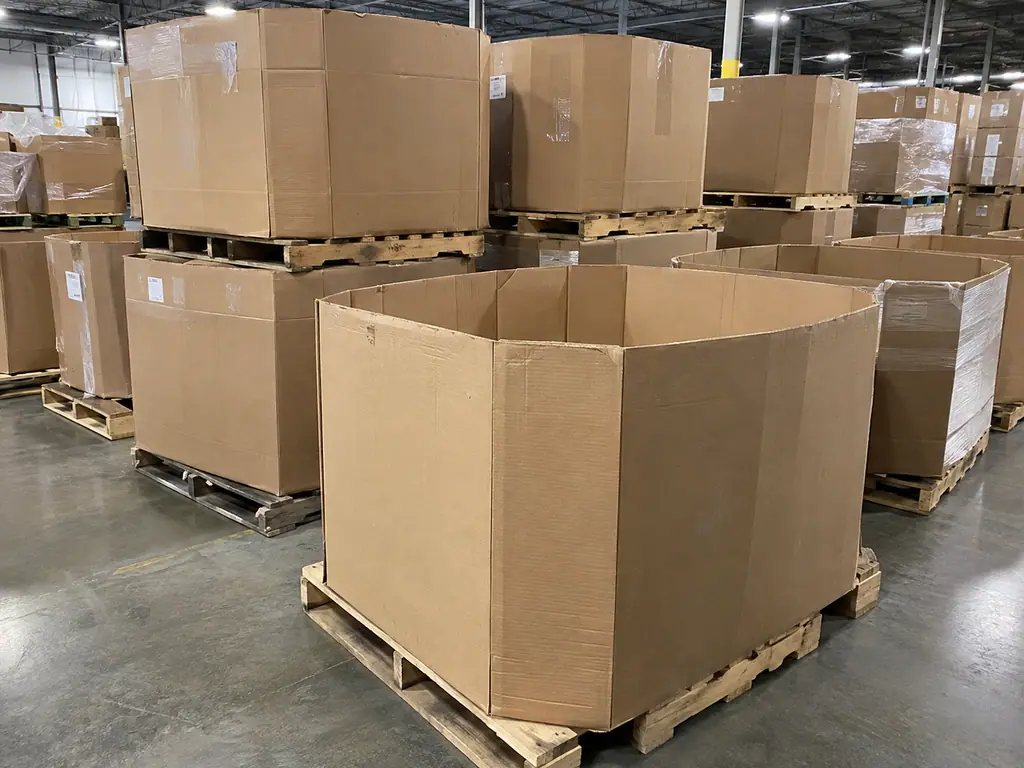
The load does not sit on the walls
It is intuitive to imagine a loaded gaylord resting on its flat panels, the weight spread evenly across four broad faces. That is not how corrugated behaves. Compression travels down the stiffest path available, and in a folded box the stiffest paths are the four vertical corners where two walls meet and the flutes of both panels resist crushing together.
Compression testing consistently shows that most of a container's stacking capacity sits in those four edges. The panels in between are, structurally speaking, mostly a way of keeping the corners a fixed distance apart and the product contained.
This single fact explains most bulk packaging advice. When a used container is graded, corner integrity is checked early, right after moisture and odor — not because it is the most visible defect, but because it is the one that decides whether the unit can be stacked.
Failure one: the strap cut
A very common kind of corner damage has nothing to do with weight. It is a polyester strap pulled over an unprotected vertical edge and tensioned. The strap concentrates a large force into a narrow line, crushing the flutes underneath it permanently.
The container looks fine. It stacks fine on day one. Weeks into storage, with humidity doing its work, the crushed section buckles and the whole stack leans. When a stack collapses for no obvious reason, strap damage at the corners is one of the first things worth checking.
The fix is cheap: a V-board corner protector under the strap. It is one of the best returns available in bulk packaging, and it is routinely skipped because the damage it prevents happens weeks after the strap goes on.
Failure two: the forklift kiss
Forklift contact rarely punches through a wall. What it does is shear the corner laterally, breaking the glue bond between liner and medium along a six-inch band. From the outside you see a scuff. Inside the board, the flute has separated from the facing and that section now carries nothing.
You can find this damage with a thumb. Press firmly at three heights on each vertical edge — knee, waist, shoulder. A sound corner resists uniformly. A delaminated one gives slightly and feels hollow, like pressing on a biscuit tin lid.
This test is worth teaching to anyone who inspects an incoming load. It takes seconds per container and it catches damage that photographs rarely show.
Failure three: overhang
If a 48×40 container sits on a 48×48 pallet, two of its corners have four inches of unsupported deck under them. The corner is now a cantilever carrying stack load with nothing beneath it. It will fail, and it will fail at the bottom score line where you cannot see it until you unload.
Footprint mismatch is the single most preventable cause of corner failure, and it happens constantly because pallets and boxes are usually bought by different people on different schedules. If you take one procurement change away from this article, make it this: specify the pallet and the box together, from the same quote.
Failure four: time
Corrugated loses compression strength under sustained load, and loses it faster in high humidity. A corner that holds a given weight on Monday is not rated for that weight a month later.
This is why sensible stacking guidance sounds conservative: two high loaded for triple wall, one high for double wall, six high nested empty. Rules of thumb like these build in time and humidity, which is precisely what laboratory figures do not.
- Storage over 30 days: divide laboratory compression by about four.
- Above 70% relative humidity: deduct a further 25–35%.
- Hand-loading or repeated forklift contact: deduct another 10–15%.
- Then stack to the result — not to what the corner bears on day one.
What to do tomorrow morning
Walk your storage area and look only at vertical edges. Ignore print, ignore scuffs on panels, ignore labels. If you find strap cuts, order corner boards today. If you find forklift shear, the problem is aisle width or operator training, not packaging. If you find overhang, fix the pallet spec.
Three of those four problems are free to fix. The fourth costs little per container and pays for itself the first time a stack does not fall over.