Operations · April 11, 2024 · 6 min read

Teaching Receiving to Knock Down a Box Correctly

The difference between a resellable container and a sheet of baled fiber is which line somebody folded it on.

At a glance
Quote request
Free, no obligation
Fulfilled by
Partner suppliers
Requests from
Across the US
Pricing
By written quote
Request a quote

Put this to work on your load

Free and no obligation. The form notes which page you were reading, and a partner supplier in our network follows up.

US or Canada numbers only

US ZIP code or Canadian postal code

✳ required. Every field is checked before sending so genuine requests never sit behind spam. Your details are shared with partner suppliers in our network to prepare this quote. See the privacy policy.
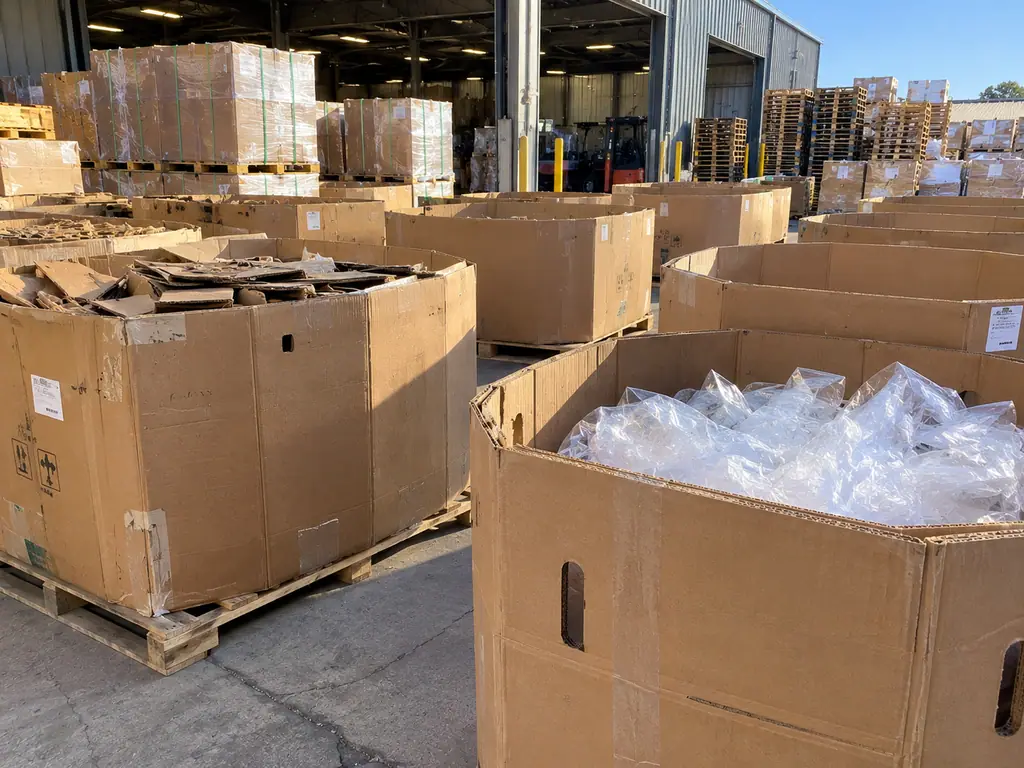
Bulk bins and gaylord boxes with liners on a loading dock, pallet stacks behindOn the dock
Lined bulk containers on a loading dock.

The ten-second decision

When a receiving associate empties a bulk container, they make a decision that determines whether it can be resold or only recycled. They almost never know they are making it.

Folded along its original score lines, a container stays a container: scores intact, corners square, ready to be re-erected and sold. Folded across a vertical corner — which is the natural thing to do if nobody has said otherwise — the corner delaminates and the unit is fiber.

What to actually teach

The instruction is short enough to put on a laminated card at the unload station, which is a good idea.

  • Open all four top flaps fully outward.
  • Find the four vertical score lines at the corners — run a thumb down each one.
  • Push two opposite walls inward along those scores so the container folds flat like a paper bag.
  • Never fold across a corner, and never step on a folded stack to flatten it further.
  • Stack flat, scores aligned, in one place. Maximum stack height about sixty inches.

Why it does not stick the first time

The behaviour fails for a predictable reason: the person doing it gets no feedback. The container leaves, somebody else deals with it, and nothing in their day changes based on whether they did it right.

The fix is to close that loop. Tell the team what the collapsed containers are worth and what happened to the money — whether that is a rebate, a credit against the next purchase, or a line on a diversion report they actually see. A single conversation about the value of an empty can change receiving behaviour.

The storage half of the problem

Correctly collapsed containers stored badly are still ruined. Outdoors is the worst case — one rainstorm turns sellable material into damp fiber worth a fraction of that.

Indoors, off the floor, away from dock doors, stacked flat with the scores aligned. If indoor space genuinely does not exist, arrange more frequent collection instead; the freight cost of an extra pickup is far less than the value of a water-damaged stack.

What it is worth

A plant generating a steady stream of empties that flattens them carelessly may be losing real recoverable value every month, depending on construction and market.

That is the return on a laminated card and a ten-minute toolbox talk. There is no cheaper improvement available anywhere on a dock.

Takeaway: Collapse along the original score lines, never across a vertical corner. That is the entire lesson.
Newer postResin Pellets, Static and the Antistatic Liner QuestionOlder postRunning a Reusable Pool of 400 Gaylords
Reference

The tables this post refers to

Construction reference for the figures discussed above.

Construction, thickness and typical working capacity
ConstructionThicknessTypical max weightStackingTypical use
Single wall C5/32" (4.0 mm)65 lbNot for bulkLids, layer pads, dividers
Double wall BC9/32" (7.1 mm)900 – 1,200 lb1 high loadedGeneral bulk under 1,200 lb
Double wall CC5/16" (7.9 mm)1,000 – 1,300 lb1 high loadedSlightly better cushioning than BC
Triple wall BCC7/16" (11.1 mm)2,200 – 2,500 lb2 high loadedThe bulk workhorse
Triple wall ACC1/2" (12.7 mm)2,400 – 2,700 lb2 high loadedDense product with cushioning need
Five wall AAC5/8" (15.9 mm)3,000 lb+3 high, matched palletsCastings, stampings, export
FAQ

Common questions on this subject

Short answers to common questions. If yours is not covered, ask it on the form and a partner supplier in our network can answer it with your quote.

All 33 answers
What happens to boxes that fail grading?
Boxes that cannot be reused are usually baled and recycled as Old Corrugated Containers (OCC), which is one of the most widely recycled packaging materials.
How does selling empties work?
Send photographs and a count through the form. A partner supplier who buys used containers reviews them, makes an offer by grade and arranges collection if the numbers work. Small quantities may need to be combined with a nearby pickup.
What exactly is a gaylord box?
A bulk corrugated container sized to a pallet footprint, usually 48×40 inches, built from two to five layers of corrugated board and handled by forklift. The name comes from the Gaylord Container Company; it is now a generic industry term.
Are used gaylord boxes strong enough?
For most applications, yes, provided they are graded properly. Corrugated loses much of its strength on its first compression cycle and much less on later trips. Ask the supplier to state wall count, flute and grade on the quote so you can check it against your load.
How much do used gaylords cost?
Pricing is set by the partner supplier who quotes your request. Grade, wall count, height, quantity and freight all move the number, and freight is usually the biggest variable, so ask for it as a separate line.
What is the minimum order?
It depends on the partner supplier. Used gaylords are usually sold by the banded bundle or the truckload. Put the quantity you need on the form and the supplier will tell you what they can do.
Next step

Apply it to your actual containers

One free, no-obligation request. A partner supplier in our network follows up with grade, flute, height and freight.