Selling Guide · 6 min read

How to Sell Your Empty Gaylords

A dock-level playbook: photographing, counting, grading honestly and getting paid for material you were about to pay to remove.

At a glance
Quote request
Free, no obligation
Fulfilled by
Partner suppliers
Requests from
Across the US
Pricing
By written quote
Request a quote

Questions on this piece?

Send them with your request. The source page is attached automatically.

US or Canada numbers only

US ZIP code or Canadian postal code

✳ required. Every field is checked before sending so genuine requests never sit behind spam. Your details are shared with partner suppliers in our network to prepare this quote. See the privacy policy.
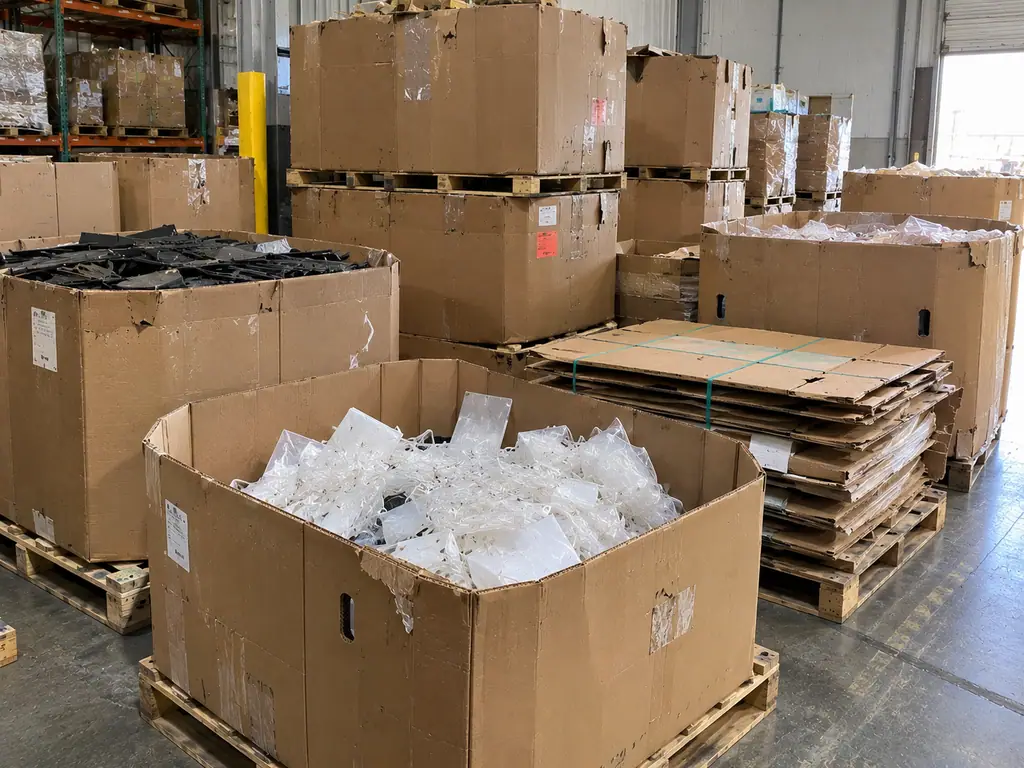
Bulk containers filled with lined plastic components beside stacks of flattened boardIn service
Lined containers in service on a 48×40 footprint.

Stop flattening them

A knocked-down gaylord with intact scores is still sellable. A gaylord flattened across the vertical corner is fiber. The single highest-value change most plants can make is instructing receiving to collapse along the original score lines and stack flat, not to fold boxes however they land.

Six photographs

Buyers quote from images. Send two wide shots of the stack, two close shots of vertical corners, one interior shot, and one shot showing stack height against a person or forklift for scale. That set answers most grading questions without a site visit.

Count and sort before you quote

Separate by footprint and wall count. A mixed pile quotes at the lowest common grade; two sorted stacks quote individually and often net more. Sorting a few dozen boxes is quick work.

Understand the freight math

Empty boxes are volume, not weight, so haul cost depends on how many you can load, not what they weigh. A trailer holds roughly 400–600 knocked-down triple-wall gaylords. Small quantities often need to be combined with a nearby pickup before collection makes sense.

Reference

The tables behind this guide

Construction limits and conversions: the working sheets that sit under the prose.

Construction, thickness and typical working capacity
ConstructionThicknessTypical max weightStackingTypical use
Single wall C5/32" (4.0 mm)65 lbNot for bulkLids, layer pads, dividers
Double wall BC9/32" (7.1 mm)900 – 1,200 lb1 high loadedGeneral bulk under 1,200 lb
Double wall CC5/16" (7.9 mm)1,000 – 1,300 lb1 high loadedSlightly better cushioning than BC
Triple wall BCC7/16" (11.1 mm)2,200 – 2,500 lb2 high loadedThe bulk workhorse
Triple wall ACC1/2" (12.7 mm)2,400 – 2,700 lb2 high loadedDense product with cushioning need
Five wall AAC5/8" (15.9 mm)3,000 lb+3 high, matched palletsCastings, stampings, export
Height selection on a 48 × 40 footprint
HeightCubeFitsBest forWatch for
28"25.9 ft³Low-clearance racking, pick facesDense product, ergonomic sortingDoubles your container count on light goods
36"33.3 ft³Most standard rackingThe default — best price and availabilityCheck reach height if hand-loaded
40"37.0 ft³Cooler racks, harvest linesProduce, bakery, mixed DCTop-edge wear climbs with reach
44"40.7 ft³Tall bays, textile sortingLight bulky goods — foam, film, apparelHand-loading above 44" is uncomfortable
48"44.4 ft³Dedicated tall programsVery light, very bulky loadsTriple wall only; never stack loaded
Quick conversions for bulk packaging
MeasureImperialMetricNotes
Standard footprint48 × 40 in1,219 × 1,016 mmThe GMA pallet that standardised US distribution.
Triple wall thickness7/16 in11.1 mmTakes about 7/8 in off interior width across both walls.
Typical capacity2,200 lb998 kgTriple wall BCC, evenly distributed, matched pallet.
Container cube at 36"33.3 ft³0.943 m³Outside dimensions, before board thickness.
OCC bale1,000 – 1,400 lb454 – 635 kgTypical bale from a horizontal baler.
Trailer capacity, knocked down400 – 600 units—53-foot dry van; cube limited, never weight limited.
Moisture ceiling for OCC12%12%Above this you are selling water at a penalty.
FAQ

Common questions on this subject

Short answers to common questions. If yours is not covered, ask it on the form and a partner supplier in our network can answer it with your quote.

All 33 answers
How does selling empties work?
Send photographs and a count through the form. A partner supplier who buys used containers reviews them, makes an offer by grade and arranges collection if the numbers work. Small quantities may need to be combined with a nearby pickup.
How long will containers last in outdoor storage?
Not long. Corrugated has almost no wet strength; one serious rain event can turn sellable stock into recycling. If you have no indoor space, schedule collections more often instead.
How do I reduce my packaging spend fastest?
Three moves, in order: buy used where it performs as well as new, measure your settled product height and drop unnecessary container height, and sell your empties instead of paying to have them removed.
Can I sell my used boxes?
Often, yes. Send photographs and a count through the form. A partner supplier who buys used containers reviews them and, if the numbers work, makes an offer and arranges collection.
How fast can I get containers?
Lead times are set by the partner supplier who quotes your request and depend on stock and distance. Put your deadline on the form so the supplier can tell you whether they can meet it.
How do I contact Gaylord Boxes?
Through the quote form. It goes to a partner supplier in our network, who follows up about your request.
Next step

Apply this to your load

One form and a free, no-obligation request. A partner supplier in our network follows up with grade, construction and freight.