Operations · August 12, 2025 · 6 min read

How to Store 600 Empty Gaylords Without Ruining Them

Empty containers are inventory, not waste — and they depreciate faster in a yard than almost anything else on your site.

At a glance
Quote request
Free, no obligation
Fulfilled by
Partner suppliers
Requests from
Across the US
Pricing
By written quote
Request a quote

Put this to work on your load

Free and no obligation. The form notes which page you were reading, and a partner supplier in our network follows up.

US or Canada numbers only

US ZIP code or Canadian postal code

✳ required. Every field is checked before sending so genuine requests never sit behind spam. Your details are shared with partner suppliers in our network to prepare this quote. See the privacy policy.
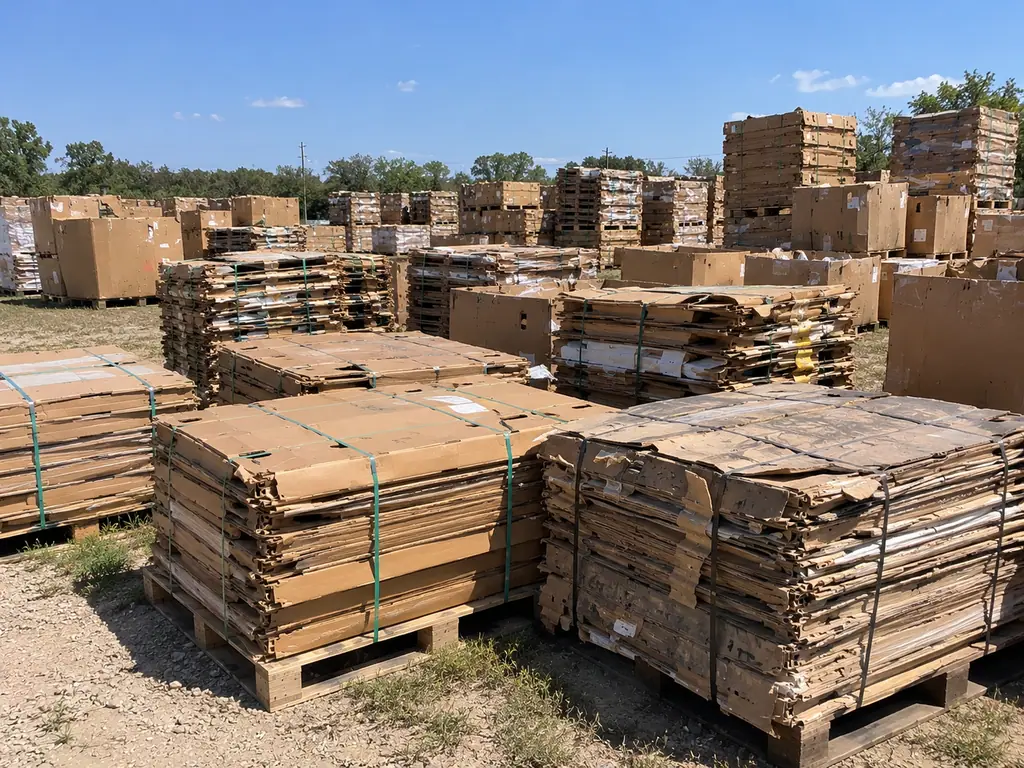
Outdoor storage area with banded pallets of flattened gaylord boxes under a blue skyStorage
Flattened containers on pallets outdoors. Corrugated has little wet strength, so cover it quickly.

The depreciation nobody books

Sound knocked-down triple-wall containers have real resale value. Left outdoors through one serious rain event, they are worth little more than wet fiber.

No other inventory on a typical site loses that much value that fast, and almost nobody treats it as inventory.

The four rules

All four are free. None requires a project or a capital request.

  • Indoors. If that is impossible, under a roof on a pallet with a weighted cover and the edges clear of standing water.
  • Flat, collapsed along the original score lines — never folded across a vertical corner.
  • Off the floor on a pallet or dunnage, because concrete wicks moisture even when it looks dry.
  • Scores aligned, stacks no higher than about sixty inches, away from dock doors and forklift traffic lanes.

Why stack height matters for empties

Flat-stacked corrugated above about sixty inches compresses the scores at the bottom of the stack. Those containers then will not re-erect square, which turns a Grade B unit into a Grade C one without anybody damaging anything.

Two shorter stacks are better than one tall one, and they are also easier to rotate oldest-first.

Rotation and the forgotten pile

Every site that stores empties eventually develops a forgotten pile in a corner: the units at the back that never move, slowly absorbing moisture from the wall behind them.

Mark the stack with the month it was created. Use the oldest first. If a stack has been there more than about six months, either sell it or acknowledge that you are storing fiber rather than containers.

When storage is the wrong answer

If your indoor space is genuinely full, more frequent collection beats worse storage every time. A partial collection costs freight; a ruined stack costs the whole asset value.

Regular scheduled collections help for this reason: empties never accumulate past the point where they have to go outside.

Takeaway: Indoors, flat, off the floor, scores aligned. One rainstorm is the difference between inventory and fiber.
Newer postDesigning a Dock for Bulk Packaging TurnaroundOlder postPallet Grades Explained: #1, #2 and Remanufactured
Reference

The tables this post refers to

Construction reference for the figures discussed above.

Construction, thickness and typical working capacity
ConstructionThicknessTypical max weightStackingTypical use
Single wall C5/32" (4.0 mm)65 lbNot for bulkLids, layer pads, dividers
Double wall BC9/32" (7.1 mm)900 – 1,200 lb1 high loadedGeneral bulk under 1,200 lb
Double wall CC5/16" (7.9 mm)1,000 – 1,300 lb1 high loadedSlightly better cushioning than BC
Triple wall BCC7/16" (11.1 mm)2,200 – 2,500 lb2 high loadedThe bulk workhorse
Triple wall ACC1/2" (12.7 mm)2,400 – 2,700 lb2 high loadedDense product with cushioning need
Five wall AAC5/8" (15.9 mm)3,000 lb+3 high, matched palletsCastings, stampings, export
FAQ

Common questions on this subject

Short answers to common questions. If yours is not covered, ask it on the form and a partner supplier in our network can answer it with your quote.

All 33 answers
What happens to boxes that fail grading?
Boxes that cannot be reused are usually baled and recycled as Old Corrugated Containers (OCC), which is one of the most widely recycled packaging materials.
How does selling empties work?
Send photographs and a count through the form. A partner supplier who buys used containers reviews them, makes an offer by grade and arranges collection if the numbers work. Small quantities may need to be combined with a nearby pickup.
How long will containers last in outdoor storage?
Not long. Corrugated has almost no wet strength; one serious rain event can turn sellable stock into recycling. If you have no indoor space, schedule collections more often instead.
Next step

Apply it to your actual containers

One free, no-obligation request. A partner supplier in our network follows up with grade, flute, height and freight.